Tampilkan postingan dengan label Doctor K. Tampilkan semua postingan

Minggu, 15 April 2012

This Year's Mets Have A 1984 Feel To Them

In 1984, the Mets were coming off one of the darkest eras in franchise history.  For seven straight seasons, the Mets finished at least 21 games under .500 and never finished higher than fifth place in the six-team NL East.  There were no expectations going into 1984 even though the team had a veteran leader in Keith Hernandez, a nice mix of homegrown talent (Darryl Strawberry, Hubie Brooks, Mookie Wilson, Wally Backman) and a new manager in Davey Johnson.

They also had a young pitcher named Dwight Gooden, who was given the ball despite having no experience in the major leagues.  Gooden went on to reward the Mets for showing their faith in him, making the All-Star team and becoming the fourth Met to win the Rookie of the Year Award.

After seven consecutive losing seasons, that combination of veteran leadership and youth, along with an intelligent manager, gave the Mets their first winning record since 1976 and only their second 90-win season in franchise history.

Fast forward nearly three decades to 2012.  The Mets have yet to record a winning season since moving to Citi Field in 2009.  In addition, although they did finish above .500 in each of their last three seasons at Shea Stadium, the 2006 to 2008 teams are most known for losing at the end of each campaign.  In essence, the team has "lost" for six straight seasons now.

But this year's Mets appear to be on the right track.  They have a young homegrown pitcher (Jonathon Niese) who was just given a vote of confidence by the Mets in the form of a five-year contract extension.  Just as Gooden rewarded the 1984 team when they had faith in him, Niese is doing the same for the 2012 club, winning his first two starts in dominant fashion (.156 batting average against, .178 slugging percentage against).

The 1984 Mets also had two veteran pitchers who performed very well for the team in Walt Terrell and Bruce Berenyi.  The two pitchers combined to go 20-18 with a 3.60 ERA.  Twenty-eight years later, the Mets have that same veteran presence in the rotation with Johan Santana and R.A. Dickey, who have both pitched exceptionally well during the first week and a half of the season.

Jesse Orosco (10-6, 31 saves, 2.59 ERA), Doug Sisk (15 saves, 2.05 ERA) and Tom Gorman (6-0, 2.97 ERA) were a formidable threesome in the bullpen in 1984, just as the trio of Frank Francisco, Jon Rauch and Bobby Parnell have been for the Mets in 2012 (the three have combined to post a 0.61 ERA and 0.68 WHIP).

As far as the offense goes, the 1984 Mets were fueled by a young power hitting rightfielder named Darryl Strawberry, who led the team with 26 home runs in his first full season in New York.  (The Straw Man was called up to the Mets in May 1983.)  The 2012 Mets also have a young power hitter in right field, Lucas Duda, who was called up for good during the 2011 season and is now leading the 2012 team in home runs.

Other young homegrown players who blossomed in 1984 were infielders Wally Backman and Hubie Brooks, as well as outfielder Mookie Wilson.  The 2012 team are succeeding with their own young homegrown players, such as infielders Ruben Tejada and Ike Davis, and outfielder Kirk Nieuwenhuis.

Hubie Brooks' breakout season in 1984 allowed the Mets to trade him for Gary Carter, who started the tenth inning rally in Game 6 that ended with Mookie Wilson's roller.  Ain't symmetry grand?


And of course, who could forget about Keith Hernandez?  The man who would eventually become the Mets' first team captain was entering his eighth full season in the major leagues at the age of 30 and was absolutely spectacular (.311, 31 doubles, 15 HR, 94 RBI, .409 OBP).  David Wright is now entering his eighth full season with the Mets.  Wright, who will turn 30 before year's end, is off to his best start, hitting an impressive .571 (12-for-21), while also reaching base at a .615 clip.  The unofficial team captain has also struck out only two times in 26 plate appearances, becoming one of team's best contact hitters nearly three decades after Hernandez was doing the same.

Finally, just as Davey Johnson had managed many of his players in the minor leagues before becoming the Mets' manager in 1984, Terry Collins also coached a number of players in the Mets' minor league system who he eventually managed in the major leagues.  This familiarity would lead to a comfort level between both managers and their players, leading to less friction and more production.

No one expected the 1984 Mets to be as good as they were.  But they won six of their first seven games en route to a surprise second-place finish in the National League East.  The same can be said for the Mets' expectations in 2012.  But after a 6-3 start, predictions of a last-place finish might have to be revised.

Big Brother was watching everyone in 1984.  Now the 1984 Mets might be serving as a big brother to the 2012 team, writing the script that the current team is following.  In the end, the 1984 team fell short of the playoffs, as might their 2012 counterparts.  But the 1984 Mets served as a springboard for what was to follow over the next few seasons.  Will the 2012 Mets do the same?  It wouldn't be surprising if they did.

Sabtu, 14 April 2012

R.A. Dickey Is Quietly All About Quality


Shhh.  Don't tell anyone.  But R.A. Dickey is quietly approaching a few Mets greats in the team's record books.

With last night's 5-2 victory over the Philadelphia Phillies, R.A. Dickey recorded his 14th consecutive quality start (minimum of six innings pitched with no more than three earned runs allowed), dating back to last year.  It is currently the longest such streak in baseball.

Over the streak, which began last July 25 in Cincinnati when Dickey allowed two earned runs in 6⅔ innings in a 4-2 victory over the Reds, Dickey has been phenomenal.  In those 14 starts, Dickey has posted a 2.40 ERA and 1.14 WHIP.  However, due to poor run support, he has only received credit for six victories during the skein.  How impressive is Dickey's quality start streak?  He's about to reach rarefied air with it.

In 1985, Dwight Gooden started his Cy Young campaign with 17 consecutive quality starts, a streak that ended on July 4 when he was pulled after 2
⅓ innings because of a rain delay (long-time Mets fans will remember that game as the Fireworks Night game in Atlanta).  Gooden also closed out the 1984 season with four consecutive quality starts, giving him a team-record 21 straight quality starts over the two seasons.

Tom Seaver holds the team record for most consecutive quality starts in one season.  From June 13 to September 13, 1973, Seaver recorded 19 straight quality starts.  Ironically, the streak could have ended on July 4, as Gooden's did 12 years later, when Seaver allowed five runs in 7⅓ innings against the Montreal Expos.  However, because of an error by shortstop Ted Martinez (who was filling in for the injured Bud Harrelson), two of the runs were unearned.  Therefore, Seaver's quality start streak was allowed to continue as he only allowed three earned runs in that Independence Day loss to the Expos.

Although Seaver's 19-game quality start streak in 1973 is the longest such streak for a Mets pitcher over one season, it wasn't the only time Seaver recorded 19 consecutive quality starts.  In 1971, a year in which Seaver was robbed of the Cy Young Award by the Cubs' Ferguson Jenkins - Seaver went 20-10 and led the league with a 1.76 ERA, 289 strikeouts and 0.945 WHIP, while Jenkins went 24-13 but had a 2.77 ERA and led the league in hits allowed (304) and home runs allowed (29) - Tom Terrific ended the season with 16 straight quality starts.  He also recorded quality starts in each of his first three appearances in 1972, giving him 19 quality starts in a row over two seasons.

Now R.A. Dickey is working on a quality start streak of his own.  After ending the 2011 season with 12 consecutive quality starts, he has begun the 2012 campaign with two more.  If this stretch of good pitching continues, he will reach legendary Mets pitchers Tom Seaver and Dwight Gooden by Memorial Day.

Tom Seaver.  Dwight Gooden.  R.A. Dickey.  Prior to last July, one of those names would not have belonged with the others.  But when it comes to quality starts, those three names might be forever linked together in Mets lore.  Not bad for a converted knuckleball pitcher who only had 18 career quality starts prior to becoming a Met.

Rabu, 04 April 2012

Song Parody: My Johan's Back

After being missing from the Citi Field mound for the past 19 months, Johan Santana will reprise his role as the Mets' ace on Opening Day against the Atlanta Braves.  It will be Santana's fourth Opening Day start for the Mets, making him the fourth pitcher in franchise history to be a four-time starter in the team's opener.  Only Tom Seaver (11 starts), Dwight Gooden (8 starts) and Tom Glavine (4 starts) have gotten the ball on Opening Day as many time as Santana.

But what's most important to the Mets is the fact that Johan Santana is starting any game for them.  Not since September 2, 2010 has Santana faced major league hitters in a regular season game, when he defeated the Braves, 4-2, in Atlanta.  This year, Santana is looking to continue his Opening Day success, as he won all three of his previous season openers for the Mets.

In honor of Santana making his (hopefully triumphant) return to the Mets, the crack staff at Studious Metsimus has concocted a song parody.  We figured a classic song should be rewritten to honor a classic pitcher such as Santana.  So let's stop with the chit-chat and start with the song!  Dedicated to Johan Santana, here is our version of the '60s standard, "My Boyfriend's Back", renamed in honor of the Mets' ace as "My Johan's Back".  Enjoy!  (...and take a listen to an updated version of the original song by Me First and the Gimme Gimmes after you read/sing our version.)


He went away
And we hung around, wanting him every fifth night
But now that his rehab’s through
His opponents will have to think twice

My Johan’s back and the hitters are in trouble
(Hey la, hey la, my Johan’s back)
They'll see his change-up and their bats will turn to rubble
(Hey la, hey la, my Johan’s back)
He’s before your eyes in orange and blue
(Hey la, hey la, my Johan’s back)
So look out now, Johan’s coming after you
(Hey la, hey la, my Johan’s back)

Hey, we know that he’s been tryin’
Now he’s back, there’s no denyin’

He’s been gone for such a long time
(Hey la, hey la, my Johan’s back)
Now he’s back and things will be fine
(Hey la, hey la, my Johan’s back)
The hitters are sorry they were ever born
(Hey la, hey la, my Johan’s back)
‘Cause his arm ain’t weak; it’s actually strong
(Hey la, hey la, my Johan’s back)

Philly’s ready for defeatin’
Marlins gonna get a beatin’
What made them think his career had all but died?
(Wah-ooo, wah-ooo)
Johan’s back right now and he’ll shut them out tonight
(Wah-ooo.  Wait and see!)

My Johan’s back; he's getting back his reputation
(Hey la, hey la, my Johan’s back)
The Nats and Braves are gonna get an education
(Hey la, hey la, my Johan’s back)

Hey, can you see Johan comin’?
Wow, his change-up is still stunnin’

Wah-ooo, wah-ooo.
Wah-ooo.  Wait and see!

My Johan’s back; he's getting back his reputation
(Hey la, hey la, my Johan’s back)
The NL East is gonna get an education
(Hey la, hey la, my boyfriend’s back)

Hey, my Johan’s back!  (Hey la!)
Hey, my Johan’s…
BACK!
(Wah-ooo…)


Minggu, 01 April 2012

Smells Like A Good Deal For Jonathon Niese!

It looks like our fav'rit homegrown lefty starter will be calling New York home for a very long time.  According to Adam Rubin, the Mets and Jonathon Niese will soon be shaking hands on a five-year deal worth approximately $28.5 million.  The deal would also call for two team options in 2017 and 2018, worth $11 million and $11.5 million, respectively.

Once the two sides have crossed their i's and dotted their t's (or is it the other way around), the deal will be made official.  It would be the first contract of more than two years signed by a Met under Sandy Alderson's watch and would also keep Niese in Flushing until he is in his 30s.

Keeping Niese into his 30s would give the Mets stability in the starting rotation.  But it would also give the team a chance to finally keep one of its homegrown players for the majority of his career.  With all the uncertainty surrounding David Wright and the possibility he will not be with the team in 2013, Niese could become the first homegrown player since Vance Wilson in 2003 to remain with the team until after his 30th birthday.

Even if Niese's club options for 2017 and 2018 aren't picked up, Niese has a good chance to establish himself as one of the top pitchers in franchise history.  That might seem like a stretch right now, but consider the following:

Jonathon Niese is currently tied for 43rd place on the Mets' all-time list with 22 victories.  Should he average only nine wins per year over the next five years, he would crack the top ten, surpassing Steve Trachsel, who is currently 10th on the Mets' all-time wins list with 66.  Despite spending time on the disabled list in 2010 and 2011, Niese reached the nine-win mark in both seasons.

With 315 strikeouts as a Met, Jonathon Niese is currently No. 39 on the team's all-time strikeout list.  Niese has averaged 143 strikeouts per season over the last two years, even with the time missed due to injuries.  If Niese were to average that amount over the duration of his contract (not including the option years), he would add 715 strikeouts to his career total, giving him 1,030 lifetime strikeouts.  Only seven pitchers in Mets history have reached that lofty total (Tom Seaver, Dwight Gooden, Jerry Koosman, Sid Fernandez, David Cone, Ron Darling, Al Leiter).

The Mets have had their share of excellent right-handed pitchers, such as the aforementioned Seaver, Gooden, Cone and Darling.  However, besides Koosman, Fernandez and Leiter, the only other left-handed pitcher in Mets' history to appear regularly on the club's all-time leaderboards is Jon Matlack.  (Johan Santana hasn't been healthy enough to appear on these lists and we're not discussing Tom Glavine here.)  By the end of his contract, we might be talking about Koosman, Fernandez, Leiter, Matlack and Niese as the top five left-handed starters in club history.  Who'da thunk it?

In giving Jonathon Niese a five-year deal, the Mets assured themselves of stability in their rotation through 2016.  But they may have also assured themselves of keeping a pitcher who could end up being mentioned in the same sentence as the team's all-time greats.

Seaver, Gooden, Koosman, Niese?  It's not as far-fetched as you think.

Selasa, 20 Maret 2012

Joey's Soapbox: What The Wilpons Should Do With Their Money


Over the past 24 hours, two seasons officially ended.  For those not involved in Ponzi schemes, winter turned to spring at 1:14 AM.  For those whose surname is Wilpon, your winter of discontent has also ended.  Now that the Mets’ owners and Irving Picard have settled for $162 million before the case went to trial, the focus can now shift completely to what’s happening on the field and not what could have happened off it.

But before we return to the action between the foul lines, I wanted to hop on my soapbox.  If I may, I’d like to share my thoughts with you on what I think the brothers-in-law Wilpon and Katz should do now that they won’t have to fork over $386 million to the Picard peeps.  Who knows?  Maybe they might actually listen to me this time.  Who am I?  I'm Joey Beartran, and I'm about to take you for a ride on my soapbox.


Sign a starting pitcher that can actually stay on the mound

In 2006, the Mets won 97 games.  They also used 13 starting pitchers, all of whom made at least three starts for the team.  Only Tom Glavine and Steve Trachsel were able to make more than 23 starts.  Of course, the Mets' lack of depth and health in the starting rotation caught up with them in the National League Championship Series, especially when both Pedro Martinez and Orlando "The Dookie" Hernandez couldn't pitch in the postseason due to injuries.

Two years later, the Mets traded for Johan Santana and gave him a six-year contract extension.  To date, Santana has given the Mets one DL-free season.  Looks like it's obvious here.  The Wilpons should use their money to sign a dependable starting pitcher that can actually stay on the mound.  The Phillies did it with Roy Halladay and Cliff Lee and they've been able to withstand all sorts of injuries to their everyday players.  The Mets should follow suit.  Or they should find a way to injure Roy Halladay and Cliff Lee.


How about a pitcher who can strike out a batter or ten?

In 1984, Dwight Gooden struck out 276 batters as a rookie, fanning ten or more batters in 15 of his 31 starts.  In 2011, a Mets' starting pitcher reached double digits in strikeouts in a single game twice.  That's two times in 162 games.  Only R.A. Dickey and Chris Capuano reached the level that Gooden reached regularly, and they were only able to do it once apiece.

Since 1992, the only Mets pitchers to strike out 200 or more batters in a single season have been Al Leiter (2000, 200 Ks), Pedro Martinez (2005, 208 Ks) and Johan Santana (2008, 206 Ks).  In each of the years they accomplished their hefty strikeout totals, the Mets finished with a winning record.  That's not a coincidence.

With Citi Field's fences moving in for the start of the 2012 season, it would behoove the Mets to find pitchers who can keep the ball in the ballpark.  Either that or they'll need pitchers with the ability to get opposing batters to hit the ball on the ground, preferably away from Daniel Murphy at second base.  Of course, we wouldn't even have to discuss this if the Mets had pitchers who could strike out a batter or ten.


Spend money on scouting and minor league development

Over the past decade, the only two pitching prospects to stick around have been Mike Pelfrey and Jonathon Niese.  Both players have losing records in the major leagues and neither has made the All-Star team.  In fact, other than Jose Reyes and David Wright, the last homegrown All-Star (regardless of whether he was a pitcher or everyday player) was Edgardo Alfonzo in 2000.  Who was the last homegrown All-Star pitcher?  You have to go back to 1997 and Bobby Jones.

Winning teams succeed with the right combination of veteran leadership and homegrown talent.  The Mets haven't been able to get this consistently right for over a decade.  A few extra bucks spent on their scouts and the development of players in the minor leagues should help the Mets in that regard.


Don't spend on a big-name free agent; spend on a big-name exorcist

On the night Citi Field hosted its first regular season game, a frisky feline darted onto the field and crept past David Wright, who was standing in the on-deck circle.  It was a scene reminiscent of the black cat that ran behind Cubs' third baseman Ron Santo at Shea Stadium in 1969.  Just as the black cat served as the superstitious impetus for the Cubs' demise, the Citi kitty might have done the same to the Mets.

I don't usually believe in curses or the supernatural, but surely a lower power must be involved in the Mets' misfortunes.  Therefore, instead of throwing cash at the next hot ticket free agent, why don't the Mets just hire the best exorcist money can buy?  Clearly, Fred Wilpon already used an exorcist on himself, as his head is no longer spinning due to the resolution of the Madoff mess.  Now it's time to use it on the team.  It might be our only hope.


Give Jeff Wilpon a makeover

New York is the media capital of the world.  Because of that, Jeff Wilpon has found himself in front of the TV cameras quite a bit over the years.  This would normally be a good thing for someone who bears a strong facial resemblance to a popular TV star, as Wilpon does.  However, when that popular television character is Alfalfa from The Little Rascals, it’s a sign that Little Jeffy needs a makeover.

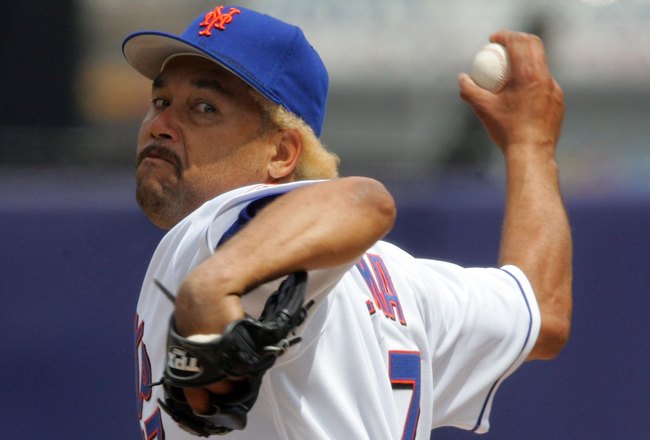
Perhaps a new hairstyle would work.  It doesn’t have to be outlandish like the blond curls sported by the late Jose Lima during his month-long stay in New York in 2006.  (If you don’t remember Lima ever being a Met, it’s probably because you were in an alcohol-induced stupor due to his constant poundings on the mound.)  All his new "do" must do is say “I want you to believe that I’m going to put the best team on the field” instead of “I want you to believe that Darla will one day fall in love with me”.  It’s time for Jeff Wilpon to change the way he looks.  Even Buckwheat would say “o-tay” to that.


Invest in antivenom

In last year’s infamous New Yorker interview, Fred Wilpon stated that Jose Reyes would never get Carl Crawford’s money.  He was right.  He also said that David Wright was a good, but not great player.  With Wright’s latest injury keeping him out of action, he may be right on that front, too.  Papa Smirk is definitely not a saint, but he might be a prophet.

Since everything Wilpon said in the article has come true, then we should also believe him when he says “we’re snakebit, baby!”  In that case, I’d like to make a suggestion to our fearless leader.  Snakes have venom.  Antivenom can combat snake bites.  You now have extra money that won’t be siphoned out of your Sandy Koufax piggy back.  Do the math.


As things stand now, even if the Mets improve upon last year’s 77-85 record, they might still finish in last place.  Every team in the National League East is better on paper.  The Nationals and Marlins, who finished in third and fifth place in the division last year, respectively, are exponentially better this year.  The Nationals added Gio Gonzalez and Edwin Jackson to their starting rotation (not to mention a healthy Stephen Strasburg) and will now have Brad Lidge closing games for them.  Meanwhile, the Marlins added Mark Buehrle to anchor their rotation and All-Star Heath Bell to seal the deal in the ninth inning.  The Braves have the best one-two punch in the bullpen in Jonny Venters and Craig Kimbrel, in addition to a solid starting rotation.  Even with an off-year by rightfielder Jason Heyward, the Braves still competed for a playoff spot until the last day of the season.  And the Phillies?  They’re pretty good.

The Mets have a long way to go if they want to be mentioned in the same sentence as the other teams in the division.  Right now, the only way the Mets could realistically compete in the National League East is if they faced Cole Hamels every day.  That’s about as likely as Shane Victorino learning how not to complain like a little … ahem … sorry,  I got carried away there.  It’s just that I’m very passionate about my team, and I want them to do well.

Surely, the team’s owners want the same thing for their team as I do.  Throwing money at the best available free agent just won’t cut it anymore.  Doing that just gets you Oliver Perez or Jason Bay.  Perhaps Los Wilpons will read this and get an idea or six.  My suggestions can’t hurt as much as the Wilpons have hurt the fan base over the past few years, right?


Sabtu, 17 Maret 2012

I Tawt I Taw A Tim Byrdak

For many years, Sylvester the Cat has been foiled by Tweety Bird.  Similarly, for many months, Mets fans with Twitter accounts were foiled by Tim Byrdak not having his own account.  But fear not, Mets fans.  Your fav'rit Hulkamaniac is no longer sans Twitter account.  You heard me right.

Sylvester never caught Tweety Bird.  But we have now caught Byrdak tweeting.

I tawt I taw T.B.!  But is it Tweety Bird, Terry Bollea or Tim Byrdak?


At Studious Metsimus, we want all of our readers to get the full Mets experience, so we encourage all of you to follow Tim Byrdak on Twitter, which you can do by clicking here.

Here is our first tweet to the Mets' lefty specialist, who is currently "specializing" in torn meniscus surgery rehabilitation.


Here's hoping that Tim Byrdak recovers from his surgery soon to become an important part of the Mets bullpen.  The sooner he comes back, the sooner we can relax knowing that the Mets will not try to make a trade for Oliver Perez to fill in for him as the team's lefty specialist.


To follow other past, present and future Mets on Twitter, please click on the following links:

R.A. Dickey: @RADickey43
Justin Turner: @redturn2
Johan Santana: @johansantana
Zack Wheeler: @wheelerpro45
Sandy Alderson: @MetsGM
Dwight Gooden: @DocGooden16
Chris Schwinden: @CSchwinny


Jumat, 16 Maret 2012

What Will The Mets Produce Next: A No-Hitter or A 20-Game Winner?


What do the Mets have a better chance of producing?  A no-hitter or a 20-game winner?  On the surface, the question appears to have a simple answer.

Considering that the Mets have had five different pitchers produce a total of eight 20-win seasons (Tom Seaver accomplished the feat four times, while Jerry Koosman, Dwight Gooden, David Cone and Frank Viola each did it once), yet they've never pitched a no-hitter, it would seem that the 20-game winner would be the obvious choice.

But what would appear to be the clear-cut favorite of two things sometimes isn't, as I'm sure fans of the 1988 Mets (boo, Dodgers) and 2006 Mets (boo, Cardinals) can attest.

The five pitchers who won 20 games in a single season for the Mets all experienced great success in the major leagues.  Tom Seaver won 311 games in the big leagues en route to receiving the highest percentage of votes of any Hall of Fame inductee.  Fellow 1969 World Series champion Jerry Koosman finished his career with 222 victories.  Dwight Gooden, David Cone and Frank Viola also had long and successful careers in the major leagues, with Gooden and Cone both winning 194 games and Viola finishing his career with 176 victories.

In addition, four of the five 20-game winners for the Mets also won the Cy Young Award at some point in their careers, with the lone exception being Jerry Koosman, who came tantalizingly close in 1976 when he finished second in the vote to Padres' pitcher (and future Met) Randy Jones.

Here's the kicker.  Although none of the five pitchers ever pitched a no-hitter while in a Mets uniform, three of them (Seaver, Gooden, Cone) accomplished the feat after leaving the Mets, and David Cone took it one step further, pitching a perfect game against the Montreal Expos in 1999 as a member of the New York Yankees.

Tom Seaver never did it as a Met.  Neither did Jerry Koosman, Dwight Gooden, David Cone or Frank Viola.  In fact, no Mets pitcher has ever pitched a no-hitter.  But dozens of Mets hurlers have tossed one-hitters, and not all of them were pitched by All-Stars or future Hall of Famers.  In fact, many of them were pitchers who didn't even win 100 games in the major leagues.

Of course, Tom Seaver leads the list of most one-hitters fired by Mets pitchers with five.  David Cone pitched two complete-game one-hitters as a Met and combined with Jeff Innis on a third.  Dwight Gooden pitched a one-hitter for the Mets during his rookie season, but never pitched another one in a Mets uniform.  Meanwhile, Jerry Koosman and Frank Viola never pitched a one-hitter for the Mets.
 
But Jack Hamilton did.  So did Terry Leach, Pete Schourek, Bobby Jones, Aaron Heilman, Jonathon Niese and R.A. Dickey.  What do all of those pitchers have in common?  None of them won 100 games over their major league careers.  Even Shawn Estes, who won four games as a Met, was able to pitch a one-hitter for the team.  (He could pitch a one-hitter, but he couldn't hit one pitcher.  Ah, the Roger Clemens jokes never get old, do they?)

Both Aaron Shawn Estes and George Thomas Seaver were known by their middle names and they both pitched one-hitters for the Mets.  But Seaver would've hit Roger Clemens if he had the chance.


Want some more?  Gary Gentry pitched two one-hitters as a Met, but only won 46 games in the majors.  John Maine also pitched two one-hitters in New York (with one being of the rain-shortened variety), yet he only won 41 games over his career (so far).  Even the underrated and never quite appreciated Steve Trachsel authored two one-hitters during the 2003 campaign.

A total of 35 one-hitters have been pitched in club annals.  More than half of them (18) have come after 1990.  Why is that year so important?  Because that was the last time the Mets had a 20-game winner.

Since Frank Viola's 20-win season in 1990, no Met pitcher has reached that level of pitching excellence.  In fact, the closest any pitcher has come was in 1998 when Al Leiter won 17 games for the Mets.

For a pitcher to win 20 games, he has to be consistently good over the course of an entire season.  It also helps to have a good bullpen.  Johan Santana went 16-7 for the 2008 Mets, but the bullpen blew seven games in which he left with the lead, costing him a potential 20-win season.  Meanwhile, to pitch a no-hitter, a pitcher only needs to have one game in which he harnesses all of his "stuff" against opposing hitters.

It's rare for a so-so pitcher to win 20 games.  None of the five pitchers who accomplished the feat for the Mets would be considered "so-so".  In fact, Seaver, Koosman, Gooden, Cone and Viola combined to make the All-Star team a total of 19 times as members of the Mets.

But considering how guys like Terry Leach, Pete Schourek and Aaron Heilman all came within one safety of becoming the first Met to pitch a no-hitter, it goes to show that players with nondescript careers can occasionally show flashes of brilliance.

All one needs to pitch a no-hitter is a nine-inning flash of brilliance.  For a pitcher to win 20 games in a season, he'll need a couple hundred innings of brilliance (and a good bullpen).  John Maine won only 39 games in five seasons as a Met, but came within one Paul Hoover dribbler of pitching a no-hitter.  Jonathon Niese has barely cracked 20 wins over his entire major league career, yet he came within a Chris Denorfia double of pitching a perfect game.  Even Pete Schourek and Shawn Estes, who won 20 games COMBINED over their Mets careers, have one-hitters to their credit.

It's true that the Mets have gone 50 years without a no-hitter, but perhaps we'll see one before we see another 20-game winner in a Mets uniform.  It's been 22 years since Frank Viola became to last Met to record 20 wins in a season.  Since then, there have been 18 occasions in which the Mets have come within one hit of recording the team's first no-hitter.  Common sense and superstition might suggest that the Mets will have another 20-game winner before they record their first no-hitter.  But considering how close the Mets have come to pitching a no-hitter on several occasions over the past two-plus decades, while not having a pitcher even sniff a 20-win season over the same time period might suggest otherwise.

What will Mets' pitchers accomplish next?  Will it be a no-hitter?  Or will it be a 20-win season?  It wouldn't surprise me if it was the former rather than the latter.

Jumat, 10 Februari 2012

Never Mind Santana's Arm; The Mets Need His Bat!


Here's a bit of trivia for you.  There are six pitchers in Mets history who hit at least 10 doubles during their tenure in Flushing.  Can you name them?

Well, five of the six had long careers in New York.  The club's all-time leader in doubles by a pitcher is Ron Darling, who collected 20 two-base hits in nine seasons as a Met (but somehow, all he remembers are his home runs in back-to-back games in 1989).  Next up are Tom Seaver (17 doubles in 12 seasons), Dwight Gooden (15 doubles in 11 seasons), Sid Fernandez (14 doubles in 10 seasons) and Jerry Koosman (12 doubles in 12 seasons).  But right behind all of them with 11 two-baggers is a guy who's only been a Met for four seasons and one of them was spent entirely on the disabled list.

From 2008 to 2010, Johan Santana collected 11 doubles in 182 at-bats, am impressive feat for a player who had spent his entire career in the American League prior to joining the Mets in 2008.  That's as many doubles as Willie Randolph hit as a Met in 286 at-bats.  Even Jason Bay, who is paid to be a big-time hitter, needed 360 at-bats to reach 11 doubles in 2011.

Santana has averaged a double every 16.5 at bats as a Met.  Let's compare that to the top ten doubles leaders in Mets history:

  • David Wright: 281 doubles in 4,161 at-bats (14.8 AB/double)
  • Ed Kranepool: 225 doubles in 5,436 at-bats (24.2 AB/double)
  • Jose Reyes: 222 doubles in 4,453 at-bats (20.1 AB/double)
  • Howard Johnson: 214 doubles in 3,968 at-bats (18.5 AB/double)
  • Edgardo Alfonzo: 212 doubles in 3,897 at-bats (18.4 AB/double)
  • Carlos Beltran: 208 doubles in 3,133 at-bats (15.1 AB/double)
  • Mike Piazza: 193 doubles in 3,478 at-bats (18.0 AB/double)
  • Darryl Strawberry: 187 doubles in 3,903 at-bats (20.9 AB/double)
  • Cleon Jones: 182 doubles in 4,223 at-bats (23.2 AB/double)
  • Mookie Wilson : 170 doubles in 4,027 at-bats (23.7 AB/double)

As you can see, only David Wright and Carlos Beltran had a better doubles per at-bat ratio than Johan Santana, and their ratio isn't that much better than Santana's.

There are two Hall of Famers who hit fewer doubles while they were on the Mets than John Santana.  Duke Snider hit eight doubles as a Met in 354 at-bats and Richie Ashburn hit seven doubles in 389 at-bats.  Did I mention that both Snider and Ashburn were All-Stars as Mets despite their lack of two-base hits?

Mike Hampton was considered by many to be one of the best hitting pitchers of his generation.  But in his one season as a Met, he did not collect a single extra-base hit, despite his .274 batting average.

Johan Santana spent the entire 2011 season on the disabled list.  Obviously, the Mets missed him on the mound.  But looking at his career numbers, they might have missed him more at the plate.  Without question, Johan Santana not being available is double trouble for the Mets.  And I do mean double.

Kamis, 09 Februari 2012

The Mets Weren't Alone In Finishing '86 On A High Note

During his ten years in the major leagues, Dennis "Oil Can" Boyd was never one to keep his mouth shut about anything.  But there was one thing he kept mum about over the past quarter century.  Until now.

In an interview with Jon ("I'm not the one who says Bel-TRON") Miller of WBZ radio in Boston, Boyd admitted that he pitched under the influence of cocaine in every ballpark.  In addition to the revelation about his rampant drug use, Boyd offered the following oily nuggets:

"Some of the best games that I've ever, ever pitched in the major leagues, I stayed up all night.  I'd say two-thirds of them.  And if I had went to bed, I would have won 150 ballgames in the time span that I played.  I felt like my career was cut short for a lot of reasons."
"If I wasn't outspoken and so-called 'a proud, proud black man', maybe I would have got empathy and sympathy like other ballplayers got that I didn't get; like a Darryl Strawberry or Dwight Gooden, Steve Howe.  I can name 50 people that got third and fourth chances all because they weren't outspoken black individuals."

So let me get this straight.  "Oil Can" Boyd, who was supposed to start Game 7 of the 1986 World Series against the Mets until the game was postponed and pushed back a day, felt his career was cut short for many reasons.  I can give him a good reason why he threw his final pitch in the major leagues before his 32nd birthday.  How about this?

He was high on cocaine!

"Oil Can" Boyd wasn't always high, as evidenced by this photograph during the 1986 World Series.  Getting knocked around for four first-inning runs in your first World Series start will do that to you.


After Boyd was replaced as the Game 7 starter by Bruce Hurst (who had already been proclaimed the World Series MVP before the Mets mounted their improbable rally in Game 6), his next three seasons weren't exactly something to sniff your nose at.

From 1987 to 1989, Boyd combined to go 13-12 in 40 starts with a 5.19 ERA.  Boyd did recover to go 10-6 with a 2.93 ERA in 1990 as a member of the Montreal Expos, but stumbled mightily in 1991.  In his final year in the majors, Boyd went 8-15 for Les Expos and the Texas Rangers.  In 12 starts for the Rangers, Boyd went 2-7 and posted a 6.68 ERA.  Everything is supposedly bigger in Texas.  Perhaps that explains why Boyd was such a big flop in Arlington.  Or perhaps it was his sleep deprivation and the rolled up 20s he kept leaving behind in hotel bathrooms.

Now, about the excuse about not getting empathy, sympathy and any other "pathy" there is to get.  Boyd was quoted as saying that because he was an outspoken black individual, he didn't get multiple chances the way rehab regulars Darryl Strawberry, Dwight Gooden and Steve Howe got.  Um, I hate to say it to you, "Oil Can", but that certain former Mets rightfielder you mentioned wasn't exactly Sherman Shushypants.  And the last time I checked, he appeared to be African-American.  Just sayin'.

Cocaine is not something to be proud of and I'm sure "Oil Can" Boyd wishes he had done things a little differently when he was a player.  But to come out 25 years later and make claims like the ones he's making not only don't make anyone feel sympathetic towards him, but in some cases, might make people dislike him more than when he was an active major leaguer.

Maybe "Oil Can" Boyd would have done better if he would just stop making excuses for everything he caused to himself.  When he finally learns to take the blame for his actions, perhaps he'll see things for what they really are.  Until then, I'm sure he'll sell plenty of books on the topic.

Editor's note: "They Call Me Oil Can: My Life In Baseball" will be released in June.  How convenient that he's discussing his past drug use now when his autobiography is about to be released.

Senin, 30 Januari 2012

One Season Wonders: Frank Viola

The 1989 Mets were a team in transition.  After cruising to their second division title in three years in 1988, the Mets fell flat in '89.  Co-captains Keith Hernandez and Gary Carter spent much of the year on the disabled list, combining to play in only 125 games.  Dwight Gooden did not make a start after the All-Star Break, missing over two months of the season with a shoulder injury before returning in September to make two relief appearances.

Assistant GM Joe McIlvane was also in the process of dismantling the team that enjoyed great success from 1984 to 1988.  Veterans Mookie Wilson and Lee Mazzilli became teammates in Toronto.  Roger McDowell and Lenny Dykstra were shipped off to Philadelphia.  Terry Leach became a Kansas City Royal.  Despite all the changes in personnel, the Mets remained competitive in the NL East.  At the All-Star Break, the Mets were only 2½ games out of first place, albeit with a less than spectacular 45-39 record.

But the plethora of injuries, especially the one to Gooden, were beginning to catch up to them in late July.  The Mets finished the month on a seven-game losing streak, which included a three-game sweep at the hands of the division-leading Chicago Cubs.  The team was also losing their patience with Rick Aguilera.


Aguilera, who was the winning pitcher in Game 6 of the 1986 World Series, had begun the year brilliantly after two poor middle relief appearances to start the season.  From April 18 to June 19, Aggie had one of the most dominant stretches in Mets' history, allowing one earned run in 39 innings (0.23 ERA).  Opposing batters hit .169 against him and he had a phenomenal strikeout to walk ratio, fanning 47 batters while walking only eight.  It was during this stretch that the Mets started using him more in the final innings and he rewarded them by going 6-for-6 in save opportunities to go with three wins.

But then Aguilera hit a wall, one in which he never recovered from as a Met.  In 14 appearances from June 20 to July 30, Aggie was brutal to watch.  He blew four out of five save opportunities, lost five games and had a 4.78 ERA, while allowing opposing batters to hit just under .300 against him.  By then, Randy Myers was firmly entrenched as the team's closer (a position he also held in 1988) and Aguilera was deemed expendable.  The Mets were teetering close to the .500 mark and had fallen five full games behind the first place Cubs.  Joe McIlvane felt a change was needed and did not hesitate when the opportunity presented itself.  He needed more than just Rick Aguilera to complete the deal, but when it was completed, the Mets had themselves a former World Series champion and Cy Young Award winner in Frank Viola.


Frank Viola wore shades because he thought his future would be bright with the Mets.


The late July swoon and the need to find a suitable replacement for the injured Dwight Gooden led the Mets to make a major move at the trade deadline.  On July 31, 1989, the Mets sent Rick Aguilera, minor league prospects Kevin Tapani, David West, Tim Drummond and a player to be named later (Jack Savage) to Minnesota for left-handed starter and Long Island native Frank Viola.

Frank John Viola had built quite a résumé in the Twin Cities, winning 112 games in 7½ seasons, including a 24-win season in 1988 that earned him the American League Cy Young Award.  That came on the heels of the Twins' first World Series championship, a series in which Viola won two games against the St. Louis Cardinals, including the seventh and deciding game.  The Mets had acquired themselves one of the best pitchers in baseball and expected Viola to turn the team around in 1989 and beyond.

Unfortunately, the Mets did not come back to win the division in 1989, finishing in second place with an 87-75 record.  It was the first season since 1983 in which the Mets failed to win 90 games.  Viola was only mediocre in his 12 starts for the Mets, going 5-5 with a 3.38 ERA.  The man known as Sweet Music failed to deliver a division-winning concerto for the Mets in 1989.  However, with the return of a healthy Dwight Gooden in 1990, Viola took the National League by storm as part of a formidable one-two punch.  His renaissance started early and continued throughout the season.  Before he was done, Viola found himself doing things no left-handed pitcher had ever done before in a Mets uniform.

When the Mets traded for Frank Viola in 1989, they expected to see a Cy Young-caliber performance in almost every start.  They got much more than that over Viola's first seven outings in 1990.  Through mid-May, Viola was off to one of the best starts in franchise history.  Sweet Music started seven games and was the winning pitcher in all seven, allowing five runs in 51
⅔ innings, striking out 52 batters while walking only six.  Five of the seven games resulted in shutouts.

Although Viola was 7-0 to start the season, the same could not be said for the rest of the staff.  After winning his seventh game on May 12, the Mets were just barely over .500 with a 16-14 record.  The Mets were depending too much on Frank Viola to carry the staff while the other players got their act together.  So when Viola had his first mini-slump of the season, although it was only two starts, the team completely fell apart, leading to the dismissal of their long-time manager.


No need to look so mean, Frank.  It wasn't your fault that Davey Johnson got fired in 1990.


Following his scorching start, Viola cooled down.  In his final two appearances in May, Viola faced the San Diego Padres both times.  The Friars did as they pleased with the Met lefty, scoring 11 runs (10 earned) in 11⅓ innings off Viola, handing him the loss on each occasion.  With Viola not winning, the team followed suit, losing nine of 13 games to go below .500.  During this cold streak, manager Davey Johnson was fired, replaced by Buddy Harrelson.  As with most managerial changes, the team responded quickly with Frank Viola leading the way.

From June 1 to the All-Star Break, Viola returned to his winning ways, going 6-1 over his next eight starts (one no-decision).  In his one loss, Viola gave up seven runs in 5
⅓ innings to the Pittsburgh Pirates.  But in his six wins, Viola was back to making the sweet music he was creating in the early part of the season.  Viola allowed five runs in 48⅔ innings in those six victories for a 0.92 ERA.  In the team's final game before the All-Star Break, Viola pitched 7⅔ innings of one-run ball, improving his record to 13-3.

After losing their first game under Buddy Harrelson, the Mets had suddenly become the hottest team in the National League, going 27-9 in their final 36 games before the All-Star Break to pull to within half a game of the first place Pirates.  With his 13-3 record at the break, Viola was named to the National League All-Star team for the first time, where he pitched one scoreless inning in relief.  

Unfortunately, the break couldn't have come at a worse time for the Mets, as the time off killed any momentum they had gained since the beginning of June.  In their first 33 games after the Midsummer Classic, the Mets were barely a winning team, going 17-16.  However, the Pirates weren't exactly taking advantage of the Mets' mediocrity, going 15-16 over the same time period.  The Pirates' slump catapulted the Mets into first place, but by late August, the Mets were once again behind Pittsburgh in the NL East, and this time they were four games back.  Needing one more push to retake the lead in the division, the Mets called upon Frank Viola to deliver.  The southpaw did all he could to carry the team on his back.

After seeing his record fall to 15-8 in mid-August, Viola turned it up a notch for the stretch run.  In a six-start span from August 22 to September 15, Viola went 4-1 with a 1.69 ERA.  He pitched at least eight innings in all but one of those six starts (Viola pitched seven innings in his one loss, a 2-1 defeat to the Los Angeles Dodgers) and held opponents to a .283 on-base percentage.  During this stretch, the Mets retook the lead in the National League East, only to fall behind by 3½ games in early September.  When Viola defeated the Phillies on September 15 for his 19th win of the season, the Mets were back to within half a game of first place.  That would be the closest the Mets would come to wresting the division lead away from the Pirates, as New York went 8-9 over their final 17 games while the Pirates took 11 of their final 16 contests to win the division by four games over the Mets.

Viola would win his 20th game of the season in the season finale against the division champions, but by then, it was too late.  The Pirates had won the first of three consecutive NL East titles and the Mets would go on to post six consecutive losing seasons after 1990.


Frankie V made Sweet Music throughout the entire 1990 season for the Mets.


Despite the disappointing end to the 1990 campaign, the Mets thought they would be able to count on Frank Viola for years to come.  Viola finished the year with a 20-12 record and a 2.67 ERA, becoming only the fifth pitcher (and second lefty) to win 20 games in a season for the Mets.  For his efforts, Viola finished third in the NL Cy Young Award vote, behind Doug Drabek and Ramon Martinez.  It would be the last time Viola would taste that type of success in the major leagues.

Although Frank Viola began the 1991 season strongly, going 11-5 with a 2.78 ERA over his first 19 starts and earning his second All-Star Game selection as a Met, he was an absolute disaster over the second half of the season.  From July 17 until the end of the season, Viola's music turned sour.  In 16 starts, Viola went 2-10 with a 5.75 ERA, failing to pitch more than six innings in 11 of those starts.  He wasn't fooling anyone at the plate, allowing 121 hits while striking out only 57 batters in 92⅓ innings.

For the season, Viola finished 13-15 with a 3.97 ERA.  The most telling stat of Viola's 1991 season was his hits allowed.  In 231⅓ innings, Viola surrendered 259 hits.  It was the most hits allowed by a Met since Roger Craig gave up 261 safeties in 233⅓ innings during the team's inaugural 1962 campaign.  To this day, Viola's figure remains the second-highest total in club history.  In addition, since 1991, the only National League pitcher to give up more than 259 hits in a season has been Livan Hernandez, who accomplished the feat in 1998, 2001 and 2005.  That's how bad Viola's 1991 season was, especially after the All-Star Break.

The Mets finished the 1991 season with a 75-86 record, their first losing record since 1983.  That offseason, Frank Viola became a free agent.  Given his poor second half in 1991, the Mets decided to go in another direction, allowing Viola to sign a three-year, $13.9 million deal with the Boston Red Sox. 


Viola had a so-so season in his first year in Boston (13-12, 3.44 ERA), followed by a decent second year (11-8, 3.14 ERA).  However, despite still being relatively young (age 33), Viola made only 15 more appearances in the major leagues following his second season in Boston, winning two of them.  A torn ligament in his left elbow sent Viola to the disabled list for the first time in 1994 and he underwent Tommy John surgery to fix it.  He ended up making six starts for Boston in 1994, three starts for Cincinnati in 1995 and six starts for Toronto in 1996, combining to go 2-5 with a 6.19 ERA before retiring at the age of 36.  He finished his career with a 176-150 record and a 3.73 ERA, going 38-32 in 2½ seasons with the Mets.

It's a shame Frank Viola didn't get to go out on top of his game.  He certainly was on top in 1990.


Frank Viola came to the Mets in 1989, hoping to get the team back to the heights it had reached in 1986 and 1988.  In his first full season in New York, Viola became the second left-handed pitcher in club annals to win 20 games.  However, he followed that up by giving up the second-most hits in franchise history in 1991.  By 1992, he was no longer a Met and by 1996, he was out of baseball.  Meanwhile, the players he was traded for made quite a name for themselves in the major leagues.

Rick Aguilera became a top closer in the American League, setting the Twins' career franchise record for saves (eventually surpassed by Joe Nathan in 2011).  Kevin Tapani won 143 games in the major leagues, of which 75 came in Minnesota.  In 1991, while Viola was giving up hit after hit for the Mets, Aguilera was tying the Twins' single-season record with 42 saves and Tapani was en route to a 16-9 record with a 2.99 ERA, helping the Twins win their second World Series championship.

The Mets wanted sweet music from Frank Viola when they acquired him in 1989.  All they got was one season of greatness.  However, his one spectacular season has become the last 20-win season recorded by a Mets' pitcher, as no one has won more than 17 games since 1990 (Al Leiter won 17 games for the Mets in 1998).  The fact that no Met has approached 20 wins since Viola accomplished the feat in 1990 is as much a wonder as Viola's one season was.


Note: One Season Wonders is a thirteen-part weekly series spotlighting those Mets who had one and only one memorable season in New York.  For previous installments, please click on the players' names below:
 
January 2, 2012: Bernard Gilkey
January 9, 2012: Terry Leach 
January 16, 2012: George Stone
January 23, 2012: Roger Cedeño
 

Selasa, 24 Januari 2012

Loyalty And Leaderboards

Former Yankee catcher Jorge Posada officially announced his retirement from baseball today.  He left the game after playing exclusively for the Yankees since his promotion to the major leagues in 1995.

Those aren't sentences I usually begin a blog post with.  After all, this is Studious Metsimus, which the last time I checked, focused on Mets-related news.  But I couldn't help but notice something about Posada's career numbers with the Yankees, especially when compared to some of the Mets' all-time greats.

Jorge Posada collected 6,092 at-bats over his 17-year career.  In those at-bats, he picked up 1,664 hits, of which 379 were doubles and 275 were home runs.  Posada also walked 936 times, scored 900 runs and piled up 1,065 RBIs.  He's nowhere near the Yankee team leaders in any of those categories, nor does he rank among the top five hitting catchers of all-time, as players like Mike Piazza, Ivan Rodriguez, Johnny Bench, Ted Simmons, Yogi Berra and Roy Campanella were all better hitters than Posada.  So why am I making such a big deal about this?

Because Jorge Posada would be the Mets' all-time leader in hits, doubles, home runs, walks, runs scored and RBIs if he had played his entire career in Flushing.

As hard as it is for me to admit it, Jorge Posada was a better hitter than Ed Kranepool.


Jorge Posada surpassed 150 hits in a season only once (2007), a figure that has been achieved by many Mets.  One might argue that Posada's hit total would be lower than most hitters because of all his time spent as a catcher.  To those people, I submit the fact that Mike Piazza, also a catcher, reached the 150-hit plateau three times as a Met and eight times in his career.  Posada also hit 30 or more doubles four times, reached 30 home runs once, walked 100 times once, drove in 100 runs once and never scored 100 runs in any of 17 seasons.  Several Mets players have reached those numbers multiple times, except for walks, where John Olerud is the only Met to walk 100 times in a season.

Had Jorge Posada played his entire career as a Met and produced the same numbers, he'd be considered the greatest offensive player in Mets history and would be counting down the days till his number joined Nos. 37, 14 and 41 on the left field wall at Citi Field.  Instead, he is just one of many Yankees who had very good careers in pinstripes.  Is this a testament to the fact that the Yankees have been Slugger Central over the past century or have the Mets just done poorly developing and keeping their offensive stars?

There's a reason why Tom Seaver is referred to as "The Franchise".  It's not because he's the sole player in the Hall of Fame with a Mets cap on his plaque.   It's because the Mets have a tough time producing elite players, and when they do, they end up trading them or letting them walk via free agency.  Tom Seaver was an elite player with the Mets for 11 years.  Since 1983, when Seaver played his last game as a Met, the only player developed in the Mets' minor league system who spent over a decade in Flushing was Dwight Gooden.  The only hitters originally drafted by the Mets who played over a decade in New York were Ed Kranepool, Cleon Jones, Bud Harrelson and Ron Hodges.  That's not exactly a Murderer's Row we're talking about there.

Perhaps one day the Mets will develop a player in their minor league system, watch him become an All-Star in Flushing and keep him around for a while.  Jose Reyes could have been that player.  David Wright could still be that player if the Mets don't decide to keep their pennies to themselves.  Jorge Posada was that type of player for the Yankees.  Had he been a Met, he'd be atop the team's all-time leaderboard in a plethora of categories.  See what a little loyalty can do for you?

Sabtu, 14 Januari 2012

A Homegrown Pitcher Who Hasn't Really Grown


Mike Pelfrey turns 28 today.  He's about to enter his prime for a pitcher in the major leagues.  But does that mean he's about to blossom the way we thought he was doing during the first few months of the 2010 season?

Since making his debut for the Mets in 2006, Pelfrey has won 50 games in six seasons.  Those 50 victories put him in 15th place on the Mets' all-time leaderboard, just one win behind former Met Bobby Ojeda.  Going by that, it would appear that Big Pelf is one of the best pitchers the Mets have ever had and certainly one of the best who came up through the team's minor league system.

But one look at the career numbers of these all-time Mets greats shows that Pelfrey might be in the same classroom as they are, but he's not learning the same lessons.

Of the 15 pitchers to win 50 or more games for the Mets, Pelfrey is the seventh player originally drafted by the Mets, joining the likes of Tom Seaver, Dwight Gooden, Jerry Koosman, Jon Matlack, Bobby Jones and Craig Swan.  Two other members of the 50-win club were originally drafted by other teams, but won their first 50 games in the majors as members of the New York Mets.

Ron Darling was drafted by the Texas Rangers in 1981 but made his major league debut in 1983 for the Mets.  Long-time teammate Sid Fernandez actually pitched in two games for the Los Angeles Dodgers in 1983, but finished with an 0-1 record in Dodger blue.  He was credited with his first victory in the major leagues as a member of the Mets in 1984.

Let's take a look at the nine players who won their first 50 games in the big leagues as members of the New York Mets to see if we notice something interesting about the most recent 50-game winner.  We'll consider the player's age and number of appearances (including starts) it took for that player to reach the 50-win plateau.

  • Tom Seaver: 24 yrs, 9 mos, 9 days.  Won 50th game in 100th appearance (99 starts)
  • Dwight Gooden: 21 yrs, 7 mos, 13 days.  Won 50th game in 82nd appearance (82 starts)
  • Jerry Koosman: 28 yrs, 4 mos, 16 days.  Won 50th game in 112th appearance (105 starts)
  • Ron Darling: 26 yrs, 11 mos, 9 days.  Won 50th game in 131st appearance (130 starts)
  • Sid Fernandez: 25 yrs, 10 mos, 2 days.  Won 50th game in 124th appearance (122 starts)
  • Jon Matlack: 25 yrs, 4 mos, 24 days.  Won 50th game in 122nd appearance (119 starts)
  • Bobby Jones: 27 yrs, 6 mos, 28 days.  Won 50th game in 121st appearance (121 starts)
  • Craig Swan: 31 yrs, 6 mos, 13 days.  Won 50th game in 174th appearance (149 starts)
  • Mike Pelfrey: 27 yrs, 7 mos, 10 days.  Won 50th game in 144th appearance (140 starts)

Only Jerry Koosman and Craig Swan were older than Pelfrey at the time of their 50th victories.  And only Swan had made more starts and total appearances than Pelfrey when he recorded his 50th win.  However, Koosman did not become a regular in the Mets' rotation until he was 25 and Swan pitched the majority of his career with some of the worst Mets teams since the days of their infancy.

By the time he was 25, Pelfrey had already made 49 starts in the major leagues.  Also, as bad as the Mets have been over the past three seasons, they still managed to win at least 70 games every year.  Meanwhile, in his 12 years in Flushing, Craig Swan pitched for eight different Mets teams that finished at least 20 games below .500.  That includes the strike-shortened 1981 season, when the Mets finished with a 41-62 record.

Mike Pelfrey was expected to become a mainstay in the Mets' rotation when the team promoted him to the major leagues in 2006.  That part has become true, as Pelfrey has become one of the 15 winningest pitchers in franchise history.  But if not for Craig Swan, Pelfrey would have taken longer than any Met to reach that win total, and even so, it only took Swan nine more starts on some pretty bad teams to win No. 50.

The Mets have produced many homegrown pitchers who have had tremendous success in the major leagues.  Unfortunately, Mike Pelfrey has yet to become one of them.  It'll take a lot more growth for this homegrown pitcher to move to join Seaver, Gooden and Koosman at the head of the Mets' pitching class.

Selasa, 10 Januari 2012

Mets Teammates Who Played Together The Longest

Within the next two weeks, longtime Yankees catcher Jorge Posada will announce his retirement from baseball.  The 40-year-old Posada will hang up his catchers' gear after 15 full seasons (17 overall) in Yankee pinstripes.  With Posada's retirement, that will leave Derek Jeter and Mariano Rivera as the only Yankee teammates to be together since the days of Buck Showalter.  Jeter and Rivera made their major league debuts six days apart during the 1995 season and will be entering their 18th season as Yankee teammates in 2012.

Only one pair of teammates played together longer than Jeter and Rivera.  From 1977 to 1995, Lou Whitaker and Alan Trammell were double play partners in Detroit.  Their 19 seasons as teammates surpassed the previous record of 18 years set by George Brett and Frank White when they played together in Kansas City from 1973 to 1990.

It's rare for an athlete to play for a single team over his entire career, especially if his career is lengthy.  It's even rarer for teammates to stay together for an extended period of time.  Lou Whitaker and Alan Trammell played an unprecedented 19 seasons together.  No individual player, let alone a set of teammates, has ever been a Met for that long, as Ed Kranepool's 18 seasons with New York has remained the franchise record for over three decades.

This brings up an interesting question.  If no individual Met has played more than 18 seasons with the team, which pair of Mets were teammates the longest?  Surely, one of the dynamic duo had to be Kranepool, right?  We've gone through mounds of paperwork (and by paperwork, I mean baseball-reference.com) and came up with the teammates who played together the longest in orange and blue.  These pairs of Metropolitans played all or parts of twelve (or more) seasons together.  Here they are:

  • Ed Kranepool and Cleon Jones (12 seasons; 1963, 1965-75)
  • Bud Harrelson and Jerry Grote (12 seasons; 1966-77)
  • Ed Kranepool and Jerry Grote (12 seasons; 1966-77)
  • Ed Kranepool and Jerry Koosman (12 seasons; 1967-78)
  • Ron Hodges and Craig Swan (12 seasons; 1973-84)
  • Ed Kranepool and Bud Harrelson (13 seasons; 1965-77)

Ed Kranepool was everyone's teammate so long ago that color film hadn't been invented yet.


That was kind of boring, wasn't it?  Other than the Hodges/Swan combo that most Mets fans might have overlooked, the other pairs of teammates all played in the same era of Mets baseball.

The more interesting question might be which teammates played the longest since the '80s began?  That list is probably one you wouldn't be able to recite off the top of your head.  In fact, we uncovered only one pair of teammates that played at least ten seasons together since the Reagan administration and another nine that played a minimum of eight seasons with each other.  Time to go through those mounds of paperwork again...

  • Darryl Strawberry and Ron Darling (8 seasons; 1983-90)
  • Sid Fernandez and Ron Darling (8 seasons; 1984-91)
  • Dwight Gooden and Ron Darling (8 seasons; 1984-91)
  • John Franco and Bobby Jones (8 seasons; 1993-2000)
  • Jose Reyes and David Wright (8 seasons; 2004-11)
  • Mookie Wilson and Wally Backman (9 seasons; 1980-88)
  • Sid Fernandez and Howard Johnson (9 seasons; 1985-93)
  • Dwight Gooden and Howard Johnson (9 seasons; 1985-93)
  • John Franco and Todd Hundley (9 seasons; 1990-98)
  • Dwight Gooden and Sid Fernandez (10 seasons; 1984-93)

(Editor's note:  John Franco missed the 2002 season with an injury.  That eliminates a pairing of Franco and Edgardo Alfonzo as eight-year teammates, as Fonzie was with the Mets from 1995 to 2002, thereby only making him Franco's teammate for seven years.  Ya gotta believe... in semantics!) 

We know Sid Fernandez wore No. 50.  But he wore No. 10 in this photo to commemorate the number of seasons he was Dwight Gooden's teammate with the Mets.  We wouldn't lie to you about that.


With Jose Reyes now waiting for the latest fire sale in Miami, David Wright and Mike Pelfrey have become the current longest running duo on 126th and Roosevelt, having played all or parts of six seasons together.  Since neither player is guaranteed to return after the 2012 season, it may be a while before the Mets have a pair of teammates play at least eight seasons together, let alone the number of seasons that players like Ed Kranepool, Jerry Grote, Bud Harrelson and others from the early days of the franchise played together.

The business of baseball has changed quite a bit since the Mets were the little team that could.  Keeping a team intact for an extended period of time has become more difficult than spelling Mientkiewicz after downing a few Coronas.

Where have you gone, Eddie Kranepool?  The Mets don't have the same look to me...

Senin, 09 Januari 2012

One Season Wonders: Terry Leach

Many players have dreams of making it to the major leagues.  Some go through many years of minor league seasoning before getting their first call to the big show.  Others bounce around from team to team in the hopes of getting a small taste of big league baseball.  Those who do both rarely get to stay in the majors for very long, usually getting a cup of coffee with the parent club before being relegated to the bench or back to the minors.

One former Met fit the criteria for all of the above scenarios, as Terry Leach was originally selected by the Boston Red Sox in the seventh round of the 1976 MLB January draft.  Soon after, that pick was voided and Leach became a free agent.  In 1977, Leach signed with the Atlanta Braves, toiling in their minor league system for four years before being released midway through the 1980 season.  New Mets GM Frank Cashen, always on the lookout for fresh young talent, scooped up Leach four days after his release from the Braves.

Leach had two brief stints with the Mets in 1981 and 1982 as a spot starter and reliever.  In 1981, he went 1-1 with a 2.55 ERA in 21 games (one start).  Leach regressed in 1982, posting a 5.35 ERA over his first 20 appearances, all in relief, before finally getting a start during the last weekend of the season against the Philadelphia Phillies.  In that start, Leach gave the Mets one of the best pitching performances in franchise history.  He threw ten shutout innings while allowing only one hit, a fifth inning triple to Luis Aguayo.  The Mets, who themselves had only one hit through the first nine innings, won the game for Leach by manufacturing a run in the tenth inning.  It was Leach's first career victory as a starter.

The dominating start by Leach to close out the 1982 season didn't translate into future success with the Mets, as Leach began the 1983 season at AAA-Tidewater and fared poorly, going 5-7 with a 4.46 ERA and 1.43 WHIP in 113 innings.  He was traded to the Chicago Cubs that summer for two minor leaguers and it was believed that his once promising career with the Mets had come to a close.  However, this was not the case, as a few short years later, Leach turned in one of the most unexpected seasons in Mets' history.

It took many years and organizations for Terry Leach to become a one-season wonder for the Mets.


Terry Hester Leach had thrown his last pitch for the Mets following the 1982 season, or so he thought.  The 1982 season only turned out to be the final chapter in Act One of Terry Leach's career with the Mets.  After his trade to the Cubs in 1983, Leach was dealt back to the Atlanta Braves, the team for which he began his professional career in 1977.  A month later, Leach was released a second time by the Braves and was re-signed the next day by Frank Cashen.  Given a new lease on his baseball life by the Mets, Leach was not going to disappoint the team.

Leach, now in his 30s, began the 1985 season in the Mets' minor league system, but didn't stay there very long.  In 24 relief appearances for Tidewater, Leach was dominant, posting a 1.59 ERA and 0.90 WHIP.  His performance for the Tides got Leach a call to the majors in June, where he once again pitched in relief with an occasional spot start when needed.  Leach performed well in his first extended stay in the majors, going 3-4 with a 2.91 ERA in 55.2 innings of work.  However, it was his work as a spot starter that got the most attention.  In four starts, Leach went 3-1 with a 2.70 ERA and 1.05 WHIP.  Opposing batters were confounded by Leach's submarine delivery and when they did get on base, they didn't hit the ball very hard.  Leach held hitters to a .221 batting average in those four starts, to go with a .272 on-base percentage and a lilliputian .295 slugging percentage.

Judging by his performance in four starts during the 1985 season, Leach appeared to be on his way to becoming a successful starting pitcher in the major leagues.  But then came the 1986 season, a season in which Dwight Gooden, Ron Darling, Sid Fernandez, Bobby Ojeda and Rick Aguilera made 148 of the team's 162 starts and combined to go 76-30.  With Gooden, Darling, Fernandez and Ojeda all pitching over 200 innings each, and Roger McDowell and Jesse Orosco combining to throw over 200 more, it was difficult for Leach to pitch in any role for the 1986 Mets.  As a result, Leach pitched mostly at Tidewater, going 4-4 with a 2.49 ERA in 34 appearances (15 starts), while only making six appearances (all in relief) for the 1986 Mets.

The 1987 season appeared to be no different for Leach, as the same five starters who took over the 1986 season were scheduled to begin the '87 season in the rotation.  Then Gooden missed the first two months of the season to check himself into rehab for cocaine abuse, giving Leach a spot on the major league roster.  It was an opportunity that Leach had been looking forward to for the better part of a decade.

At the age of 33, Leach was finally part of an Opening Day roster for the first time in his professional career.  Although he began the season pitching out of the bullpen, Leach performed extremely well in that role.  Leach made 18 relief appearances in April and May, going 3-0 with a 2.37 ERA and 1.19 WHIP.  But once Rick Aguilera was placed on the disabled list in late May with a strained elbow ligament, joining the rehabbing Dwight Gooden and the injured Bobby Ojeda, another spot opened up in the starting rotation.  Leach was tabbed by manager Davey Johnson to face Fernando Valenzuela and the Los Angeles Dodgers on June 1.  It would become the most important start in Terry Leach's career.

Leach pitched well against the Dodgers, besting Valenzuela with six strong innings.  He allowed one unearned run on four hits while walking one batter in the 5-2 Mets victory.  It was the first of 12 starts Leach would make during the 1987 season and each one appeared to come after another starter got hurt.

As players continued to succumb to injuries, Leach continue to thrive with his increased workload and responsibility.  Eight days after making his first start of the season,  Leach made his second.  He pitched well again, allowing two earned runs to the Chicago Cubs in six innings of work.  But the bullpen failed that afternoon at Wrigley Field, as Randy Myers and Roger McDowell combined to give up the go-ahead runs in the eighth inning of the Mets' 6-5 loss.  With the loss, the Mets dropped to 28-28 on the season.  They were in fourth place in the NL East and hopes of repeating as World Series champions were fading fast.  It was then that Terry Leach went on an unprecedented run of success for the Mets.

Following the bullpen meltdown on June 9, the team went on a major roll, going 35-18 over the next 53 games to move into second place in the NL East and within striking distance of the first place St. Louis Cardinals.  By the time the run ended in mid-August, the Mets had added Sid Fernandez to the long list of players who spent time on the disabled list.  But by then, Terry Leach had done what no one had expected him to do and what no other Mets pitcher had ever done before him.

From mid-June to mid-August, Leach made eight more starts.  The Mets won all eight of those starts.  Over that magical two-month stretch, Leach went 6-0 with two no-decisions.  He allowed two runs or less in six of those eight starts, which included his second career shutout, a two-hit masterpiece over the Cincinnati Reds on July 2.  When his streak of excellence ended, Leach's record stood at a perfect 10-0, making him the first pitcher in Mets history to win his first ten decisions in a single season.

Leach finally suffered his first loss of the season on August 15, allowing four runs in a 7-3 loss to the Cubs.  He made one more start after that loss, receiving a no-decision in the Mets' 7-4 victory over the San Francisco Giants on August 20, then returned to the bullpen for the rest of the season once the injured starters returned to the land of the healthy.  As a reliever, Leach won his 11th game of the year on September 8, earning the victory over the Philadelphia Phillies.  That win, followed by the following night's victory, pulled the Mets to within 1½ games of the division-leading Cardinals.  It was the closest the Mets would get to first place in 1987.  However, the Mets would never have found themselves in such close proximity to the division lead had it not been for Herculean effort of Terry Leach.

With injuries no longer a problem following the 1987 season, Terry Leach went back into the Mets bullpen for good.   Leach made 52 appearances in 1988, all in relief, en route to a 7-2 record and 2.54 ERA.  In 1989, Leach made 10 relief appearances for the Mets, but saw his ERA rise to 4.22.  On June 9, the Mets traded Leach to the Kansas City Royals for minor league pitcher Aguedo Vasquez.  Vasquez never pitched for the Mets and was out of professional baseball by age 24.  Leach's trade began a flurry of activity for the Mets, as a number of mainstays from the 1986 World Series champions such as Lenny Dykstra, Roger McDowell, Mookie Wilson, Lee Mazzilli and Rick Aguilera were either waived or traded.

Once traded by the Mets, Leach's career resembled his early days in professional baseball.  He was released by the Royals in 1990 and was signed by the Minnesota Twins.  He pitched two seasons in Minnesota, appearing in 105 games (all in relief) and winning a World Series ring in 1991.  He then signed with Montreal as a free agent in 1992 before being released by the Expos prior to Opening Day.  One day after his release, he was signed by the Chicago White Sox, pitching the final two seasons of his career (1992-1993) as a member of the Pale Hose.

Terry Leach was not a typical pitcher.  He didn't overpower opposing batters with a blazing fastball or possess a standard out pitch.  But for one incredible season, he was as dominant as any pitcher in the Mets' rotation.  In 1987, Leach was 11-1 for the Mets in a season where each member of the starting rotation spent time on the disabled list.  Leach pitched in six other seasons for the Mets but only managed to win 13 games in those other half-dozen campaigns.

Terry Leach's overall numbers in New York were very good.  He was 24-9 with a 3.11 ERA in 176 career appearances.  Of those 176 appearances, all but 18 came in relief.  But what he did in those 18 starts was more crucial than anything he did in his plethora of relief appearances.  Terry Leach did everything he could to save the Mets' season in 1987, but couldn't do it all on his own.  Despite his best efforts, the Mets still finished three games behind the pennant-winning St. Louis Cardinals in the NL East.  But the season could have been over well before Terry Pendleton effectively ended it on that infamous night in September at Shea Stadium.

From his beginnings in Selma, Alabama to the bright lights of New York, Terry Leach did nothing but fight his way to get to the big leagues.  He could have given up on his dream every time he was released or traded, but instead chose to use the rejection as motivation to continue to be the best pitcher he could be, regardless of the role he was used in.  Terry Leach had a dream season for the Mets in 1987 and although it was his only year in the spotlight, it was one of the most important seasons by a pitcher in club history.  Not bad for the kid from the small town in Alabama.


Note: One Season Wonders is a thirteen-part weekly series spotlighting those Mets who had one and only one memorable season in New York.  For previous installments, please click on the players' names below:
 
January 2, 2012: Bernard Gilkey