Tampilkan postingan dengan label Al Leiter. Tampilkan semua postingan

Rabu, 18 April 2012

A Not-So-Brief Discussion On No-Hitters And The Mets

When R.A. Dickey gave up a second-inning double to the Braves' Freddie Freeman during today's rubber match, it marked the 7,980th consecutive game that a Mets pitcher has failed to pitch a no-hitter.  How many games have the Mets played in their half century of existence?  7,980.

Barring any rainouts or (heaven forbid) an actual no-hitter in the next 20 games, the Mets' streak will reach 8,000 games on Friday, May 11 when the team plays the Miami Marlins in their new park for the first time.  These are the same Marlins who have only been in existence since 1993, but have registered four no-hitters of their own (tossed by Al Leiter, Kevin Brown, A.J. Burnett and Anibal Sanchez).

As of this writing, there have been 272 no-hitters in major league history, with 229 of them occurring in the modern era (since the forming of the American League in 1901).  The Brooklyn/Los Angeles Dodgers have pitched the most no-hitters in history with 20, while the Mets and San Diego Padres have yet to pitch their first.

Of course, may of those 272 hitless games took place before the Mets came into existence in 1962.  Since the Mets played the first of their 7,980 games, there have been a total of 129 no-hitters pitched in the big leagues.  Let's look at that list to see what random goodies we can find.

Tom Seaver came oh-so-close to pitching a no-hitter for the Mets on several occasions.


When the Mets came into the league in 1962, they were one of two teams to join the National League.  The Houston Colt .45s (you know them as the Astros) were also National League neophytes in 1962, but they didn't take very long to join the no-hit parade.  On May 17, 1963, Houston's Don Nottebart pitched the first no-hitter in the team's short history, holding the Philadelphia Phillies hitless (but not scoreless) in a 4-1 victory.  If you just said "Don who?" when you read the last sentence, you're probably not alone.  It was one of only 36 wins in Nottebart's nine-year career, a career in which he was used mostly as a reliever (Nottebart appeared in 296 games in the majors, of which only 89 were starts).

Although the Mets have never pitched a no-hitter, they have had three occasions in which a no-hitter was taken into the ninth inning, with Tom Seaver being on the mound for all three.  Of course, the one everyone remembers is the "imperfect game".  On July 9, 1969, Seaver was two outs away from a perfect game when the Cubs' Jimmy Qualls broke up the bid with a single.  "The Franchise" retired the next two hitters and settled for a one-hit shutout.  Seaver's mound opponent that night, Ken Holtzman, clearly learned a thing or two from watching Tom Terrific's performance.  Less than six weeks after Seaver's near-perfecto, Holtzman pitched the first of his two career no-hitters.

Tom Seaver took two other no-hitters into the ninth inning during his tenure with the Mets.  On July 4, 1972, in the first game of an Independence Day doubleheader, Seaver once again recorded 25 outs before allowing his first hit (although this time he mixed in four walks).  But the Padres' Leron Lee broke up Seaver's no-hit bid in the ninth with a one-out single to center, just one batter before Nate Colbert ended the game by grounding into a double play.  Three years later, Seaver was once again on the precipice of baseball immortality, but this time he got a little closer.

On September 24, 1975, six years after his first date with no-hit destiny, Seaver held the Cubs hitless through eight innings.  After striking out Don Kessinger and Rick Monday to start the inning, Seaver became the first Met to come within one out of a no-hitter.  There was only one problem.  He wasn't winning the game at the time.  The Mets and Cubs were locked in a scoreless battle when Joe Wallis came up to the plate with two outs in the ninth.  If Seaver had retired Wallis, he'd have pitched nine hitless innings, but would technically not have pitched a no-hitter since the game would not have ended there.  Alas, Seaver did not retire Wallis, as the Cubs' rightfielder broke up the no-hit bid with a single.  The game went into extra innings, with Seaver allowing two more hits in the tenth, before Skip Lockwood lost the game in the 11th on a single and three walks.  No other pitcher has taken a no-hitter into the ninth inning for the Mets, with Tom Glavine and John Maine coming closest (both pitched 7⅔ hitless innings in their gems in 2004 and 2007, respectively).

Despite not having a no-hitter to their credit, the Mets have pitched 35 one-hitters, with one coming in the post-season (Bobby Jones' NLDS-clinching victory over San Francisco in 2000).  However, a number of the pitchers who participated in these one-hitters went on to pitch no-hitters elsewhere.  The first pitcher who comes to mind is Nolan Ryan, who pitched a record seven no-hitters over his career, but never threw one for the Mets.  He did pitch one of the team's 35 one-hitters, allowing only a first-inning single to the Phillies' Denny Doyle on April 18, 1970.  (Ironically, Ryan's mound opponent in the game was Jim Bunning, who pitched a perfect game against the Mets in 1964.)  Other pitchers who hurled one-hitters for the Mets and then went on to pitch a no-hitter elsewhere include Tom Seaver (June 16, 1978 for the Cincinnati Reds), Dwight Gooden (May 14, 1996 for the New York Yankees) and David Cone (July 18, 1999, also for the Yankees).

Shawn Estes (left), Tom Seaver (center) and R.A. Dickey (right) have combined to throw 20% of the Mets' 35 one-hitters.  But Estes and Dickey have a long way to go to match The Franchise in wins.


Ryan, Seaver, Gooden and Cone are the only four pitchers to throw a one-hitter for the Mets before pitching a no-hitter elsewhere.  However, they are not the only four who played for the Mets but pitched a no-hitter elsewhere.  In fact, there have been a few former Mets who pitched no-hitters after leaving New York and even more who pitched their no-hitters before joining the Mets.

Mike Scott had a lackluster career for the Mets, to say the least, going 14-27 for New York from 1979 to 1982.  But once he became a Houston Astro and learned the split-finger fastball from original Met Roger Craig, his career took off.  Four years after throwing his final pitch for the Mets, Scott threw the last pitch of the first division-clinching no-hitter in league history.  The only other former Met who threw a no-hitter after leaving New York was Hideo Nomo, who pitched for the Mets in 1998 and then pitched a no-hitter for the Boston Red Sox in 2001.  Nomo also threw a no-hitter before joining the Mets, victimizing the Colorado Rockies in 1996 while a member of the Los Angeles Dodgers.

In addition to Nomo, nine other pitchers threw no-hitters before coming to the Mets.  Those lucky nine include:

  • Don Cardwell: no-hitter in 1960 (Chicago Cubs); was a Met from 1967-1970
  • Warren Spahn: no-hitters in 1960 and 1961 (Milwaukee Braves); was a Met in 1965
  • Dean Chance: no-hitter in 1967 (Minnesota Twins); was a Met in 1970
  • Dock Ellis: no-hitter in 1970 while tripping on acid (Pittsburgh Pirates); was a Met in 1979
  • John Candelaria: no-hitter in 1976 (Pittsburgh Pirates); was a Met in 1987
  • Bret Saberhagen: no-hitter in 1991 (Kansas City Royals); was a Met from 1992-1995
  • Scott Erickson: no-hitter in 1994 (Minnesota Twins); was a Met in 2004
  • Kenny Rogers: perfect game in 1994 (California Angels); was a Met in 1999
  • Al Leiter: no-hitter in 1996 (Florida Marlins); was a Met from 1998 to 2004

Notice that of the ten total pitchers (including Nomo), only three (Cardwell, Saberhagen, Leiter) were with the Mets for more than one season. 

A no-no before New York.  A no-no after New York.  But no no-no for Nomo in New York.  No fair.


Almost every team has pitched at least one no-hitter and several teams have pitched more than a handful.  But the Mets aren't alone when it comes to no-hit futility.  In fact, the Mets' 50-year streak without a no-hitter isn't the longest a team has gone without one.  That "honor" belongs to the Philadelphia Phillies, who went 58 years without a no-no.  After Johnny Lush kept the Brooklyn Superbas (that's what the Dodgers called themselves back then) hitless on May 1, 1906, no Phillies pitcher was able to match Lush's performance until Jim Bunning turned the trick with a perfect game on June 21, 1964 against the Mets.  Although Bunning's gem was the second of six no-hitters pitched against the Mets, it remains the only perfect game tossed against New York.

So there you have it, my friends.  You've just read my not-so-brief discussion on the Mets and their history (or lack of) with no-hitters.  By this time next month, the Mets might have played their 8,000th consecutive game without celebrating a no-no.  But the Mets have been known to surprise us in the past, and the possibility remains, however slim, that the streak will end before it reaches the magic 8,000-game mark.

Hey, if Don Nottebart could do it, than why can't a Met?  It's just one of those incredible things that makes baseball (and being a Mets fan) so amazin'.

Minggu, 01 April 2012

Smells Like A Good Deal For Jonathon Niese!

It looks like our fav'rit homegrown lefty starter will be calling New York home for a very long time.  According to Adam Rubin, the Mets and Jonathon Niese will soon be shaking hands on a five-year deal worth approximately $28.5 million.  The deal would also call for two team options in 2017 and 2018, worth $11 million and $11.5 million, respectively.

Once the two sides have crossed their i's and dotted their t's (or is it the other way around), the deal will be made official.  It would be the first contract of more than two years signed by a Met under Sandy Alderson's watch and would also keep Niese in Flushing until he is in his 30s.

Keeping Niese into his 30s would give the Mets stability in the starting rotation.  But it would also give the team a chance to finally keep one of its homegrown players for the majority of his career.  With all the uncertainty surrounding David Wright and the possibility he will not be with the team in 2013, Niese could become the first homegrown player since Vance Wilson in 2003 to remain with the team until after his 30th birthday.

Even if Niese's club options for 2017 and 2018 aren't picked up, Niese has a good chance to establish himself as one of the top pitchers in franchise history.  That might seem like a stretch right now, but consider the following:

Jonathon Niese is currently tied for 43rd place on the Mets' all-time list with 22 victories.  Should he average only nine wins per year over the next five years, he would crack the top ten, surpassing Steve Trachsel, who is currently 10th on the Mets' all-time wins list with 66.  Despite spending time on the disabled list in 2010 and 2011, Niese reached the nine-win mark in both seasons.

With 315 strikeouts as a Met, Jonathon Niese is currently No. 39 on the team's all-time strikeout list.  Niese has averaged 143 strikeouts per season over the last two years, even with the time missed due to injuries.  If Niese were to average that amount over the duration of his contract (not including the option years), he would add 715 strikeouts to his career total, giving him 1,030 lifetime strikeouts.  Only seven pitchers in Mets history have reached that lofty total (Tom Seaver, Dwight Gooden, Jerry Koosman, Sid Fernandez, David Cone, Ron Darling, Al Leiter).

The Mets have had their share of excellent right-handed pitchers, such as the aforementioned Seaver, Gooden, Cone and Darling.  However, besides Koosman, Fernandez and Leiter, the only other left-handed pitcher in Mets' history to appear regularly on the club's all-time leaderboards is Jon Matlack.  (Johan Santana hasn't been healthy enough to appear on these lists and we're not discussing Tom Glavine here.)  By the end of his contract, we might be talking about Koosman, Fernandez, Leiter, Matlack and Niese as the top five left-handed starters in club history.  Who'da thunk it?

In giving Jonathon Niese a five-year deal, the Mets assured themselves of stability in their rotation through 2016.  But they may have also assured themselves of keeping a pitcher who could end up being mentioned in the same sentence as the team's all-time greats.

Seaver, Gooden, Koosman, Niese?  It's not as far-fetched as you think.

Selasa, 20 Maret 2012

Joey's Soapbox: What The Wilpons Should Do With Their Money


Over the past 24 hours, two seasons officially ended.  For those not involved in Ponzi schemes, winter turned to spring at 1:14 AM.  For those whose surname is Wilpon, your winter of discontent has also ended.  Now that the Mets’ owners and Irving Picard have settled for $162 million before the case went to trial, the focus can now shift completely to what’s happening on the field and not what could have happened off it.

But before we return to the action between the foul lines, I wanted to hop on my soapbox.  If I may, I’d like to share my thoughts with you on what I think the brothers-in-law Wilpon and Katz should do now that they won’t have to fork over $386 million to the Picard peeps.  Who knows?  Maybe they might actually listen to me this time.  Who am I?  I'm Joey Beartran, and I'm about to take you for a ride on my soapbox.


Sign a starting pitcher that can actually stay on the mound

In 2006, the Mets won 97 games.  They also used 13 starting pitchers, all of whom made at least three starts for the team.  Only Tom Glavine and Steve Trachsel were able to make more than 23 starts.  Of course, the Mets' lack of depth and health in the starting rotation caught up with them in the National League Championship Series, especially when both Pedro Martinez and Orlando "The Dookie" Hernandez couldn't pitch in the postseason due to injuries.

Two years later, the Mets traded for Johan Santana and gave him a six-year contract extension.  To date, Santana has given the Mets one DL-free season.  Looks like it's obvious here.  The Wilpons should use their money to sign a dependable starting pitcher that can actually stay on the mound.  The Phillies did it with Roy Halladay and Cliff Lee and they've been able to withstand all sorts of injuries to their everyday players.  The Mets should follow suit.  Or they should find a way to injure Roy Halladay and Cliff Lee.


How about a pitcher who can strike out a batter or ten?

In 1984, Dwight Gooden struck out 276 batters as a rookie, fanning ten or more batters in 15 of his 31 starts.  In 2011, a Mets' starting pitcher reached double digits in strikeouts in a single game twice.  That's two times in 162 games.  Only R.A. Dickey and Chris Capuano reached the level that Gooden reached regularly, and they were only able to do it once apiece.

Since 1992, the only Mets pitchers to strike out 200 or more batters in a single season have been Al Leiter (2000, 200 Ks), Pedro Martinez (2005, 208 Ks) and Johan Santana (2008, 206 Ks).  In each of the years they accomplished their hefty strikeout totals, the Mets finished with a winning record.  That's not a coincidence.

With Citi Field's fences moving in for the start of the 2012 season, it would behoove the Mets to find pitchers who can keep the ball in the ballpark.  Either that or they'll need pitchers with the ability to get opposing batters to hit the ball on the ground, preferably away from Daniel Murphy at second base.  Of course, we wouldn't even have to discuss this if the Mets had pitchers who could strike out a batter or ten.


Spend money on scouting and minor league development

Over the past decade, the only two pitching prospects to stick around have been Mike Pelfrey and Jonathon Niese.  Both players have losing records in the major leagues and neither has made the All-Star team.  In fact, other than Jose Reyes and David Wright, the last homegrown All-Star (regardless of whether he was a pitcher or everyday player) was Edgardo Alfonzo in 2000.  Who was the last homegrown All-Star pitcher?  You have to go back to 1997 and Bobby Jones.

Winning teams succeed with the right combination of veteran leadership and homegrown talent.  The Mets haven't been able to get this consistently right for over a decade.  A few extra bucks spent on their scouts and the development of players in the minor leagues should help the Mets in that regard.


Don't spend on a big-name free agent; spend on a big-name exorcist

On the night Citi Field hosted its first regular season game, a frisky feline darted onto the field and crept past David Wright, who was standing in the on-deck circle.  It was a scene reminiscent of the black cat that ran behind Cubs' third baseman Ron Santo at Shea Stadium in 1969.  Just as the black cat served as the superstitious impetus for the Cubs' demise, the Citi kitty might have done the same to the Mets.

I don't usually believe in curses or the supernatural, but surely a lower power must be involved in the Mets' misfortunes.  Therefore, instead of throwing cash at the next hot ticket free agent, why don't the Mets just hire the best exorcist money can buy?  Clearly, Fred Wilpon already used an exorcist on himself, as his head is no longer spinning due to the resolution of the Madoff mess.  Now it's time to use it on the team.  It might be our only hope.


Give Jeff Wilpon a makeover

New York is the media capital of the world.  Because of that, Jeff Wilpon has found himself in front of the TV cameras quite a bit over the years.  This would normally be a good thing for someone who bears a strong facial resemblance to a popular TV star, as Wilpon does.  However, when that popular television character is Alfalfa from The Little Rascals, it’s a sign that Little Jeffy needs a makeover.

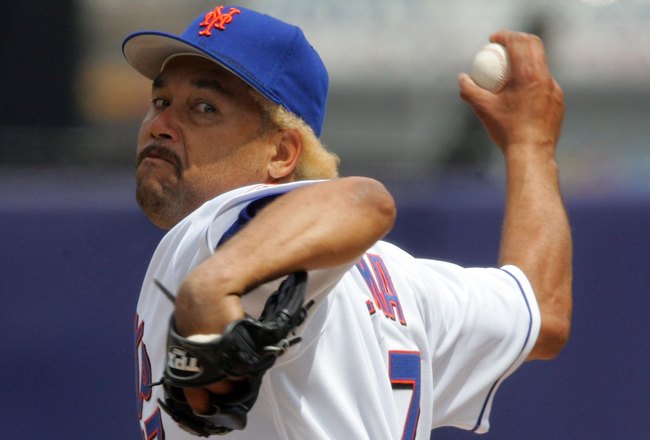
Perhaps a new hairstyle would work.  It doesn’t have to be outlandish like the blond curls sported by the late Jose Lima during his month-long stay in New York in 2006.  (If you don’t remember Lima ever being a Met, it’s probably because you were in an alcohol-induced stupor due to his constant poundings on the mound.)  All his new "do" must do is say “I want you to believe that I’m going to put the best team on the field” instead of “I want you to believe that Darla will one day fall in love with me”.  It’s time for Jeff Wilpon to change the way he looks.  Even Buckwheat would say “o-tay” to that.


Invest in antivenom

In last year’s infamous New Yorker interview, Fred Wilpon stated that Jose Reyes would never get Carl Crawford’s money.  He was right.  He also said that David Wright was a good, but not great player.  With Wright’s latest injury keeping him out of action, he may be right on that front, too.  Papa Smirk is definitely not a saint, but he might be a prophet.

Since everything Wilpon said in the article has come true, then we should also believe him when he says “we’re snakebit, baby!”  In that case, I’d like to make a suggestion to our fearless leader.  Snakes have venom.  Antivenom can combat snake bites.  You now have extra money that won’t be siphoned out of your Sandy Koufax piggy back.  Do the math.


As things stand now, even if the Mets improve upon last year’s 77-85 record, they might still finish in last place.  Every team in the National League East is better on paper.  The Nationals and Marlins, who finished in third and fifth place in the division last year, respectively, are exponentially better this year.  The Nationals added Gio Gonzalez and Edwin Jackson to their starting rotation (not to mention a healthy Stephen Strasburg) and will now have Brad Lidge closing games for them.  Meanwhile, the Marlins added Mark Buehrle to anchor their rotation and All-Star Heath Bell to seal the deal in the ninth inning.  The Braves have the best one-two punch in the bullpen in Jonny Venters and Craig Kimbrel, in addition to a solid starting rotation.  Even with an off-year by rightfielder Jason Heyward, the Braves still competed for a playoff spot until the last day of the season.  And the Phillies?  They’re pretty good.

The Mets have a long way to go if they want to be mentioned in the same sentence as the other teams in the division.  Right now, the only way the Mets could realistically compete in the National League East is if they faced Cole Hamels every day.  That’s about as likely as Shane Victorino learning how not to complain like a little … ahem … sorry,  I got carried away there.  It’s just that I’m very passionate about my team, and I want them to do well.

Surely, the team’s owners want the same thing for their team as I do.  Throwing money at the best available free agent just won’t cut it anymore.  Doing that just gets you Oliver Perez or Jason Bay.  Perhaps Los Wilpons will read this and get an idea or six.  My suggestions can’t hurt as much as the Wilpons have hurt the fan base over the past few years, right?