Tampilkan postingan dengan label Mike Piazza. Tampilkan semua postingan

Senin, 05 Maret 2012

One Season Wonders: Robin Ventura

In 1997, the Chicago White Sox were standing only 3½ games behind the first place Cleveland Indians on the morning of July 31.  However, with a 52-53 record, owner Jerry Reinsdorf felt they should be sellers instead of buyers at the trade deadline.  Throwing up the proverbial white flag, the White Sox shocked the baseball world by dealing their top starting pitcher (Wilson Alvarez), their closer (Roberto Hernandez) and a veteran pitcher (Danny Darwin) to the San Francisco Giants for a bevy of minor leaguers.

The South Siders were also attempting to trade their starting third baseman, but no team was interested in acquiring a player who had suffered a gruesome leg injury in spring training that had kept him out of the lineup for the majority of the '97 season.  As a result, the White Sox kept their third baseman until his contract expired following the 1998 season, allowing him to leave the team as a free agent.

Meanwhile, the Mets, who already had a third baseman in Edgardo Alfonzo, were interested in adding a little power to the hot corner.  With the White Sox showing no interest in bringing back their long-time third baseman, the Mets jumped at the opportunity to sign him, moving Fonzie back to second base to accommodate their newest infielder.  It took a four-year, $32 million contract to do it, but the Mets had finally wrangled themselves a power-hitting third baseman in Robin Ventura.


In 1999, Robin Ventura's sweet swing connected with baseballs and Mets' fandom alike.


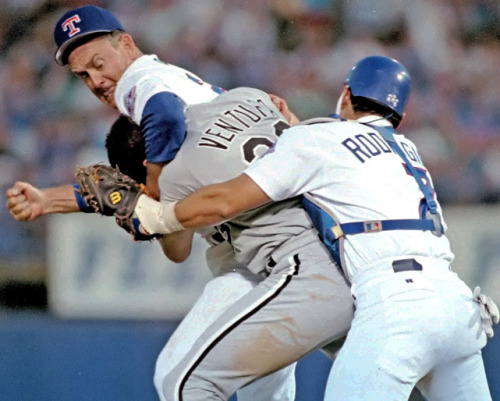
Before coming to the media capital of the world, Robin Mark Ventura had already been in the media spotlight on a number of occasions.  Sometimes the attention was positive (Ventura set an NCAA record at Oklahoma State University with his 58-game hitting streak in 1987) and sometimes he was getting a noogie from future Hall of Famer Nolan Ryan.

But one thing was for certain.  Robin Ventura was a complete player.  In ten years with the White Sox, Ventura had six seasons of 90 or more RBIs, surpassed 20 homers five times and hit over .280 in five different campaigns.  He was also an outstanding defensive player, winning five Gold Gloves as a member of the White Sox.  Although Edgardo Alfonzo was a good player at the time, he had never hit as many as 20 HR or collected as many as 80 RBIs.  He had also never been rewarded with a Gold Glove Award in four years with the Mets.  Robin Ventura had accomplished all of those feats prior to becoming a Met.  And in 1999, he was on a mission to accomplish the trifecta again.

In his first year in New York, Robin Ventura wasted no time getting acquainted with National League pitching.  The Mets' new third baseman hit .375 with five extra-base hits (three doubles, two homers) and 11 RBIs over his first ten games.  His torrid start put him among the league leaders in RBIs and made him one of the few players in Mets' history to reach 20 RBIs in a season before the end of April.  (In 1994, Jeff Kent set the franchise record for RBIs in April with 26.)

But once April turned into May, Ventura suffered his first slump as a Met and the team soon followed.  After defeating the Astros on May 3, the Mets' record stood at 17-9.  The team then went on to lose 19 of their next 28 games to fall below the .500 mark at 27-28.  During the month-long meltdown, Ventura batted only .240, dropping his season average to .268.  Although he still managed to hit eight doubles and five home runs during the 29-game stretch, he began to strike out more often, whiffing 27 times in 100 at-bats.

It was during this otherwise poor stretch that Ventura became the first player in major league history to hit grand slams in both ends of a doubleheader, as he accomplished the previously unprecedented feat against the Milwaukee Brewers at Shea Stadium on May 20.  However, this display of clutch hitting was rare for the Mets in May, and for Ventura in particular.  During the team's month-long slumber, Ventura only managed an additional three home runs and 13 RBIs on days when he wasn't hitting multiple grand slams.  The end result of the team-wide slump was the firing of pitching coach Bob Apodaca, hitting coach Tom Robson and bullpen coach Randy Niemann in early June, which coincided with a season-long eight-game losing streak.

After the dismissal of Apodaca, Robson and Niemann, Valentine famously stated that if the team didn't do well over the next 55 games, then he should also be relieved of his managerial duties.  Wanting to save his manager and the team's season, Robin Ventura went on a hitting tear, beginning with the Mets' 7-2 victory in the Subway Series finale against Roger Clemens and the Yankees.  In that game, Ventura collected two hits and scored two runs off Clemens, as the Mets handed him his first regular season loss in over a year.

The victory over the Yankees put the Mets back on track, as they went on to go 40-15 over their next 55 games, saving Valentine his job.  There were very few players in the National League as hot as Robin Ventura was over the two-month stretch.  From June 6 to August 6, Ventura batted .337 with 11 doubles, 16 HR and 48 RBI.  He also had a .405 on-base percentage and cut down on his strikeouts dramatically, fanning only 29 times in 223 plate appearances.

The Mets were finally cooled down with a loss to the Dodgers on August 7 (a game the Mets' third baseman didn't start), but Ventura's bat continued to smoke.  From August 8 to September 6, Ventura batted .366, lashed 13 extra-base hits (eight doubles, five homers) and drove in 22 runs.  On September 19, the Mets defeated the Philadelphia Phillies, 8-6, with Ventura driving in the game-tying run in the fifth inning.  The win upped the Mets' record to 92-58 and left them one game behind the Atlanta Braves for the NL East lead.  It also gave them a four-game lead over the Cincinnati Reds for the wild card, who had lost that day to the Pittsburgh Pirates.  With 12 games to go in the regular season, the Mets weren't thinking of the wild card.  They wanted to dethrone the Atlanta Braves, who had won eight consecutive division titles.  But things have a tendency to change quickly in baseball, and over the final two weeks of the season, the Mets found out just how true that adage was.

The Mets had a seemingly comfortable lead in the wild card race with 12 games to go.  But then the Mets embarked on a seven-game losing streak.  At the same time, the Reds won seven out of eight games.  With three games left in the regular season, the Braves had already clinched the division title and the Mets were now chasing the Reds and the Astros in the wild card race, as both teams were tied atop the National League Central division with identical 95-64 records.  At 93-66, the Mets were two games out with three games to go.  Their season was in jeopardy of ending prematurely for the second straight year.  But with one swing of Robin Ventura's bat, the team began to believe in themselves again.

On October 1, the Mets began a three-game series against the Pittsburgh Pirates, basically needing to sweep the Bucs and hope for outside help to have any chance of winning the wild card.  The Mets took an early 1-0 lead on Robin Ventura's 32nd homer.  But the Pirates came back and tied the game, sending it into extra innings.  After reliever Pat Mahomes escaped a two-on, one-out jam in the 10th inning, he retired the Bucs in order in the 11th.  In the bottom of the 11th, the Mets put a runner on second base with one out.  After an intentional walk to Edgardo Alfonzo and a groundout by John Olerud, the Pirates decided to walk Mike Piazza to load the bases for Ventura, hoping that southpaw reliever Scott Sauerbeck would retire the lefty-swinging Ventura to end the inning.  The inning did end, but not the way the Pirates wanted, as Ventura lined Sauerbeck's second pitch to right-center for a game-winning single.  As an added bonus, the Astros and Reds both lost to the Dodgers and Brewers, respectively.  The Mets were now one game behind Houston and Cincinnati for the wild card, and Shea Stadium was ready for an epic final weekend.

Going into the season's penultimate game, the Mets already knew that the Astros had won and the Reds had lost.  Houston was now leading the National League Central by a game over Cincinnati.  The Reds' loss meant that the Mets were one win away from tying them for the wild card lead.  Rick Reed was tabbed to start the game on October 2 and pitched the game of his life, striking out 12 Pirates and allowing no runs.  However, Bucs' starter Francisco Cordova was matching Reed zero for zero throughout the first five innings.  All that changed when the Mets came to bat in the sixth inning.  The Mets needed some mojo risin' and they needed it fast.  Up come Robin Ventura to provide the Mets with all the mojo they would need.

With two men on base, Ventura ripped a double down the right field line, plating the Mets' first run of the game.  The Mets scored another run in the inning and added five insurance runs in the eighth inning en route to a 7-0 victory over the Pirates.  The season had come down to Game No. 162, with the Mets and Reds tied for the wild card lead.  Ventura went 1-for-4 in the series finale against the Pirates and was on deck when Mike Piazza watched Brad Clontz's wild pitch bounce over the backstop in the ninth inning, scoring Melvin Mora from third base with the winning run and setting off a wild celebration at home plate in front of the Shea faithful.  Despite the thrilling ending, the Mets could not pop the champagne at home, as the Reds defeated the Brewers that night after a long rain delay, setting up a one-game playoff at Cinergy Field the following night.

Needing one victory to secure their first playoff berth in 11 years, the Mets got off to an early lead, compliments of Edgardo Alfonzo's two-run homer off Reds' starting pitcher Steve Parris.  In the third inning, Robin Ventura collected his 120th RBI of the season, drawing a bases-loaded walk from reliever Denny Neagle to give the Mets a 3-0 lead.  Ventura would reach base two more times in the game, but by then, Mets' starting pitcher Al Leiter had deflated the Reds' bubble, as the Mets went on to win the game and the National League wild card berth, advancing to the NLDS to play the NL West champion Arizona Diamondbacks.

Although Ventura hit only .214 against the Diamondbacks in the series, he found other ways to contribute.  In Game 1, it was Ventura who led off the ninth inning with a single off Randy Johnson.  What made the hit so incredible was the fact that Johnson had allowed a mere nine hits to left-handed batters over the entire 1999 regular season.  Five batters later, Edgardo Alfonzo hit the go-ahead grand slam off reliever Bobby Chouinard to give the Mets an 8-4 lead, a lead that held up in the bottom of the ninth when Diamondbacks' shortstop Hanley Frias popped out to (you guessed it) Robin Ventura to end the game.  The Mets split the next two games before winning Game 4 at home to take the series, with Ventura contributing a double and a walk in the deciding game.  Despite his low batting average in the NLDS, Ventura reached base seven times (four walks, three hits) for a .389 on-base percentage.

In the NLCS, Ventura struggled at the plate, taking oh-fers in each of the first four games.  Ventura didn't get off the schneid until the 11th inning of Game 5, when he singled for his first hit in 17 NLCS at-bats.  Although that hit has long been forgotten, his next hit in the NLCS will always be remembered.  Four innings after his 11th inning single, Ventura lashed another single, although this one carried over the right field wall.  The famous Grand Slam Single gave the Mets a 4-3 victory and sent the team back to Georgia for a Game 6 showdown against the Braves.

Ain't life grand?


Unfortunately, the Mets could not force a seventh and deciding game in Atlanta, but Robin Ventura tried his best to get the Mets to Game 7.  With the Mets down 5-0 in the sixth inning, Ventura was on deck when Mike Piazza hit a sacrifice fly to plate the Mets' first run.  Ventura then doubled to right field off Braves' starter Kevin Millwood and scored on Darryl Hamilton's two-run single.  The Mets had cut the Braves' lead to 5-3 and eventually sent the game into extra innings.  But the magical run ended in the bottom of the 11th inning, when Kenny Rogers walked Andruw Jones with the bases loaded.

Despite hitting a combined .154 (6-for-39) during the Mets' ten-game postseason run in 1999, Robin Ventura provided some of the timeliest hits for the Mets against Arizona and Atlanta.  Ventura was nothing but clutch for the Mets in 1999.  For the season, he set career-highs in batting average (.301), slugging percentage (.529), on-base plus slugging (.908), hits (177), doubles (38) and RBIs (120).  The Mets' third baseman also added 32 homers, scored 88 runs and won his sixth Gold Glove Award.  (He also was prominently featured as part of Sports Illustrated "Best Infield Ever?" story.)  For his efforts, Ventura finished sixth in the National League MVP vote, finishing just ahead of teammates Mike Piazza (7th) and Edgardo Alfonzo (8th).

The 2000 Mets were expected to build upon their success from 1999, with Robin Ventura being one of the key contributors.  Although the team did well in 2000, winning their fourth National League pennant, Ventura did not perform as expected in his second season in New York.  Ventura played in 85 of the team's first 87 games, but only batted .235 with 17 doubles, 16 HR and 53 RBIs.  He was then placed on the disabled list with a bruised right rotator cuff and missed the next 14 games.  Upon returning, he did even worse, batting .227 with six doubles, eight HR and 31 RBIs over his final 56 games.  His final numbers in 2000 (.232, 23 doubles, 24 HR, 84 RBI, 61 runs scored in 141 games) were a far cry from what he produced in 1999. (In fact, Ventura's only positive contribution to the 2000 Mets might have been his one-man performance in Rain Delay Theatre at Yankee Stadium.)  In the postseason, Ventura's batting average continued to suffer, as he hit .167 in 14 postseason games for the Mets in 2000.  He also failed to reach base in any of his last nine plate appearances against the Yankees in the World Series.

Ventura's 2001 campaign was more of the same.  Although his batting average went up slightly to .237 (still nowhere near the .301 average he produced in 1999), Ventura's power and run production continued to suffer.  In 142 games, Ventura hit 20 doubles and 21 HR, but only collected 61 RBIs.  He also struck out 101 times, which was only slightly lower than his hit total (108).  The 108 hits represented a career-low for Ventura over a season in which he played at least 100 games.  Unlike the 2000 season, in which the Mets made the playoffs despite Ventura's subpar campaign, the Mets barely finished above .500 in 2001.  As a result, the Mets decided that they needed to shed their third baseman's high salary and move in a different direction.  They did just that when they dealt Ventura to the Yankees for David Justice, who was then traded a week later to Oakland for pitchers Mark Guthrie and Tyler Yates.

Robin Ventura wasn't all about his bat.  He may have been better with his glove.


Despite only having one outstanding season with the Mets, Robin Ventura is still a beloved figure in New York.  He was an outstanding defensive third baseman during his three years in Flushing and provided many memorable moments for the team, although most of them came during their magical 1999 campaign.  Ventura is now managing the Chicago White Sox, the team for which he played the majority of his professional career.  But no matter what he does in Chicago, Ventura will always have 1999, a season that started out so innocently, but ended with a new Mets legend being born.

From his doubleheader grand salamis in May to his torrid two-month stretch in the summer of '99 to "The Best Infield Ever" to the Grand Slam Single, Robin Ventura was in the middle of many great moments during one of the most memorable seasons in Mets history.  He may not have had the best Mets career, but for one season, he was in the center of it all.  It's no wonder that that one season turned him into the Mets legend that he now is.


Note: One Season Wonders is a thirteen-part weekly series spotlighting those Mets who had one and only one memorable season in New York.  For previous installments, please click on the players' names below:
 
January 2, 2012: Bernard Gilkey
January 9, 2012: Terry Leach 
January 16, 2012: George Stone
January 23, 2012: Roger Cedeño
January 30, 2012: Frank Viola
February 6, 2012: Joe Christopher 
February 13, 2012: Dave Magadan 
February 20, 2012: Pedro Martinez
February 27, 2012: Bret Saberhagen

Sabtu, 28 Januari 2012

The Perfect Way For The Mets To Stick It To The Marlins


As all Mets fans know, the Marlins have been a thorn in the team's side since 2007.  First, Tom Glavine was able to retire only one more batter than I did in the 2007 regular season finale, completing the Mets' collapse.  One year later, the Marlins wouldn't get off the field after they once again eliminated the Mets (and Shea Stadium) in Game No. 162.  Three years after that, they stuck it to the Mets again, this time by signing Jose Reyes to a six-year deal worth $106 million, or about $106 million more than Fred Wilpon has stored away in his souvenir Sandy Koufax piggy bank.

In fact, if you really want to get technical about it, the Marlins have been one-upping the Mets since 1997, when they replaced the Mets as the fastest expansion team to win a World Series.  (The Marlins have since been knocked off that perch by the fourth-year Arizona Diamondbacks in 2001.)

But other than the Mets celebrating their 2006 NL East title in front of their home fans while the Marlins watched in the road dugout, they haven't really done anything that would be considered negative to the Marlins.  Are they upset that the Mets took Mike Piazza and Carlos Delgado from them?  Did Fred Wilpon insult Marlins' owner Jeffrey Loria's mother because he found out Loria grew up as a Yankee fan during the era in which the Brooklyn Dodgers kept losing to them in the World Series?

The time has come for the Mets to stand up to the Marlins once and for all.  And I know just how they can do it.

Earlier today, it was reported that Bud Selig expects two extra wild-card teams to be in place for this season, rather than the 2013 campaign.  Therefore, with five teams now qualifying for the playoffs in the National League instead of the usual four, the Marlins have reasonable expectations that they will be one of those five teams.

More than likely, the Phillies will win the NL East for the sixth consecutive season.  But the Atlanta Braves are coming off an epic late-season collapse.  The St. Louis Cardinals and Milwaukee Brewers both lost their top power hitters (Albert Pujols, Prince Fielder) to free agency.  With all those windows being opened in the National League, the Miami Marlins are poised to break through and crash the playoff party for the first time since Art Howe was supposedly managing the Mets.

Like many other teams competing for the wild card spots, the Marlins might not play a potential clinching game until the final series of the season.  And who, pray tell, will the Marlins be playing on October 1, 2 and 3 in front of their dozens of fans at their brand spanking-new ballpark?

The New York Mets.

Wouldn't it be something if the Marlins needed to win their final series of the season and the newly-signed (and former Met) Heath Bell blew a save or two to the Mets?  Or how about if Jose Reyes, representing the tying run in the bottom of the ninth was caught stealing to end a game?  What if the Marlins' new ace, Mark Buehrle, only lasted a third of an inning in the regular season finale, as the Mets battered him for run after run in the opening frame?  Would that be devastating to them?

It's been too long since the Marlins have been a thorn in the Mets' side.  Ever since Steve Trachsel's arm and Jose Valentin's bat took them down in the 2006 division clincher, the artists formerly known as the Florida Marlins have been giving the Mets and their fans recurring nightmares.

Hey, we all know the Marlins are just one poor finish away from conducting their once-a-decade fire sale.  Why not speed up the inevitable and give them a chance to do it this year?  The Marlins have been sticking it to the Mets every chance they've gotten since 2007.  It's time for the Mets to stick it right back to them in 2012.  Ya gotta believe.

Kamis, 26 Januari 2012

Ten Things You May Have Forgotten About John Franco

Photo courtesy of Associated Press/New York Mets

Earlier today, the Mets announced that John Franco will be inducted into the team's Hall of Fame in a ceremony prior to the June 3rd game against the World Champion St. Louis Cardinals.  Franco will become the 26th member of the Mets' Hall of Fame and the first to be inducted since Davey Johnson, Darryl Strawberry, Dwight Gooden and Frank Cashen were bestowed the honor in 2010.

Many people know that John Franco played more years for the Mets (14) than any player not named Ed Kranepool and was the team's last captain.  It's also fairly common knowledge amongst Mets fans that Franco holds the club record for saves (276) and is the all-time leader for saves by a left-handed pitcher (424).

But what about the things you may have forgotten about the Brooklyn-born Franco?  He was much more than just a pitcher who racked up saves and years played with the team.  In fact, I've come up with ten things you may not remember about the man who came into games as Chuck Berry serenaded him over the Shea Stadium speakers.  In honor of the newest member of the Mets' Hall of Fame, I present to you...


Ten Things You May Have Forgotten About John Franco

1.  Before Mike Piazza became synonymous with No. 31, John Franco wore the number.  In fact, he wore it longer than Piazza did as a Met, but gave it up to the superstar catcher upon his arrival in May 1998.  Franco switched to No. 45, the number he wore as a player at St. John's University and the number of his childhood hero, Tug McGraw.

2.  When John Franco was traded from Cincinnati to the Mets in December 1989, he was the Reds' all-time saves leader with 148.  In 1994, Franco recorded his 108th save as a Met, taking over the team's top spot from Jesse Orosco.  For ten seasons, John Franco held the No. 1 spot in saves for both the Reds and the Mets until Reds' closer Danny Graves surpassed Franco in 2004.

3.  John Franco is one of only two Mets players who played for both Davey Johnson and Bobby Valentine, joining his battery mate, Todd Hundley.  Johnson was fired as Mets' manager during Franco's first season in New York, while Valentine dialed Franco's number in the bullpen 295 times.  Unfortunately for Johnson, Franco gave up two runs in two-thirds of an inning during a loss to the Padres on May 27, 1990.  It would be Davey's final game as Mets' manager.

4.  Although most fans remember Tom Seaver throwing out the first pitch at Citi Field, it was actually John Franco who threw out the ceremonial first pitch at the inaugural baseball game played at the Mets' home.  On March 29, 2009, Franco took the mound before the college baseball game between St. John's and Georgetown, opening up the ballpark with its first toss to the plate.

5.  The Mets lost the 2000 World Series to the Yankees in five games.  Who was the only Mets' pitcher credited with a victory in the first Subway Series in 44 years?  None other than John Franco, who earned the victory in Game 3 after Benny Agbayani's RBI double gave the Mets an eighth-inning lead.

6.  John Franco was once relieved by Matt Franco.  On Fireworks Night in 1999, Matt Franco traded in his pinch-hitting role to be the "pinch-pitcher" after John Franco left the game with a strained tendon in the middle finger of his throwing hand.  Franco (Matt) would give up a three-run homer to the first batter he faced, adding two runs to Franco's (John) pitching line for the night.  The Mets would go on to lose the game to the Braves, 16-0.  That wouldn't be the only thing lost that night, as Franco (John, not Matt) lost his job as Mets' closer to Armando Benitez because of his injury.

7.  Darryl Strawberry and David Wright are widely considered to be the two best homegrown hitters in franchise history, with both players popping up all over the Mets' all-time offensive leaderboards.  John Franco is the only player who was a teammate of both players while with the Mets.  Franco's first season in New York (1990) coincided with the Straw Man's last year as a Met, while his last year (2004) was the year David Wright made his Met debut.

8.  John Franco is one of only three Mets' relievers to finish in the top ten in the Cy Young Award vote in a particular year.  In the strike-shortened 1994 season, Franco led the National League with 30 saves and placed 7th in the Cy Young vote.  Jesse Orosco (3rd in 1983) and Billy Wagner (6th in 2006) are the other Mets who have received Cy Young Award votes in addition to Franco.

9.  With 33 saves in 1990, John Franco became the first Met ever to lead the league in saves.  He repeated the feat in 1994 when he saved 30 games for the Mets to pace the NL.  To this day, Franco remains the only Mets pitcher to lead the National League in saves.

10.  John Franco is one of only two men to pitch for the Mets at age 44.  In 1965, Hall of Famer Warren Spahn became the first player to accomplish the feat, pitching in 20 games (19 starts) for the Mets at the age of 44.  Franco's final appearance as a Met (October 3, 2004) was also his only appearance as a 44-year-old.  That's not the only thing Spahn and Franco have in common.  Both pitchers are first all-time in wins and saves for left-handed pitchers, respectively.  Spahn's 363 career victories and Franco's 424 saves lead all southpaws in major league history.

Selasa, 24 Januari 2012

Loyalty And Leaderboards

Former Yankee catcher Jorge Posada officially announced his retirement from baseball today.  He left the game after playing exclusively for the Yankees since his promotion to the major leagues in 1995.

Those aren't sentences I usually begin a blog post with.  After all, this is Studious Metsimus, which the last time I checked, focused on Mets-related news.  But I couldn't help but notice something about Posada's career numbers with the Yankees, especially when compared to some of the Mets' all-time greats.

Jorge Posada collected 6,092 at-bats over his 17-year career.  In those at-bats, he picked up 1,664 hits, of which 379 were doubles and 275 were home runs.  Posada also walked 936 times, scored 900 runs and piled up 1,065 RBIs.  He's nowhere near the Yankee team leaders in any of those categories, nor does he rank among the top five hitting catchers of all-time, as players like Mike Piazza, Ivan Rodriguez, Johnny Bench, Ted Simmons, Yogi Berra and Roy Campanella were all better hitters than Posada.  So why am I making such a big deal about this?

Because Jorge Posada would be the Mets' all-time leader in hits, doubles, home runs, walks, runs scored and RBIs if he had played his entire career in Flushing.

As hard as it is for me to admit it, Jorge Posada was a better hitter than Ed Kranepool.


Jorge Posada surpassed 150 hits in a season only once (2007), a figure that has been achieved by many Mets.  One might argue that Posada's hit total would be lower than most hitters because of all his time spent as a catcher.  To those people, I submit the fact that Mike Piazza, also a catcher, reached the 150-hit plateau three times as a Met and eight times in his career.  Posada also hit 30 or more doubles four times, reached 30 home runs once, walked 100 times once, drove in 100 runs once and never scored 100 runs in any of 17 seasons.  Several Mets players have reached those numbers multiple times, except for walks, where John Olerud is the only Met to walk 100 times in a season.

Had Jorge Posada played his entire career as a Met and produced the same numbers, he'd be considered the greatest offensive player in Mets history and would be counting down the days till his number joined Nos. 37, 14 and 41 on the left field wall at Citi Field.  Instead, he is just one of many Yankees who had very good careers in pinstripes.  Is this a testament to the fact that the Yankees have been Slugger Central over the past century or have the Mets just done poorly developing and keeping their offensive stars?

There's a reason why Tom Seaver is referred to as "The Franchise".  It's not because he's the sole player in the Hall of Fame with a Mets cap on his plaque.   It's because the Mets have a tough time producing elite players, and when they do, they end up trading them or letting them walk via free agency.  Tom Seaver was an elite player with the Mets for 11 years.  Since 1983, when Seaver played his last game as a Met, the only player developed in the Mets' minor league system who spent over a decade in Flushing was Dwight Gooden.  The only hitters originally drafted by the Mets who played over a decade in New York were Ed Kranepool, Cleon Jones, Bud Harrelson and Ron Hodges.  That's not exactly a Murderer's Row we're talking about there.

Perhaps one day the Mets will develop a player in their minor league system, watch him become an All-Star in Flushing and keep him around for a while.  Jose Reyes could have been that player.  David Wright could still be that player if the Mets don't decide to keep their pennies to themselves.  Jorge Posada was that type of player for the Yankees.  Had he been a Met, he'd be atop the team's all-time leaderboard in a plethora of categories.  See what a little loyalty can do for you?

Sabtu, 19 November 2011

Joey's Small Bites: Dodgers & Padres & Bears, Oh My! (Part Two: Petco Park Tour)

Howdy doody, fellow Mets fans!  This is Joey Beartran, taking a break from dreaming about chicken nachos at Citi Field (a dream I have daily during the offseason) to share my experiences with you on our recent trip to the National League ballparks in Southern California.

In part one of this two-part series, I discussed our tour of Dodger Stadium (which you can read for yourself by clicking here), where there is plenty of love for the Brooklyn Dodgers and Fred Wilpon's high school sweetheart (Sandy Koufax) and hero (Jackie Robinson), in addition to all the Gil Hodges memorabilia that should be at Citi Field.

Part two of the Studious Metsimus Southern California tour took us to Petco Park in beautiful San Diego.  The ballpark is visually stunning from the outside, but it is inside where the beauty fully comes out to play.  Let's take a look!

Everything is beautiful in San Diego, which is why I fit in so well.

Our tour guide took us into the ballpark behind home plate, up the staircase that is adjacent to a cascading waterfall (which was not on at the time - water conservation is important everywhere, my friends).  He explained that Petco Park has some of the widest concourses for fans in the major leagues and has the most plants found in any major league ballpark.  The plants were carefully selected because San Diego doesn't get much rain (approximately 10-15" of precipitation falls in San Diego annually, according to our tour guide), so only plants that can withstand drought were planted in and around the ballpark.

One of the great things about watching a game at Petco Park is that you can purchase a Standing Room Only ticket behind the last row of seats in the field level behind home plate.  The price of the ticket is only $5.  Compare that to the last row of seats behind home plate, which are $69 and only two feet in front of the Standing Room Only section, and you have the best bargain in the ballpark.  Of course, you might not be able to see high fly balls from that area (see photo below of the view from the Standing Room Only section), but no Padre can hit high fly balls anyway.

Ryan Ludwick led the 2011 Padres with 11 HR, meaning that you probably have a better chance of catching a baseball in the Standing Room Only area than you do in the outfield seats at Petco Park.

From the Standing Room Only area, we moved along the right field side of the ballpark, taking note of the Padres dugout as we walked to one of the unique aspects of the park - the Western Metal Supply Co. building.

Construction of Petco Park was delayed for two seasons because of the building, which has been declared a historic landmark in San Diego.  After a court hearing, it was determined that only the exterior of the building was considered a landmark, so the Padres were able to incorporate it into the ballpark, change and add things to the inside of the building, as long as they kept the exterior intact.  The Western Metal Supply Co. building now provides a unique viewing perspective in the left field corner.  (Here are the pics to prove it.  Among them is a photo that features my sister (Iggy Beartran) and Ballapeño, who is the mascot of the Padres' AA team, the San Antonio Missions.)


Inside the Western Metal Supply Co. building, you will find all the San Diego baseball history you can digest.  We're not just talking about the San Diego Padres major league franchise, which came into existence in 1969.  We're also talking about the San Diego Padres of the Pacific Coast League, which started play in 1936.

The minor league San Diego Padres team was most known for one teenaged player who went on to become one of the best hitters in the major leagues as a member of the Boston Red Sox.  Perhaps you've heard of this native San Diegan.  His name was Ted Williams.

The Splendid Splinter got his professional start in San Diego as a member of the PCL's Padres.

The Padres are very proud of their history, even though they've never won a World Series title in two trips to the Fall Classic.  The team has retired the numbers of five of their former players (Randy Jones, Steve Garvey, Dave Winfield, Tony Gwynn and Trevor Hoffman) and isn't shy to show off their love for these players.

All over the ballpark, you will see tributes to these great players, even though Winfield and Gwynn are the only two to make it to Cooperstown.  From a Tony Gwynn statue (more on that later) to a baseball jersey made out of baseball cards to glass-enclosed "lockers" dedicated to their legendary players, coaches and front office personnel, Petco Park has no shortage of tributes to those who gave their all for the Padres.


By the way, your eyes weren't deceiving you up there.  That really was Babe Ruth in a "Bustin' Babes" jersey.  When the man who never knew a hot dog he couldn't eat was a player, he was part of a barnstorming team that played a few games in San Diego.  That made the Bambino part of San Diego baseball history and got him a spot on their wall.  See, I wasn't kidding when I said San Diego is proud of their baseball history!

Speaking of "never knowing a hot dog he couldn't eat", by this point in the tour, I was getting a little hungry (like you weren't expecting me to say that eventually), but I was disappointed that just like in the Dodger Stadium tour, the concession stands weren't open for business.  It's too bad because I really wanted to try one of their famous Friar Franks.  (Keeping the concession stands closed was not suh-WEET in my book.)  At least they have all-you-can-eat seats, so I'll definitely be making a trip back to Petco Park when there are games to be played.


After the Western Metal Supply Co. building and closed concession stand tour, we went back into the ballpark to check out the press box, suites and lounges (where were large and had great menus, but not unlike any we've ever seen before).  On the way there, we stopped at the Padres Hall of Fame Bar and Grill and noticed a couple of interesting jerseys that belonged to two former Padres.  However, the two uniforms did not have "San Diego" or "Padres" written across the front.

They were the WBC jerseys of former Met (and a Padre for one season) Mike Piazza and former Padre Adrian Gonzalez.  Piazza wore No. 31 as a coach for Team Italy in the 2009 World Baseball Classic, while Gonzalez wore No. 23 for Team Mexico.  The jerseys were there because both players suited up for the Padres at one time and because several of the WBC games were played at Petco Park.  (Ballapeño clearly has a fav'rit player, according to the photos below.)


From there, it was time to get some on-field action.  The tour guide was quite informative when telling us about the special advantages the Padres have on the field.  For example, the Padres' home dugout is 57 feet long and the bench in front of the dugout fences has a back for players and coaches to lean back on while they're sitting on it.  The visiting team's dugout is only 46 feet long and the bench in front of their dugout fence has no back for leaning purposes.  I suppose a player could lean back while sitting on that bench, but then he'd risk an injury, as the bench is a few feet above the dugout floor.  Of course, if it was a Mets player, it would cause him to miss the entire season.

In addition, the Padres have heaters and coolers in their dugout, while the visiting team has none.  Also, the Padres' bullpen is situated on grass behind the left field fence.  The road team has to warm up their pitchers on a makeshift mound in foul territory along the right field foul line, where they're subjected to the wrath (or what passes for wrath in laid-back San Diego) of the fans.  More importantly, members of the visiting team can be struck by screaming line drives that curve foul at the last moment.

I'm sure all that information is keeping you wide awake, but what you really want to see are the pictures of us on the field and in the dugout, right?  Without further ado, here they are!


Most of the time, the tour of the dugout and the field represents the end of the tour.  However, at Petco Park, there is much more to see!

Just beyond the center field fence is an area called "Park at the Park", which is open from sunrise to sunset on non-game days.  From there, you can go down a flight of steps (where the Petco Park center field bleacher seats are located) to an area that resembles a beach.  This is where kids can play during the game while their parents watch the action on the field.

Behind this seating area is a small park that contains a whiffle ball field (for kids and adults) and a statue of Mr. Padre himself, Tony Gwynn.  (See, I wasn't lying when I said "more on that later" ten paragraphs and 22 photos ago.)  We didn't take a photo of the homeless man sleeping behind the statue (or was it the San Diego chapter of "Occupy Wall Street", called "Occupy Tony Gwynn Drive"?) but we did get some great shots of the statue, beach and playing field.


Well, that about does it, Mets fans.  I hope you enjoyed our recap of the Studious Metsimus Southern California ballpark tour.  Both Dodger Stadium and Petco Park should be on your list of ballparks to visit whenever you want to make a trip to the West Coast to see the Mets play.  If you can't make it out to these cities during the baseball season, then I highly recommend taking the tours that we took.

At each park, the tour guides were informative, knew their team's history (unlike the tour guides at Citi Field - isn't that right, Mr. Prince?) and they didn't try to sell you suites (a la the Citi Field tour), making it a pleasurable experience for our entire staff.

Oh, one more thing before I sign off, since I know you were wondering.  Remember how I said none of the concession stands were open at Dodger Stadium and Petco Park?  Well, that part was true, but I did make a friend inside the Petco Park Team Store.  It wasn't edible, but the slice of Padres Pizza (see photo below) was a perfect ending to a fantastic Southern California baseball trip.

On behalf of Iggy Beartran and Ballapeño, I'm Joey Beartran, reminding you that it sometimes does rain in Southern California, but it should never dampen your feelings on the New York Mets.  Let's go Mets!

Hungry bears and a Padres pepperoni pizza pillow always go hand-in-hand!