Tampilkan postingan dengan label Atlanta Braves. Tampilkan semua postingan

Rabu, 04 April 2012

Song Parody: My Johan's Back

After being missing from the Citi Field mound for the past 19 months, Johan Santana will reprise his role as the Mets' ace on Opening Day against the Atlanta Braves.  It will be Santana's fourth Opening Day start for the Mets, making him the fourth pitcher in franchise history to be a four-time starter in the team's opener.  Only Tom Seaver (11 starts), Dwight Gooden (8 starts) and Tom Glavine (4 starts) have gotten the ball on Opening Day as many time as Santana.

But what's most important to the Mets is the fact that Johan Santana is starting any game for them.  Not since September 2, 2010 has Santana faced major league hitters in a regular season game, when he defeated the Braves, 4-2, in Atlanta.  This year, Santana is looking to continue his Opening Day success, as he won all three of his previous season openers for the Mets.

In honor of Santana making his (hopefully triumphant) return to the Mets, the crack staff at Studious Metsimus has concocted a song parody.  We figured a classic song should be rewritten to honor a classic pitcher such as Santana.  So let's stop with the chit-chat and start with the song!  Dedicated to Johan Santana, here is our version of the '60s standard, "My Boyfriend's Back", renamed in honor of the Mets' ace as "My Johan's Back".  Enjoy!  (...and take a listen to an updated version of the original song by Me First and the Gimme Gimmes after you read/sing our version.)


He went away
And we hung around, wanting him every fifth night
But now that his rehab’s through
His opponents will have to think twice

My Johan’s back and the hitters are in trouble
(Hey la, hey la, my Johan’s back)
They'll see his change-up and their bats will turn to rubble
(Hey la, hey la, my Johan’s back)
He’s before your eyes in orange and blue
(Hey la, hey la, my Johan’s back)
So look out now, Johan’s coming after you
(Hey la, hey la, my Johan’s back)

Hey, we know that he’s been tryin’
Now he’s back, there’s no denyin’

He’s been gone for such a long time
(Hey la, hey la, my Johan’s back)
Now he’s back and things will be fine
(Hey la, hey la, my Johan’s back)
The hitters are sorry they were ever born
(Hey la, hey la, my Johan’s back)
‘Cause his arm ain’t weak; it’s actually strong
(Hey la, hey la, my Johan’s back)

Philly’s ready for defeatin’
Marlins gonna get a beatin’
What made them think his career had all but died?
(Wah-ooo, wah-ooo)
Johan’s back right now and he’ll shut them out tonight
(Wah-ooo.  Wait and see!)

My Johan’s back; he's getting back his reputation
(Hey la, hey la, my Johan’s back)
The Nats and Braves are gonna get an education
(Hey la, hey la, my Johan’s back)

Hey, can you see Johan comin’?
Wow, his change-up is still stunnin’

Wah-ooo, wah-ooo.
Wah-ooo.  Wait and see!

My Johan’s back; he's getting back his reputation
(Hey la, hey la, my Johan’s back)
The NL East is gonna get an education
(Hey la, hey la, my boyfriend’s back)

Hey, my Johan’s back!  (Hey la!)
Hey, my Johan’s…
BACK!
(Wah-ooo…)


Kamis, 22 Maret 2012

Is This Your Retirement, Larry?


Earlier today, Chipper Jones announced that he will be retiring at the end of the season after almost two decades spent entirely with the Atlanta Braves.  Jones will retire as one of the Braves’ all-time greatest players, finishing in the top three in many of the team's offensive categories (along with Hank Aaron and Eddie Mathews).  He will also end his career as one of the best switch-hitters in baseball history, joining other greats such as Mickey Mantle, Eddie Murray and Pete Rose.

Chipper Jones was like Norm from Cheers, with every fan at Shea Stadium and Citi Field saying his first name in unison as he strolled into the batter's box.  But unlike Norm, whenever Jones heard his name, it wasn't usually in adulation.

When the Braves and Mets competed for National League supremacy in 1999 and 2000, it was Jones who repeatedly delivered in the clutch, keeping the Mets from ending the Braves’ reign atop the division.  By then, he was already known as “La-a-a-a-a-arry” to the Shea faithful, similar to the way Darryl Strawberry was known as “Da-a-a-a-a-arryl” to Red Sox fans during the 1986 World Series.  Of course, Strawberry got the last laugh, hitting a towering home run off Red Sox reliever Al Nipper in Game 7.  Chipper Jones usually hushed the crowd as well with his ability to come through in the clutch.

And what a clutch hitter he was against the Mets.  In 812 career at-bats versus New York, Jones hit .318 with 44 doubles, 48 HR and 154 RBI.  Only Hall of Famers Willie Stargell (60) and Mike Schmidt (49) hit more career home runs against the Mets than Chipper Jones.

But Jones wasn’t just a great hitter when the Mets were in the other dugout.  He was an equal opportunity slugger, especially within his own division.  Take a look at his stats against the other teams in the National League East:

  • vs. Marlins: .299, 45 doubles, 40 HR, 161 RBI in 834 at-bats.
  • vs. Phillies: .332, 68 doubles, 46 HR, 144 RBI in 797 at-bats.
  • vs. Expos/Nats: .298, 60 doubles, 40 HR, 154 RBI in 905 at-bats.

Through 2011, Jones has hit at least 40 doubles, 40 HR and picked up 140 RBI against every team in the National League East, numbers that will only rise as he plays his final year in the major leagues.  Despite his inability to stay on the field because of various injuries throughout the latter part of his career, he still managed to win a batting title in 2008, hitting an impressive .364 at age 36.

Over the years, Mets fans at Shea Stadium and Citi Field would shower Chipper Jones with boos and remind him of his given name whenever he stepped up to the plate.  But did they really hate Chipper Jones or was it just a masked sign of respect for a great player?

Admit it.  You've booed Chipper Jones, but you would have loved to see him in a Mets uniform.


Jimmy Rollins, Cole Hamels and Shane Victorino also get pooped on by the boo birds whenever they come to New York.  But all three of them brought it upon themselves by not being able to keep their mouths shut.  Cole Hamels may have been the biggest offender of Mets fans when he famously claimed that the Mets were choke artists.  In fact, his mouth is so big, he could insert Shaquille O’Neal's foot in it and it still wouldn’t shut him up.  Those players are players Mets fans genuinely hate.  There’s no respect in those boos.

But Chipper Jones is different.  He never guaranteed anything even when the Braves were racking up division titles faster than the current Mets rack up injuries.  He also never disrespected a fan base like Hamels or his former teammate, John Rocker, did.  In fact, Jones loved playing in New York so much, he named his son Shea.

Why was Chipper Jones booed so much in New York?  Because he was good.  Really good.  For a very long time.

Larry did his homework on the Mets, which is why he was so great against them for nearly two decades.  But he didn’t just pick on the Mets; he picked apart opposing pitchers all over the National League.  When the Braves make their final appearance at Citi Field this year on September 9, Mets fans should put aside their negative feelings and give Chipper Jones a standing ovation.  After so many years booing him, it’s time to recognize that he was one of the best players of his generation.  Jones is a certain first ballot Hall of Famer who, like Cal Ripken Jr. and Tony Gwynn, played his entire career with one team.  Only special players get to do that.  Chipper Jones has been a special player.

When the 2012 season comes to a close, Chipper Jones will be retiring from baseball.  Ask any Mets fan how they feel about the news and they’ll say they won’t be at a loss, which shouldn’t be surprising.  Why not?  Because when the game was on the line, the man they called “La-a-a-a-a-arry” usually had their favorite team at a loss.  It’s no wonder Mets fans will probably enjoy Chipper Jones’ retirement more than Chipper himself.

Senin, 12 Maret 2012

One Season Wonders: Willie Montañez

In 1977, the Mets were in the middle of dismantling the team that brought them much success in the first half of the 1970s.  They weren't just massacring the team at midnight, they were chopping the players up and spitting them out for other teams to enjoy.  The Mets traded away "The Franchise", their best power hitter (Dave Kingman) and their rock behind the plate (Jerry Grote) during the 1977 season.  But they weren't done yet.

After the season was over, the Mets were involved in a complicated four-team trade with the Atlanta Braves, Texas Rangers and Pittsburgh Pirates.  On December 8, 1977, former Rookie of the Year Jon Matlack was shipped off to Texas and slugging first baseman/leftfielder John Milner packed his bags for Pittsburgh.  In return, the Mets received outfielders Tom Grieve and Ken Henderson from the Rangers.  Neither player performed very well for the Mets.  In fact, both of them were rarely seen on the field in a Mets uniform, with Grieve's career in New York lasting 54 games (.208, 2 HR, 8 RBI) and Henderson (.227, 1 HR, 4 RBI) playing in only seven games.

The Mets received one other player in the deal that sent Matlack and Milner away.  Unfortunately, it was not future Hall of Famer Bert Blyleven, who was also involved in the trade; he went from Texas to Pittsburgh.  No, the third player sent to the Mets came via the Atlanta Braves.  It was a player who was no stranger to trades, as he had already been a part of five organizations (St. Louis Cardinals, California Angels, Philadelphia Phillies, San Francisco Giants, Atlanta Braves) before becoming a Met.  He was also no stranger to trades involving All-Stars and future Hall of Famers.

In 1970, he was the player sent to the Philadelphia Phillies from the St. Louis Cardinals when Curt Flood refused to report to his new team, paving the way for the birth of free agency.  In 1975, he was traded to San Francisco for the Secretary of Defense, Garry Maddox.  This is the same Garry Maddox who went on to win eight Gold Glove Awards and was immortalized by Ralph Kiner when the Mets' legendary broadcaster proclaimed that "two-thirds of the Earth is covered by water, the other third is covered by Garry Maddox".  In 1976, he was traded to Atlanta for Darrell Evans, who went on to hit 414 HR in his major league career.  Then came the trade in 1977 that sent him to the Mets.  Willie Montañez didn't play for very long in New York, but he did have one phenomenal season as a Met.

The Mets were entering the dark ages in 1978, but they did have a bright star in Willie Montañez.


Guillermo Montañez Naranjo was a well-traveled player before coming to the Mets.  Although he was only 29 at the time of the trade to New York, he had already completed a number of great seasons with multiple teams.  His 1971 campaign for the last-place Phillies (.255, 30 HR, 99 RBI) almost won him the National League Rookie of the Year Award, as he placed second in the voting to Atlanta's Earl Williams.  In 1975, he recorded his first 100-RBI campaign, although he split the season between the Phillies and the San Francisco Giants.  In 1976, he recorded career-highs in batting average (.317), hits (206) and games played (163).  But once again, he split the season between two teams, beginning the year in San Francisco and ending it as a member of the Atlanta Braves.

When he joined the Mets in 1978, it was Montañez's sixth professional organization.  (He was in the St. Louis Cardinals organization twice although he never played for them at the major league level, and he recorded two at-bats as a California Angel in 1966, five years before his "rookie" season for the Phillies in 1971.)  As a Brave in 1977, Montañez was a first-time All-Star, finishing the year with a .287 batting average, 31 doubles, 20 HR and 68 RBI.  The 1977 Mets, on the other hand, had no player with more than 25 doubles, 12 HR or 65 RBI.  It goes without saying that Willie Montañez was expected to carry the bulk of the offensive load for the Mets in 1978.  The team may not have produced on the field, but Willie Montañez gave the Mets solid production with his bat.

The season did not start off so well for Montañez and the Mets.  The Mets and the Braves were playing a game of musical chairs in the National League basement.  At the same time, Willie Montañez was struggling with his new team, batting .206 with two home runs and 12 RBI through the team's first 36 games.  He also had more strikeouts (29) than hits (28), which was disconcerting for a player who was only two years removed from a season in which he recorded 206 hits while striking out only 47 times.  But with one visit from his former Braves teammates at Shea Stadium, Montañez turned his season around in a big way.

On May 18, 1978, in the final game of a three-game series against Atlanta, Montañez went 3-for-3 and drove in four runs.  In the first inning, Montañez gave the Mets a short-lived 1-0 lead with a sacrifice fly, but the Braves scored four runs in the top of the second to take a three-run advantage.  In each of his next two at-bats, Montañez cut the Braves' lead to a single run.  His RBI single in the third cut the lead to 4-3, while his run-scoring double in the fifth made it a 6-5 game.  The Mets finally tied the Braves in the bottom of the seventh, with Montañez providing the game-tying RBI double, and went on to win the game in the tenth inning, when Steve Henderson drove in Lee Mazzilli from second base with a single.  The first person to greet Mazzilli at home plate was Willie Montañez, who was on deck at the time.  As great as his 3-for-3, 4 RBI effort was against the Braves, he came up even bigger the following night against the Phillies.

Following the comeback victory against the Braves, the Mets once again fell behind by three runs.  In the bottom of the eighth, the Phillies led the Mets, 3-0, when Willie Montañez came up to bat.  Although he grounded into a fielder's choice, he did drive in the Mets' first run of the game.  Three batters later, Montañez scored on Lee Mazzilli's two-run single off former Met hero Tug McGraw.  The game was tied at 3, and the Mets now had the opportunity for their second consecutive walk-off victory.  In the bottom of the ninth, the Mets loaded the bases with one out for (you guessed it) Willie Montañez, who delivered the game-winning single off McGraw.  It was Montañez's second consecutive three-hit game and gave him a total of six RBI over the two games.  It also served as the impetus for a tremendous hot streak.

Beginning with the series finale against the Braves in mid-May, Montañez went on a tear, hitting .396 through the end of the month.  In 14 games, the Mets' first baseman lashed four doubles, five home runs and drove in a whopping 21 runs.  By the All-Star Break, Montañez's numbers (.267, 12 HR, 54 RBI) made Mets fans forget his slow start.  But the team went into a free fall following the All-Star Break, losing 21 of 28 games from July 27 to August 29 to fall into last place in the NL East.  As the team slumped, so did Montañez, as he hit .238 with three home runs and 26 RBI from the break to late August.  The Mets weren't able to recover from their slump, but Montañez had one final good month in September.

Over a two-week stretch in the season's final month, Montañez returned to his pre-Midsummer Classic form.  In 12 games from September 7 to September 20, Montañez batted .298 with five extra-base hits (four doubles, one homer) and 10 RBI.  One game in particular stood out for Montañez on a personal level, as he drove in all three runs in a 3-2 victory over the Pittsburgh Pirates on September 8.  Montañez produced run-scoring singles in the first and third innings, then delivered the game-winner with an RBI double in the eighth.  All three run-scoring hits were hit off the same pitcher, Bert Blyleven, who was one of the players involved in the trade that brought Montañez to New York.  Although the Mets were just playing out the schedule by that point, they did win eight of the 12 games during Montañez's final hot streak.

For the year, Willie Montañez batted .256.  However, he did lead the team with 32 doubles, 17 HR and 96 RBI.  At the time, the only two Mets who had registered more doubles in a season than Montañez were Rusty Staub (36 doubles in 1973) and Felix Millan (37 doubles in 1975).  Montañez's RBI total was also only surpassed by two Mets - Donn Clendenon (97 RBI in 1970) and Rusty Staub (105 RBI in 1975).  The Mets finished 1978 with a 66-96 record, but they entered the 1979 campaign knowing they had a bona fide slugger in their lineup.  Unfortunately, the key word in that last sentence was "had".

The 1979 Mets had a horrendous start to their season and by the end of May, they were already 13 games out of first place.  Unlike the previous campaign, when Willie Montañez did all he could to keep the Mets fairly relevant over the first few months of the season, in 1979, he was one of the main reasons why they got off to a 16-28 start.  Through May 9, Montañez's numbers (.150, 1 HR, 4 RBI) looked more like a pitcher's offensive figures than a slugging first baseman's stats.  Although he did raise his average to a more respectable .234 by mid-August, he did it mostly with singles.  (In June and July, Montañez managed just seven extra-base hits in 213 plate appearances.)  As a result, by August 11, Montañez had only produced five home runs and 47 RBI for the season.

By then, the Mets had been all but mathematically eliminated in the NL East race, and decided to trade away their veteran first baseman to the Texas Rangers for Ed Lynch and Mike Jorgensen.  After his trade from the Mets, Montañez returned to his peripatetic ways, playing for the Rangers, Padres, Expos, Pirates and Phillies over his final three-plus seasons in the majors before retiring after the 1982 season.

Willie Montañez was known as a hot dog throughout his days in the major leagues, drawing the ire of opposing players and managers throughout his long major league career.  But despite his antics, he was still a very productive player.  For one season in New York, he was as productive a hitter as the Mets had ever seen.  Then his production fell off the table and his Mets career soon followed.  The Mets might not have had many good players or teams to root for from 1977 to 1983, but in 1978, Willie Montañez was one of the few bright spots in an otherwise dark period of Mets history.  It was only one season, but for the era in which it occurred, it was a welcome sight to have a one-season wonder like Willie Montañez take the field for the Mets.


Note: One Season Wonders is a thirteen-part weekly series spotlighting those Mets who had one and only one memorable season in New York.  For previous installments, please click on the players' names below:
 
January 2, 2012: Bernard Gilkey
January 9, 2012: Terry Leach 
January 16, 2012: George Stone
January 23, 2012: Roger Cedeño
January 30, 2012: Frank Viola
February 6, 2012: Joe Christopher 
February 13, 2012: Dave Magadan 
February 20, 2012: Pedro Martinez
February 27, 2012: Bret Saberhagen 
March 5, 2012: Robin Ventura

Senin, 05 Maret 2012

One Season Wonders: Robin Ventura

In 1997, the Chicago White Sox were standing only 3½ games behind the first place Cleveland Indians on the morning of July 31.  However, with a 52-53 record, owner Jerry Reinsdorf felt they should be sellers instead of buyers at the trade deadline.  Throwing up the proverbial white flag, the White Sox shocked the baseball world by dealing their top starting pitcher (Wilson Alvarez), their closer (Roberto Hernandez) and a veteran pitcher (Danny Darwin) to the San Francisco Giants for a bevy of minor leaguers.

The South Siders were also attempting to trade their starting third baseman, but no team was interested in acquiring a player who had suffered a gruesome leg injury in spring training that had kept him out of the lineup for the majority of the '97 season.  As a result, the White Sox kept their third baseman until his contract expired following the 1998 season, allowing him to leave the team as a free agent.

Meanwhile, the Mets, who already had a third baseman in Edgardo Alfonzo, were interested in adding a little power to the hot corner.  With the White Sox showing no interest in bringing back their long-time third baseman, the Mets jumped at the opportunity to sign him, moving Fonzie back to second base to accommodate their newest infielder.  It took a four-year, $32 million contract to do it, but the Mets had finally wrangled themselves a power-hitting third baseman in Robin Ventura.


In 1999, Robin Ventura's sweet swing connected with baseballs and Mets' fandom alike.


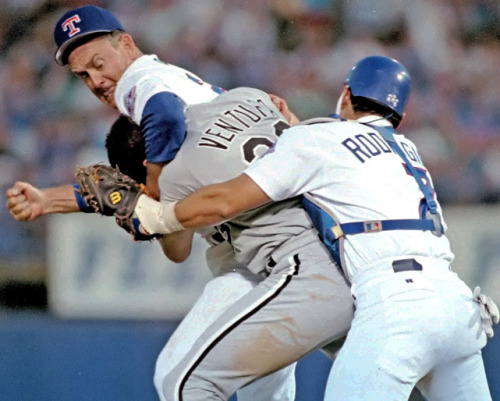
Before coming to the media capital of the world, Robin Mark Ventura had already been in the media spotlight on a number of occasions.  Sometimes the attention was positive (Ventura set an NCAA record at Oklahoma State University with his 58-game hitting streak in 1987) and sometimes he was getting a noogie from future Hall of Famer Nolan Ryan.

But one thing was for certain.  Robin Ventura was a complete player.  In ten years with the White Sox, Ventura had six seasons of 90 or more RBIs, surpassed 20 homers five times and hit over .280 in five different campaigns.  He was also an outstanding defensive player, winning five Gold Gloves as a member of the White Sox.  Although Edgardo Alfonzo was a good player at the time, he had never hit as many as 20 HR or collected as many as 80 RBIs.  He had also never been rewarded with a Gold Glove Award in four years with the Mets.  Robin Ventura had accomplished all of those feats prior to becoming a Met.  And in 1999, he was on a mission to accomplish the trifecta again.

In his first year in New York, Robin Ventura wasted no time getting acquainted with National League pitching.  The Mets' new third baseman hit .375 with five extra-base hits (three doubles, two homers) and 11 RBIs over his first ten games.  His torrid start put him among the league leaders in RBIs and made him one of the few players in Mets' history to reach 20 RBIs in a season before the end of April.  (In 1994, Jeff Kent set the franchise record for RBIs in April with 26.)

But once April turned into May, Ventura suffered his first slump as a Met and the team soon followed.  After defeating the Astros on May 3, the Mets' record stood at 17-9.  The team then went on to lose 19 of their next 28 games to fall below the .500 mark at 27-28.  During the month-long meltdown, Ventura batted only .240, dropping his season average to .268.  Although he still managed to hit eight doubles and five home runs during the 29-game stretch, he began to strike out more often, whiffing 27 times in 100 at-bats.

It was during this otherwise poor stretch that Ventura became the first player in major league history to hit grand slams in both ends of a doubleheader, as he accomplished the previously unprecedented feat against the Milwaukee Brewers at Shea Stadium on May 20.  However, this display of clutch hitting was rare for the Mets in May, and for Ventura in particular.  During the team's month-long slumber, Ventura only managed an additional three home runs and 13 RBIs on days when he wasn't hitting multiple grand slams.  The end result of the team-wide slump was the firing of pitching coach Bob Apodaca, hitting coach Tom Robson and bullpen coach Randy Niemann in early June, which coincided with a season-long eight-game losing streak.

After the dismissal of Apodaca, Robson and Niemann, Valentine famously stated that if the team didn't do well over the next 55 games, then he should also be relieved of his managerial duties.  Wanting to save his manager and the team's season, Robin Ventura went on a hitting tear, beginning with the Mets' 7-2 victory in the Subway Series finale against Roger Clemens and the Yankees.  In that game, Ventura collected two hits and scored two runs off Clemens, as the Mets handed him his first regular season loss in over a year.

The victory over the Yankees put the Mets back on track, as they went on to go 40-15 over their next 55 games, saving Valentine his job.  There were very few players in the National League as hot as Robin Ventura was over the two-month stretch.  From June 6 to August 6, Ventura batted .337 with 11 doubles, 16 HR and 48 RBI.  He also had a .405 on-base percentage and cut down on his strikeouts dramatically, fanning only 29 times in 223 plate appearances.

The Mets were finally cooled down with a loss to the Dodgers on August 7 (a game the Mets' third baseman didn't start), but Ventura's bat continued to smoke.  From August 8 to September 6, Ventura batted .366, lashed 13 extra-base hits (eight doubles, five homers) and drove in 22 runs.  On September 19, the Mets defeated the Philadelphia Phillies, 8-6, with Ventura driving in the game-tying run in the fifth inning.  The win upped the Mets' record to 92-58 and left them one game behind the Atlanta Braves for the NL East lead.  It also gave them a four-game lead over the Cincinnati Reds for the wild card, who had lost that day to the Pittsburgh Pirates.  With 12 games to go in the regular season, the Mets weren't thinking of the wild card.  They wanted to dethrone the Atlanta Braves, who had won eight consecutive division titles.  But things have a tendency to change quickly in baseball, and over the final two weeks of the season, the Mets found out just how true that adage was.

The Mets had a seemingly comfortable lead in the wild card race with 12 games to go.  But then the Mets embarked on a seven-game losing streak.  At the same time, the Reds won seven out of eight games.  With three games left in the regular season, the Braves had already clinched the division title and the Mets were now chasing the Reds and the Astros in the wild card race, as both teams were tied atop the National League Central division with identical 95-64 records.  At 93-66, the Mets were two games out with three games to go.  Their season was in jeopardy of ending prematurely for the second straight year.  But with one swing of Robin Ventura's bat, the team began to believe in themselves again.

On October 1, the Mets began a three-game series against the Pittsburgh Pirates, basically needing to sweep the Bucs and hope for outside help to have any chance of winning the wild card.  The Mets took an early 1-0 lead on Robin Ventura's 32nd homer.  But the Pirates came back and tied the game, sending it into extra innings.  After reliever Pat Mahomes escaped a two-on, one-out jam in the 10th inning, he retired the Bucs in order in the 11th.  In the bottom of the 11th, the Mets put a runner on second base with one out.  After an intentional walk to Edgardo Alfonzo and a groundout by John Olerud, the Pirates decided to walk Mike Piazza to load the bases for Ventura, hoping that southpaw reliever Scott Sauerbeck would retire the lefty-swinging Ventura to end the inning.  The inning did end, but not the way the Pirates wanted, as Ventura lined Sauerbeck's second pitch to right-center for a game-winning single.  As an added bonus, the Astros and Reds both lost to the Dodgers and Brewers, respectively.  The Mets were now one game behind Houston and Cincinnati for the wild card, and Shea Stadium was ready for an epic final weekend.

Going into the season's penultimate game, the Mets already knew that the Astros had won and the Reds had lost.  Houston was now leading the National League Central by a game over Cincinnati.  The Reds' loss meant that the Mets were one win away from tying them for the wild card lead.  Rick Reed was tabbed to start the game on October 2 and pitched the game of his life, striking out 12 Pirates and allowing no runs.  However, Bucs' starter Francisco Cordova was matching Reed zero for zero throughout the first five innings.  All that changed when the Mets came to bat in the sixth inning.  The Mets needed some mojo risin' and they needed it fast.  Up come Robin Ventura to provide the Mets with all the mojo they would need.

With two men on base, Ventura ripped a double down the right field line, plating the Mets' first run of the game.  The Mets scored another run in the inning and added five insurance runs in the eighth inning en route to a 7-0 victory over the Pirates.  The season had come down to Game No. 162, with the Mets and Reds tied for the wild card lead.  Ventura went 1-for-4 in the series finale against the Pirates and was on deck when Mike Piazza watched Brad Clontz's wild pitch bounce over the backstop in the ninth inning, scoring Melvin Mora from third base with the winning run and setting off a wild celebration at home plate in front of the Shea faithful.  Despite the thrilling ending, the Mets could not pop the champagne at home, as the Reds defeated the Brewers that night after a long rain delay, setting up a one-game playoff at Cinergy Field the following night.

Needing one victory to secure their first playoff berth in 11 years, the Mets got off to an early lead, compliments of Edgardo Alfonzo's two-run homer off Reds' starting pitcher Steve Parris.  In the third inning, Robin Ventura collected his 120th RBI of the season, drawing a bases-loaded walk from reliever Denny Neagle to give the Mets a 3-0 lead.  Ventura would reach base two more times in the game, but by then, Mets' starting pitcher Al Leiter had deflated the Reds' bubble, as the Mets went on to win the game and the National League wild card berth, advancing to the NLDS to play the NL West champion Arizona Diamondbacks.

Although Ventura hit only .214 against the Diamondbacks in the series, he found other ways to contribute.  In Game 1, it was Ventura who led off the ninth inning with a single off Randy Johnson.  What made the hit so incredible was the fact that Johnson had allowed a mere nine hits to left-handed batters over the entire 1999 regular season.  Five batters later, Edgardo Alfonzo hit the go-ahead grand slam off reliever Bobby Chouinard to give the Mets an 8-4 lead, a lead that held up in the bottom of the ninth when Diamondbacks' shortstop Hanley Frias popped out to (you guessed it) Robin Ventura to end the game.  The Mets split the next two games before winning Game 4 at home to take the series, with Ventura contributing a double and a walk in the deciding game.  Despite his low batting average in the NLDS, Ventura reached base seven times (four walks, three hits) for a .389 on-base percentage.

In the NLCS, Ventura struggled at the plate, taking oh-fers in each of the first four games.  Ventura didn't get off the schneid until the 11th inning of Game 5, when he singled for his first hit in 17 NLCS at-bats.  Although that hit has long been forgotten, his next hit in the NLCS will always be remembered.  Four innings after his 11th inning single, Ventura lashed another single, although this one carried over the right field wall.  The famous Grand Slam Single gave the Mets a 4-3 victory and sent the team back to Georgia for a Game 6 showdown against the Braves.

Ain't life grand?


Unfortunately, the Mets could not force a seventh and deciding game in Atlanta, but Robin Ventura tried his best to get the Mets to Game 7.  With the Mets down 5-0 in the sixth inning, Ventura was on deck when Mike Piazza hit a sacrifice fly to plate the Mets' first run.  Ventura then doubled to right field off Braves' starter Kevin Millwood and scored on Darryl Hamilton's two-run single.  The Mets had cut the Braves' lead to 5-3 and eventually sent the game into extra innings.  But the magical run ended in the bottom of the 11th inning, when Kenny Rogers walked Andruw Jones with the bases loaded.

Despite hitting a combined .154 (6-for-39) during the Mets' ten-game postseason run in 1999, Robin Ventura provided some of the timeliest hits for the Mets against Arizona and Atlanta.  Ventura was nothing but clutch for the Mets in 1999.  For the season, he set career-highs in batting average (.301), slugging percentage (.529), on-base plus slugging (.908), hits (177), doubles (38) and RBIs (120).  The Mets' third baseman also added 32 homers, scored 88 runs and won his sixth Gold Glove Award.  (He also was prominently featured as part of Sports Illustrated "Best Infield Ever?" story.)  For his efforts, Ventura finished sixth in the National League MVP vote, finishing just ahead of teammates Mike Piazza (7th) and Edgardo Alfonzo (8th).

The 2000 Mets were expected to build upon their success from 1999, with Robin Ventura being one of the key contributors.  Although the team did well in 2000, winning their fourth National League pennant, Ventura did not perform as expected in his second season in New York.  Ventura played in 85 of the team's first 87 games, but only batted .235 with 17 doubles, 16 HR and 53 RBIs.  He was then placed on the disabled list with a bruised right rotator cuff and missed the next 14 games.  Upon returning, he did even worse, batting .227 with six doubles, eight HR and 31 RBIs over his final 56 games.  His final numbers in 2000 (.232, 23 doubles, 24 HR, 84 RBI, 61 runs scored in 141 games) were a far cry from what he produced in 1999. (In fact, Ventura's only positive contribution to the 2000 Mets might have been his one-man performance in Rain Delay Theatre at Yankee Stadium.)  In the postseason, Ventura's batting average continued to suffer, as he hit .167 in 14 postseason games for the Mets in 2000.  He also failed to reach base in any of his last nine plate appearances against the Yankees in the World Series.

Ventura's 2001 campaign was more of the same.  Although his batting average went up slightly to .237 (still nowhere near the .301 average he produced in 1999), Ventura's power and run production continued to suffer.  In 142 games, Ventura hit 20 doubles and 21 HR, but only collected 61 RBIs.  He also struck out 101 times, which was only slightly lower than his hit total (108).  The 108 hits represented a career-low for Ventura over a season in which he played at least 100 games.  Unlike the 2000 season, in which the Mets made the playoffs despite Ventura's subpar campaign, the Mets barely finished above .500 in 2001.  As a result, the Mets decided that they needed to shed their third baseman's high salary and move in a different direction.  They did just that when they dealt Ventura to the Yankees for David Justice, who was then traded a week later to Oakland for pitchers Mark Guthrie and Tyler Yates.

Robin Ventura wasn't all about his bat.  He may have been better with his glove.


Despite only having one outstanding season with the Mets, Robin Ventura is still a beloved figure in New York.  He was an outstanding defensive third baseman during his three years in Flushing and provided many memorable moments for the team, although most of them came during their magical 1999 campaign.  Ventura is now managing the Chicago White Sox, the team for which he played the majority of his professional career.  But no matter what he does in Chicago, Ventura will always have 1999, a season that started out so innocently, but ended with a new Mets legend being born.

From his doubleheader grand salamis in May to his torrid two-month stretch in the summer of '99 to "The Best Infield Ever" to the Grand Slam Single, Robin Ventura was in the middle of many great moments during one of the most memorable seasons in Mets history.  He may not have had the best Mets career, but for one season, he was in the center of it all.  It's no wonder that that one season turned him into the Mets legend that he now is.


Note: One Season Wonders is a thirteen-part weekly series spotlighting those Mets who had one and only one memorable season in New York.  For previous installments, please click on the players' names below:
 
January 2, 2012: Bernard Gilkey
January 9, 2012: Terry Leach 
January 16, 2012: George Stone
January 23, 2012: Roger Cedeño
January 30, 2012: Frank Viola
February 6, 2012: Joe Christopher 
February 13, 2012: Dave Magadan 
February 20, 2012: Pedro Martinez
February 27, 2012: Bret Saberhagen

Senin, 23 Januari 2012

One Season Wonders: Roger Cedeño

When the Mets acquired Mike Piazza from the Florida Marlins in 1998, the writing was on the wall for Todd Hundley.  Hundley was one of only two Mets left on the team who had played for Davey Johnson (John Franco was the other), but had spent the first three months of the 1998 season on the disabled list while recovering from major reconstructive surgery on his right elbow.  Needless to say, Hundley was not happy that the Mets were giving up on him, especially after he had given the team his best two seasons in 1996 and 1997.

Surprisingly, Hundley was not traded immediately upon his return from the DL in July.  Instead, the Mets moved him to left field, displacing Bernard Gilkey, whose poor performance (.237, 3 HR, 24 RBI in 64 games at the time of Hundley's return) moved him to the bench and eventually to the Arizona Diamondbacks three weeks later.  Despite the Mets' willingness to play Hundley, an outfield neophyte, on a regular basis, his performance at the plate suffered.  Hundley finished the injury-shortened 1998 campaign with his poorest line (.161, 3 HR, 12 RBI in 53 games) since his first full season in the majors in 1992.

Finally, after months of speculation, the Mets traded Hundley to the Los Angeles Dodgers for two players.  One of the players was All-Star catcher Charles Johnson, who was immediately shipped off to Baltimore for reliever Armando Benitez.  The other was a 24-year-old utility outfielder who had played parts of four seasons in Los Angeles, never establishing himself as a full-time player.  But once he came over to the Mets, his game took off (literally) and he became a key contributor on a team that was trying to make its first postseason appearance in 11 years.  That player was Roger Cedeño.

Before Jose Reyes wowed Mets fans with his speed, there was Roger Cedeño.


Roger Leandro Cedeño had never accumulated more than 240 at-bats in any of his four seasons as a Dodger.  He also had never shown the ability to be a prolific base stealer in the major leagues.  In 311 games with the Dodgers, Cedeño stole 23 bases, with a career-high of nine of 1997.  However, he was a base-stealing threat in the minors, as evidenced by his 121 stolen bases from 1992-1995.

At the time of the trade, it was assumed that Cedeño would not be the answer to the team's leadoff hitter conundrum.  His career on-base percentage was .317 and he was not a good contact hitter, striking out 158 times in 687 at-bats with the Dodgers.  Therefore, it was not a surprise when the Mets used him primarily as a pinch-hitter and late-inning defensive replacement over the first month of the season.  But that all started to change once May rolled around.

From Opening Day to May 2, Roger Cedeño played in 24 games.  However, he only started nine of those games, as he appeared in eight games as a pinch-hitter, two games as a pinch-runner and five games as a defensive replacement.  As a result, he didn't get much of an opportunity to establish himself as an offensive threat.  Through May 2, Cedeño was hitting .289 with five stolen bases, but had only picked up 45 at-bats.  Then came a rare start on May 3 against the Houston Astros.  It was a night that turned Cedeño's season around.

Given the opportunity to start a game, Roger Cedeño took full advantage.  Against the Astros, Cedeño went 2-for-4 with a walk, two runs scored and two stolen bases.  He got things started with a leadoff single to center in the first inning, then promptly stole second base.  He took third base on a weak groundout to third, then scored on an RBI single by Mike Piazza.  The Mets batted around in that first inning, scoring four times.

By the sixth inning, the Astros had cut the lead to one, as Richard Hidalgo's two-run homer had turned an early 4-0 lead into a tight 4-3 game.  Once again, a rally started by Roger Cedeño gave the Mets some breathing room.  With one out in the sixth, Cedeño doubled to left, then stole third base, giving Edgardo Alfonzo the opportunity to drive in a run without getting a hit, which he promptly did by lifting a sacrifice fly to center, scoring Cedeño and giving the Mets an insurance run.  The bullpen did the rest, and the Mets held on for a 5-3 victory.

The game against the Astros began a stretch in which Cedeño started 10 times in 12 games.  Given his first chance as an everyday player, Cedeño went on a blistering tear, batting .400 and reaching base 27 times (18 hits, nine walks) in those 12 games.  On May 12, Cedeño went 4-for-4 with a walk, three runs scored and a stolen base against the Phillies.  He followed that up two days later by picking up two more hits, scoring three runs and tying a franchise record with four stolen bases against the Rockies.  Naturally, both efforts led the Mets to victories in each game.

Despite a brilliant first half in which hit .332, had a .432 on-base percentage, scored 53 runs and led the league with 46 steals, Cedeño was left off the National League All-Star roster.  Perhaps feeding off his snub, Cedeño continued to excel after the break.  In his first two games following the Midsummer Classic, Cedeño went 4-for-9 with two doubles, three runs scored, three RBIs and four stolen bases.  The four steals gave him 50 thefts on the year, making him the third Met to reach that mark after Mookie Wilson (1982, 1983) and Lance Johnson (1996).

Mets fans saw this quite often in 1999, as Roger Cedeño was the master of his stolen base domain.


Cedeño tied Mookie Wilson's club record for steals when he stole his 58th base on August 10 against Padres' reliever Donne Wall.   He then waited nearly three weeks to break Mookie's mark, but when he did it, he made sure it occurred in a game Mets fans would never forget.

On August 30, the Mets were leading the Astros, 2-0 in the second inning when Cedeño stepped up to the plate after a home run by Darryl Hamilton.  Cedeño followed Hamilton's homer with a single up the middle.  After a strikeout by Rey Ordoñez and a sacrifice bunt by Masato Yoshii, Cedeño stole third base, breaking Mookie Wilson's club record.  The stolen base rattled Astros' starter Shane Reynolds, as he proceeded to give up an RBI single to Rickey Henderson, a single to Edgardo Alfonzo, a two-run double to Robin Ventura and a two-run homer to Mike Piazza.  By the time the inning was over, the Mets had taken a 7-0 lead and the onslaught was on.  The Mets went on to defeat the Astros, 17-1, but the lead story was no longer Cedeño breaking Mookie Wilson's single-season stolen base record, but Edgardo Alfonzo's one-for-the-ages performance, as Fonzie went 6-for-6 with three home runs, a double, two singles, six runs scored and five RBIs.

A week after breaking the stolen base record, Cedeño's batting average had fallen to .306, threatening to dip below the .300 mark for the first time since the day after he became an everyday player in early May.  But then Cedeño turned it up a notch for the stretch run, hitting .359 over the team's final 22 games.  He also reached base at a .431 clip, scored 13 runs and stole six bases as the Mets clinched the wild card berth in a one-game playoff against the Cincinnati Reds.  It was on to the playoffs for the Mets and Cedeño's first postseason experience was one both he and the Mets would always remember.

After starting 106 of the team's final 138 games, Roger Cedeño only started one game in the NLDS against the Arizona Diamondbacks.  But in Game 4, Cedeño kept the Mets' hopes alive with a crucial at-bat.  After the Mets had fallen behind on a two-out, two-run double by Arizona shortstop Jay Bell in the top of the eighth inning, the Mets were six outs away from having to go back to the desert to face eventual Cy Young Award winner Randy Johnson in a fifth and deciding game.  But an error by rightfielder Tony Womack gave the Mets hope and put two runners in scoring position for Cedeño, who had entered the game one inning earlier as a defensive replacement for Benny Agbayani.  Cedeño came through in the clutch, driving in the tying run with a sacrifice fly.  With the new life afforded to them via the bat of Roger Cedeño, the Mets were able to win the game and the series when Todd Pratt hit a walk-off homer to straightaway center over the not-completely outstretched glove of Steve Finley in the bottom of the tenth inning.

Cedeño and the Mets were now off to the National League Championship Series to face their division rivals in Atlanta.  This time, manager Bobby Valentine made sure to get him more playing time.  Cedeño made sure to save the best for last.

The Mets lost the first three games of the NLCS to the Braves, even with Cedeño hitting .429 over the first two games (he did not play in Game 3).  Just like they did in Game 4 of the NLDS, the Mets let a one-run eighth inning lead slip away in Game 4 of the NLCS, as Brian Jordan and Ryan Klesko hit back-to-back home runs off Mets' starter Rick Reed after Reed had faced the minimum 21 batters through the first seven innings.

With the Mets six outs away from elimination, Roger Cedeño led off the bottom of the eighth with a single off Braves' starter John Smoltz.  After Rey Ordoñez popped out on a failed bunt attempt and Benny Agbayani struck out against reliever Mike Remlinger, the Mets were only four outs away from ending their season prematurely.  But Cedeño wasn't about to let the season end without a fight, as he stole second base to put the tying run in scoring position.  Needing to pitch more carefully, Remlinger walked Melvin Mora, putting the go-ahead run on base and setting the stage for volatile closer John Rocker to come into the game to face John Olerud.  In an instant, Cedeño and Mora pulled off a daring double steal, putting two runners in scoring position for the Mets' first baseman.  Olerud then stroked a single to center, giving the Mets a lead they would not relinquish, a lead made possible by the bat and legs of Roger Cedeño.

As Roger Cedeño and Melvin Mora celebrated scoring the tying and go-ahead runs behind him, John Rocker was left to ponder what time he could catch the 7 train out of Shea.


The Mets and Braves battled for 15 innings in Game 5.  Although Cedeño didn't play in the first 14 innings, he did find himself in the right spot at the right time, coming into the game as a pinch-runner for Matt Franco in the 15th.  Cedeño ended up scoring the winning run on Robin Ventura's Grand Slam Single, the only run the Mets needed to take a 4-3 victory over the Braves.

Unfortunately, Cedeño's season ended earlier than it did for his teammates, as he was pulled for a pinch-hitter in the sixth inning of Game 6, as the Mets were rallying from an early five-run deficit.  The Mets had already scored three runs in the sixth and had the tying run at the plate in Cedeño when Bobby Valentine decided to go with a power threat in Benny Agbayani.  The Mets failed to tie the game in the sixth inning and Cedeño was out of the game, five innings before the Mets' season ended when Kenny Rogers gambled and threw ball four to Andruw Jones in the 11th inning.  Who knows if Cedeño would have provided the Mets with a key hit or stolen base in extra innings had he remained in the game?

Despite the disappointing end to the 1999 season, Cedeño had sparkled in the postseason.  Although he started only five games against the Diamondbacks and Braves, the speedster batted .421, scored three runs, drove in three more and stole three bases.  Cedeño had just completed a memorable season, one in which he finally established himself as an everyday player in the major leagues.  His fabulous postseason followed a regular season in which he hit .313, scored 90 runs and stole a franchise-record 66 bases.  So what did the Mets do to reward him for his efforts?  They traded him.

After one season in New York, the Mets dealt Roger Cedeño, Octavio Dotel (who was the winning pitcher in Game 5 of the NLCS) and minor leaguer Kyle Kessel to Houston in exchange for 22-game winner Mike Hampton and rightfielder Derek Bell.  Both Hampton and Bell were one-and-done in New York, as Hampton signed an eight-year free agent contract with the Colorado Rockies following the 2000 season and Bell inked a one-year deal with Pittsburgh.

Cedeño played one injury-plagued season in Houston, batting .282 with 54 runs scored and 25 stolen bases in 74 games before signing a one-year contract to play in Detroit in 2001.  He returned to his past glory in the Motor City, hitting .293 with a career-high 11 triples and 55 stolen bases in 131 games.  Once again, Cedeño was a free agent following the 2001 campaign and the Mets were looking for a speedster.  This time, however, it was a match that should never have been made.

On December 17, 2001, the Mets signed Roger Cedeño to a four-year, $18 million contract.  However, Cedeño showed up at training camp overweight and out of baseball shape, and it showed during the regular season.  In his first year back with the Mets, Cedeño batted .260, had a .318 on-base percentage and only stole 25 bases.  Going into the 2003 season, the Mets were hoping that Cedeño could return to his 1999 self.  Instead, they got more of the 2002 version, as Cedeño batted .267 and reached base at a .320 clip.  However, his stolen bases dropped to 14 despite playing in 148 games and his 60.9% success rate was also the worst of his nine-year career.

Those orange batting practice jerseys weren't very slimming, nor did they help Roger Cedeño recapture the form he once showed for the Mets in 1999.


Finally, after two years of high expectations and an endless stream of boos from the Shea faithful, Cedeño was traded to the St. Louis Cardinals in 2004 for Wilson Delgado.  The Mets did agree to pay all but $1 million of the remaining $10 million left on Cedeño's contract, but they were finally rid of him.

Roger Cedeño came to New York in 1999 after never establishing himself in Los Angeles.  He then put together one of the most unexpected seasons in club annals, helping the Mets reach the playoffs for the first time in 11 years.  Almost as quickly as he got here, Cedeño was gone, traded to Houston for a pitcher who helped the team make it back to the postseason in 2000.  However, despite his comeback season in Detroit in 2001, Cedeño was never as good as he was for that one wonderful season in 1999.  The Mets made the mistake to re-sign him following the 2001 season and the team suffered in the standings, finishing in last place in both years of Cedeño's second stint in New York.

Sometimes it's best to quit when one is ahead.  The Mets and Roger Cedeño were ahead of everyone but the Braves in 1999.  Three years later, both parties were behind everyone in the NL East.  It just goes to show that sometimes a one-season wonder should stop after that one wonderful season.


Note: One Season Wonders is a thirteen-part weekly series spotlighting those Mets who had one and only one memorable season in New York.  For previous installments, please click on the players' names below:
 
January 2, 2012: Bernard Gilkey
January 9, 2012: Terry Leach 
January 16, 2012: George Stone

Sabtu, 22 Oktober 2011

A Curious Stat About '80s World Series Champions

In 1983, Eddie Murray and Cal Ripken Jr. helped lead the Baltimore Orioles to the World Series championship, their third since moving to Baltimore from St. Louis in 1954.  At the time, the Orioles were one of the best teams in the American League.  From 1966-1983, no team in baseball won more pennants than Baltimore's six.  Not the Yankees or the Big Red Machine (they each won four).  Not the Dodgers (they won five pennants, but only one championship).  Not even the Oakland A's dynasty (three titles) could surpass the pennant-winning success of the Baltimore Orioles for an almost two decade span.

Murray and Ripken probably expected more championships following their 1983 title, but in the past 28 years, the city of Baltimore has been left without a World Series championship or an American League pennant.  In fact, they're not the only team to win it all in the '80s and then win nothing since then.

Following the Orioles' run to the championship, the Detroit Tigers spent every day of the 1984 season in first place in the American League East, culminating their spectacular season with a World Series championship.  The Tigers won another division title three years later (1987), a pennant in 2006 and another division title this past season, but have not given Motown another championship since '84.

After Detroit's championship in 1984, the Kansas City Royals were the last team to spray champagne in 1985, albeit with a little help from Don Denkinger's blown call in Game 6 of the World Series.  The 1985 campaign marked the seventh playoff appearance for the Royals in ten seasons, but they have not sniffed the postseason since their one championship season.

We're Mets fans.  We know what happened in 1986.  We also know that the Mets haven't won another World Series in the past quarter century.  We can move on to the next team now.

The 1987 Minnesota Twins finally broke the streak of four consecutive World Series winners in the '80s who have failed to win it all since then.  The Twins repeated as World Series champions four years later when Jack Morris (a key member of the 1984 World Champion Tigers) pitched ten shutout innings in the seventh and deciding game of the 1991 World Series against the Atlanta Braves.  But we can talk about that '91 Twins team later (and we will).

The 1988 Los Angeles Dodgers rode on the coattails of Orel Hershiser's arm and Kirk Gibson's bat to stun the Mets in the National League Championship Series and the trying-to-start-another-dynasty Oakland A's in the World Series.  Unfortunately, the Dodgers have failed to reach the World Series, let alone win it, since then.


Mets fans should remember these faces very well, even if they'd rather forget the 1988 season.  (Photo of Orel Hershiser by Tom Gannam/AP; Photo of Kirk Gibson by Steve Dykes/LA Times)


Remember those "trying-to-start-another-dynasty" A's from the last paragraph?  Sure you do.  Well, they did follow up their loss to the Dodgers in '88 with a championship of their own in 1989, defeating their Bay Area rival San Francisco Giants in four games.  The World Series that was known for the devastating earthquake prior to Game 3 would also be known to A's fans as the last one they would win.

Even after the 1980s ended, the curious stat concerning World Series winners failing to win another title continued.  The 1990 Cincinnati Reds shocked the A's in that year's World Series, sweeping Oakland in four games.  The Reds have failed to win another pennant since then.  The following year, the Minnesota Twins won their second title in five seasons.  Although the Twins have won six division titles in the past decade, they have yet to win the World Series that has eluded them for twenty years.

The 1992 Toronto Blue Jays did win another championship following their six-game defeat of the Atlanta Braves in that year's Fall Classic.  However, that title came the following season (1993).  Toronto has failed to return to the postseason since their mini-dynasty ended.

The 1994 strike killed that year's World Series, but did not kill the streak of World Series winners failing to return to glory following their championship seasons.  That streak had one more season left in it, as the 1995 Braves won their first and only title in Atlanta, defeating the Cleveland Indians (who themselves have not won a championship since 1948, the longest title-less drought in the American League) in six games.


Seriously.  This is a Mets site.  Who authorized the use of this photo?


When the Yankees won the World Series in 1996, it ended a stretch in which ten teams won their final World Series championship in 12 seasons (not including the 1994 season, which had no World Series).  Only the 1987 Twins and 1992 Blue Jays were able to win another championship during those dozen seasons, and both of them have now gone approximately two decades since their last title.

For all the talk about parity in baseball in the 21st century, what with teams like the Texas Rangers, San Francisco Giants and Tampa Bay Rays all competing for World Series championships over the past few seasons when very few experts predicted them to reach the Fall Classic, the real time for parity happened a generation ago.

One-third of the teams in major league baseball all won championships from 1983 to 1995.  None of those teams has been able to scale that mountain again.  It's a curious stat that has been overlooked over the past 20-30 years.  It makes you wonder if the teams that are winning championships now will go that long in search of their next title.

Sabtu, 10 September 2011

17 Games Left: Third Is The Word

With today's loss to the Cubs, the Mets fell to 71-74 on the season.  They remain two thousand games behind the first place Phillies (that will change after tonight's Phillies-Brewers matchup has been completed) and a few hundred games behind the wild card-leading Braves (also pending tonight's game).  However, they do remain four games ahead of the fourth place Nationals and 5½ games in front of the lowly Marlins.

So the question is not whether the Mets can catch the Braves for the wild card or cut the Phillies' lead in the NL East to one thousand games (even though a three-game sweep of Philadelphia in two weeks would certainly help), it's whether or not the Mets can forget that there are 17 games left in the season and hold off the Nats and Fish to finish higher than fourth place for the first time since moving across the parking lot to Citi Field.

The 2007 and 2008 Mets famously went 5-12 and 7-10, respectively, in their final 17 games to lose their not-so-firm grip on first place and the wild card, failing to make the playoffs each year.  The 2009 Mets also went 7-10 in their final 17 games, but managed to hold off the Washington Nationals in their quest for fourth place in the NL East (mission accomplished - yes!)

Last year's team was 72-73 at the 145-game mark, as they were duking it out with the Marlins for third place.  They then proceeded to go (you guessed it) 7-10 in their final 17 games, finishing in fourth place, a game behind the Marlins, but at least ahead of the last place Nats.

So what can we expect the Mets to do this year now that they've reached the dreaded "17 to play" mark of the season?

For one thing, the Mets have what should be a comfortable lead in the NL East over the Nationals and Marlins.  But then again, being four games up on Washington doesn't guarantee anything.  The Nationals still have something to play for.  Since moving to Washington from Montreal following the 2004 season, the Nats have finished last in every year but one (2007, when they finished two games ahead of the cellar-dwelling Marlins).  With the potential for their highest finish in the NL East, the Nationals will surely be playing hard over their final 17 games.  The Marlins, on the other hand, just lost six games over the past two weeks to the Mets.  The demons of 2007 and 2008 have been exorcised and the Marlins should pose no threat to the Mets over their final 17 games (we hope).

A quick look at my once shiny, now falling apart Mets pocket schedule reveals that the Mets will be playing a four-game series with the fourth place (and hungry) Nationals next week at Citi Field.  The Mets cannot lose this series if a) they want to finish .500 or better and 2) they don't want to choke away third place to Jayson Werth and his cohorts.  They must split this series at the very least.  Taking three of four would all but eliminate the Nats from third place contention and a four-game sweep plus drilling Werth in his $126 million @$$ would be the cherry on top of the mediocre sundae.

It would behoove the Mets to do well against Washington because after that series, the Mets will be playing the wild card-leading Braves in Atlanta (they have a worse winning percentage at Turner Field than the Washington Generals have against the Harlem Globetrotters), followed by a trip to St. Louis against the somehow-still-in-it Cardinals, and topped off with a three-game set against the team with the best record in baseball, the Philadelphia Phillies, who somehow are on their way to the best record in franchise history, even without the aforementioned Jayson Werth (guess their key off-season acquisition of Juan Samuel to be their third base coach really panned out for them).

Should the Mets falter against the Braves, Cardinals and Phillies, they'll need to sweep the Reds at Citi Field to close out the regular season to have any realistic hope of finishing ahead of the Nationals for third place.  The lowly Reds surely remember the Mets' first-ever four-game sweep in Cincinnati a few months ago, so they will not be an easy opponent, despite what the won-loss records say.

The Mets have gone 7-10 over their final 17 games in each of the last three seasons (and it's four out of five seasons if you go back to 2006; even that team went 7-10 over their final 17 regular season games).  Doing the same this year would produce a 78-84 record, a one-game dropoff from their 2010 final record.  It would also put them in jeopardy of being passed by the Washington Nationals for third place in the NL East.  Finishing .500 or better should be the ultimate goal for this year's Mets, but finishing in third place is the more likely (and attainable) goal.  It's time to show the rest of the National League East (meaning those teams not named Los Phillies or Los Braves) that this Mets team has had enough of late-season chokes and fourth place finishes.  Say it loud and say it proud!  Third is the word!  And nothing else will be acceptable!

Jumat, 15 Juli 2011

DJ Joey B Presents: Frankie Knuckles' Greatest Hits

What's up, homies? You may know me as Joey Beartran, the roving reporter and culinary expert for Studious Metsimus. But ever since I met Howie Rose during a Mets game in Texas a few weeks ago, I've begun to dream about a career in radio.

The Mets aren't currently hiring, so I decided to go into the radio business for myself as DJ Joey B. And as a bonus to you, the Studious Metsimus reader, I've decided to give you a firsthand look at my first Top Ten countdown. Today's countdown will focus on a former Met who was just traded to Milwaukee. That's right, Mets fans. I'm talking about Frankie Knuckles.

Now, in case you forgot, Frankie Knuckles is not the name of the newest character on MTV's "Jersey Shore". Rather, it is the pseudonym for Francisco Rodriguez, a nickname given to him by my colleague after he took part in last year's "Beat Your Dad-In-Law At Work" Day.

Now that Frankie Knuckles has been traded to the Milwaukee Brewers for two players to be named later, (I'm surprised they don't have names yet. Their parents are either very slow or expected to have a girl.) I'd like to present to you Frankie Knuckles' Greatest Hits (pun very much intended). These are the top ten infamous moments in Francisco Rodriguez's short Mets career.


10. Justin Maxwell Goes Grand (9/30/09)

With the season winding down and the Mets already having lost over 90 games for the first time since 2004, Frankie Knuckles was called upon to protect a two-run lead in the ninth inning against the Washington Nationals. In what was a microcosm of the Mets' lost season, K-Rod loaded up the bases with two outs, then forced in a run by walking Adam Dunn. He then found the plate and Justin Maxwell found his home run swing. Maxwell's walk-off grand slam gave the Mets their final loss of the season.


9. Second Verse, Same As The First (7/3/10)

Less than a year after his Maxwell Meltdown, it was deja vu all over again for Frankie Knuckles and the Mets. In a game started by Nationals' phenom Stephen Strasburg, it was the Mets who held a 5-3 lead going to the bottom of the ninth inning. Three walks and three hits later (including a two-run double by Adam Dunn that might have been called a walk-off grand slam had it not been for instant replay), the Nationals had the victory and K-Rod had ruined my first Mets game in Washington (yes, I was there...you can read about my experience at the game here.)


8. When A Win Feels Like A Loss (7/18/10)

In yet another game I attended (this time at AT&T Park in San Francisco), the Mets held a two-run lead over the Giants going to the bottom of the ninth inning. Of course, your fav'rit Mr. Knuckles coughed up the lead, giving up two runs in the inning. However, it should have been three runs and a loss for K-Rod and the Mets, but a blown call by home plate umpire Phil Cuzzi on what should have been Travis Ishikawa's game-winning run, gave the Mets a second chance. The Mets took advantage of Cuzzi's call, scoring a run in the tenth inning, before K-Rod got out of a self-induced jam in the bottom of the inning. We gave a courtesy cheer after K-Rod retired the final batter with the tying and winning runs on base, but it sure felt like a loss.


7. The Game Just Kept Going...And Going...And Going (4/17/10)

In one of the craziest games in recent memory, the Mets and Cardinals played to a scoreless tie through 18 innings at Busch Stadium. St. Louis had already used their entire bullpen and utility infielder Felipe Lopez (who pitched a scoreless 18th). Then they relieved their position player with another position player, Joe Mather, who promptly gave up the first run of the game in the top of the 19th inning. Enter Frankie Knuckles. He allowed St. Louis to tie the game in the bottom of the 19th. Fortunately, Mather was left in the game to pitch the 20th inning and the Mets re-took the lead. This time, K-Rod was not allowed to finish what he started, and Mike Pelfrey was brought in to record his first career save.


6. S.D.S.D. (San Diego Slam Dancing) (8/7/09)

Everth Cabrera had hit a whopping one home run in his major league career. Then he came up to bat against Frankie Knuckles with the bases loaded in the bottom of the ninth inning after the Padres had already tied the game. Nine pitches later, Cabrera had doubled his career home run total. Another day, another walk-off grand slam.


5. What The 'Eck Is Going On Here? (6/2/10)

Little David Eckstein, all three feet, six inches of him (give or take a few inches) was the Padres' last chance when he batted against Frankie Knuckles with two outs in the bottom of the ninth inning in a game led by the Mets, 1-0. K-Rod had just struck out the previous two batters (Matt Stairs, Jerry Hairston) with the tying run in scoring position. First pitch to Eckstein, strike one. Second pitch, strike two. Third pitch, base hit up the middle, tying run scores. Sigh. At least K-Rod didn't lose this game. That "honor" went to Raul Valdes, who gave up the Frankie Knuckles Special, a walk-off grand slam to Adrian Gonzalez.


5. Thank You Sir, May I Have Another? (5/27/11)

The Mets had come from behind against their arch-rivals from Philadelphia at Citi Field, erasing a 2-0 deficit by scoring single runs in the fifth, sixth and seventh innings. They kept that 3-2 lead until the eighth inning, when the Phillies tied it. With the game knotted at 3 going to the ninth inning, Frankie Knuckles was summoned from the bullpen, trying desperately to keep the game tied. He started out fine, retiring Raul Ibañez on a fly ball to center. Then the hits kept coming, and coming, and coming some more. Carlos Ruiz stroked a single. Then Ross Gload picked up a hit. Then Domonic Brown did the same. So did Chase Utley. And Placido Polanco. When all was said and done, the Phillies had scored three runs on five hits off K-Rod. At least there was a bright side to this performance, as K-Rod didn't give up a grand slam.


4. A Gift For Mariano (6/28/09)

In this game, K-Rod did not blow a lead. Rather, he was called upon to keep the game close. The Mets were trailing the Yankees by a run in the ninth inning. However, K-Rod decided to give the gift that keeps on giving, walking Brett Gardner and Derek Jeter after allowing a leadoff single to Jorge Posada. Up came Mariano Rivera, the Yankees' closer who had never driven in a run in his storied major league career. After this at-bat, that was no longer the case, as Frankie Knuckles gave Rivera a free pass, forcing in a run. Mariano went on to record his 500th career save after retiring the Mets in the bottom of the ninth, making K-Rod's gift take on a special meaning.


3. Conrad The Barbarian (6/16/11)

In the most recent addition to the list, the Mets appeared to have registered one of their most spirited wins of the year, erasing a four-run deficit against the Braves to take an 8-6 lead into the bottom of the ninth inning. Terry Collins brought in K-Rod to protect the two-run lead, but he gave up a one-out single to Jason Heyward. Up came pinch-hitter Brooks Conrad, who wasn't exactly tearing it up at the major league level (.205, 1 HR, 5 RBI, 17 strikeouts in 39 at-bats) at the time. Too bad Frankie Knuckles wasn't aware of those numbers, as Conrad launched a game-tying two-run homer off the Mets closer. The Braves went on to win the game in the tenth inning, preventing the Mets from going above .500.


2. Two Hands (6/12/09)

Although this moment ranks at No. 2, it was the lack of that number that caused K-Rod to lose the game, as Luis Castillo failed to use two hands to catch Alex Rodriguez's pop-up on what should have been the final out in a Mets victory. Instead, he dropped the ball, the Yankees scored the tying and winning runs (with Mark Teixeira hustling all the way home from first), and Frankie Knuckles probably pondered using those knuckles on Luis Castillo's head. Speaking of using one's fists...


The No. 1 Infamous Moment For Frankie Knuckles As A Met Is...

What else could it be? It's the one moment that didn't take place on the baseball diamond, but got more coverage than anything K-Rod ever did on the field. On August 11, 2010, Francisco Rodriguez earned the name Frankie Knuckles by assaulting his girlfriend's father in the Mets clubhouse following the Mets' 6-2 loss to the Colorado Rockies. He was arrested and did not play for the Mets again in 2010, as the Papi Punch tore a ligament in K-Rod's thumb. It also bought him an anger management course and began the countdown towards his departure from the Mets, which was made official after this week's All-Star Game.

So long, K-Rod. You can leave your time card behind. We'll remember to punch out for you.