Tampilkan postingan dengan label John Maine. Tampilkan semua postingan

Senin, 26 Maret 2012

One Season Wonders: The 2006 Mets

After their improbable run to the 2000 World Series, it seemed like the Mets were always one player away from taking it all.  By 2002, with deals made for Mo Vaughn, Roberto Alomar and Jeromy Burnitz, it seemed as though then-GM Steve Phillips was serious about making the Mets legitimate. By then, however, Mike Piazza had started to show signs of wear and tear for a catcher, and fan-favorite manager Bobby Valentine had shown signs of wearing out his welcome in New York.

The Mets needed a philosophy change, desperately.  Then came 2004 and the "Black Friday" deal of trading Scott Kazmir for Victor Zambrano, and it was decided that enough was enough.  Then-GM Jim Duquette and then-manager Art Howe were no longer lighting up the room, and something needed to be done.

Former Montreal Expos General Manager, Omar Teodoro Antonio Minaya y Sánchez, was hired to be the autonomous General Manager of the New York Metropolitan Baseball Club.  One of the first things he did was hire rookie manager Willie Randolph to head up his team, under the philosophy of "pitching, speed and defense."  With Minaya on board for his first full season, he made it clear that losing was not going to be an option in 2005.  And what better way to show fans he was being serious about it than by bringing in Pedro Martinez, perhaps the most sought after free-agent pitcher on the market and starter for the defending World Series champion Boston Red Sox.  Add Carlos Beltran to this mix of New Mets and the team improved from 71-91 in 2004 to 83-79 in 2005.  The seeds for success had been planted in 2005.  One year later, the team was ready to bloom.

Going into the 2006 season, the Mets still had some holes to fill.  After Mike Piazza hit a career-low .251 in 2005, it was clear that the Mets needed to go in a different direction behind the plate.  Enter Paul Lo Duca, who was an All-Star for the Florida Marlins in 2005.  At first base, the Mets turned to Carlos Delgado, the slugger who had spurned the Mets one year earlier for playing the Latino card in their attempt to sign him.  In right field, Xavier Nady was signed to replace Mike Cameron, whose 2005 season ended abruptly when the former centerfielder butted heads with the current centerfielder (literally) on the field in San Diego.

Finally, the team needed a dependable closer to replace Braden Looper, who was absolutely awful during the final two months of the 2005 season (0-3, 6-for-10 in save opportunities, 6.35 ERA, 1.65 WHIP over his final 18 appearances).  Enter Billy Wagner, the Sandman who gave opposing batters nightmares.

Once the Mets added a few role players who weren't expected to produce much for the team (Jose Valentin, Endy Chavez and Duaner Sanchez, to name a few), the team was ready for Opening Day.  After losing their first five games to start the 2005 season, the Mets needed to get off to a quick start in 2006.  They responded by getting off to one of the best starts in franchise history.

After splitting their first two games of the 2006 season, the Mets tallied seven consecutive victories, sweeping a pair of series against the Marlins and Nationals by a combined score of 35-11.  By April 17, the Mets were 10-2 and became the first team to lead its division by five games after the 12-game mark.  After a victory over the Atlanta Braves on April 29, the Mets' lead in the NL East had grown to seven games, but they had already suffered their first casualty on the mound.  It would become a recurring theme throughout the season.

Brian Bannister was drafted by the Mets in the seventh round of the 2003 amateur draft and made a quick ascent through the Mets' minor league system.  After a sensational 2005 campaign split between AA-Binghamton and AAA-Norfolk (13-5, 2.74 ERA), Bannister joined the major league squad out of spring training in 2006 and made his first start in the second game of the season.  In his first month in the major leagues, Bannister did not disappoint, going 2-0 with a sensational 2.89 ERA, never giving up more than three runs in any of his five April starts.

However, in his fifth start on April 26, Bannister injured his right hamstring while attempting to score on Kaz Matsui's double.  Although the rookie pitcher did score the run, it would be his final appearance until August, as he spent the next four months on the disabled list.

Bannister's injury would lead to the first start made by a pitcher who wasn't one of the original five starters.  On May 2, John Maine became the first pitcher other than Bannister, Pedro Martinez, Tom Glavine, Steve Trachsel and Victor Zambrano to make a start.  Other injuries would beset the team during the season and other starters were brought in to replace the injured starters in the rotation.  Some fared well in their unexpected roles (Maine, Orlando Hernandez), while others did not (Geremi Gonzalez, Jose Lima, Mike Pelfrey, Oliver Perez, Alay Soler and Dave Williams, all of whom made at least three starts for the 2006 Mets).

Only Maine and Glavine had a sub-4.00 ERA of the 13 pitchers who started at least one game for the Mets in 2006, while seven of the unlucky 13 had ERAs north of 5.00 (Steve Trachsel just missed becoming the eighth member of the mile-high ERA club, finishing the year with a 4.97 ERA despite winning 15 games).  The team's 4.14 ERA was its fifth-highest mark since the Gil Hodges era began in 1968.  Despite their makeshift, lackluster pitching staff, the 2006 Mets found a way to win 97 games.  Needless to say, it was the offense that carried the team to victory more often than not.

Newcomers Paul Lo Duca, Carlos Delgado and Xavier Nady all became major contributors in the Mets' offense.  Lo Duca finished seventh in the National League with his .318 batting average, picking up 163 hits and 39 doubles along the way.  Both of Lo Duca's totals in base hits and doubles represent franchise records for a catcher, breaking Mike Piazza's team records in both categories.

Carlos Delgado did not disappoint with his power production.  His subpar batting average (.265) was barely noticed after he rocketed 38 HR and drove in 114 runs for the Mets in 2006.  Only Darryl Strawberry (39 HR in 1987 and 1988) and Robin Ventura (120 RBI in 1999) had surpassed Delgado's totals in both categories for left-handed hitters in team history.

Xavier Nady was a quiet contributor on the 2006 Mets.  After making his major league debut with the San Diego Padres in 2000, Nady never became a constant presence in their lineup, collecting only 775 at-bats during his tenure in San Diego.  But given the everyday rightfielder's job in New York, Nady blossomed, hitting .310 with 14 extra-base hits (seven doubles, seven home runs) in his first 26 games as a Met.  By late July, Nady was quietly producing the best season of his career.  Then fellow newcomer Duaner Sanchez got the midnight munchies in Miami and Xavier Nady was no more.

By not getting a food plate delivered, Duaner Sanchez could not deliver to the plate after July 30.


Prior to the trade deadline, the Mets were not looking to make a deal for a set-up man.  After all, Duaner Sanchez had performed very well in that role, going 5-1 with a 2.60 ERA.  But when Sanchez was involved in a traffic accident while looking for late-night grub, the Mets needed to find a replacement fast.  As a result of Sanchez's taxicab collision, the Mets were forced to part ways with Xavier Nady in order to acquire set-up man Roberto Hernandez and throw-in Oliver Perez from the Pittsburgh Pirates.

With Nady no longer in right field, Lastings Milledge became the everyday rightfielder.  But Milledge was not ready to become a full-time player in the major leagues, hitting .189 with nine strikeouts in his first 12 starts after the trade.  Three weeks after becoming the everyday rightfielder, Milledge was back on the bench, with newly-acquired veteran Shawn Green replacing him.

Despite the Mets opening up a double-digit lead in the division (due mostly to an impressive 9-1 road trip in June), there was something missing from the team, and that was the team itself.  Due to injuries and poor performances by those enlisted to replace the injured players, the Mets had no consistency in their everyday lineup and starting rotation.

In addition to the 13 pitchers who made at least one start for the Mets in 2006, a total of 15 position players started at least 20 games at a position.  The fact that Paul Lo Duca (117 starts) and Ramon Castro (32 starts) were part of this list is not unexpected, as teams usually use their backup catchers often to give their No. 1 catcher at least one day off per week.  Also not unexpected were David Wright (153 starts at third base) and Jose Reyes (148 starts at shortstop) taking their positions almost every day.  But the other five positions on the field saw 11 different players make at least 20 starts.

Did anyone expect Julio Franco to start 20 games at first base in 2006, especially with Carlos Delgado having a monster year?  He did.  What about Chris Woodward making 33 starts at second base despite Kaz Matsui being the team's everyday second sacker to start the season and Jose Valentin ending the year there?  Woodward got to see more double play balls than he expected.  The oft-injured Cliff Floyd allowed Endy Chavez to start 22 games in left field.  But Chavez actually started more games in center (25 starts) and right (32 starts) than he did in left.

Clearly, there was no consistency to the team, especially in their starting lineup.  That lack of consistency would become more noticeable as the team entered the final month of the season.

The two Mets teams that followed the 2006 squad would be known for what they did over their final 17 games.  But the roots of those late-season collapses may have been traced back to 2006.  After 145 games, the 2006 Mets were proud owners of a 90-55 record and a 16-game lead in the division.  Their fourth 100-win season was within reach, as was their fifth division title.  But with the Mets needing one win against lowly Pittsburgh, the team's play became lackadaisical.  The Mets were swept in Pittsburgh and returned home to face the Florida Marlins.  The Mets did defeat the Marlins on September 18 to clinch their first National League East crown in 18 years, but it was one of their few victories over the final three weeks of the season.

Did Jose Reyes borrow those goggles from Duaner Sanchez?


After their 90-55 start, the Mets lost 10 of their next 13 games (with one of their three victories being the division clincher), before recovering to win their final four games of the regular season.  Although the team struggled to the finish line, they did finish a National League-best 97-65, with no other team in the league winning more than 88 games.  It was on to the NLDS against the wild card-winning Los Angeles Dodgers, but the Mets were going into that series missing a few key pieces.

Original Game 1 starter Pedro Martinez was scratched due to a pair of injuries in his shoulder and calf.  When word came down that Martinez's replacement, Orlando "The Dookie" Hernandez, was also unable to make the Game 1 start due to a calf injury, the Mets went with plan C, John Maine.  The first man to make a start for an injured player during the regular season was now being called upon to do the same in the postseason.  But just as the offense had picked up the beleaguered staff during the regular season, they came through again in the NLDS.

Carlos Delgado, who had never taken part in a playoff game prior to 2006, made quite a splash in his postseason debut, going 4-for-5 with a home run.  Also coming through with their bats were Cliff Floyd, who followed Delgado's blast with a homer of his own, and David Wright, who collected a pair of doubles and drove in three runs.  But the Mets might not have won the game had it not been for an odd play involving Paul Lo Duca at the plate.

With the game scoreless in the top of the second inning, the Dodgers had Jeff Kent at second base and J.D. Drew at first with no outs.  Russell Martin then drove a ball off the right field wall that should have scored at least one run.  However, Kent was slow getting around the bases and was thrown out at home.  Meanwhile, Drew, who never stopped running, was just a few feet behind Kent.  After an alert Lo Duca turned around to see Drew headed toward the plate, he made a quick tag of Drew to complete the unusual double play.  Almost forgotten in the aftermath of the play was that the Dodgers did eventually score a run in that inning to take a 1-0 lead, but it could have been much worse if not for the Dodgers' poor baserunning and the cat-like reflexes of Paul Lo Duca.  That play proved to be the difference in the Mets' 6-5 victory.

 Ernie Banks might have said "let's play two", but Paul Lo Duca said "let's tag two".


Compared to Game 1, the Mets had a relatively easy time with the Dodgers in Game 2, with Tom Glavine pitching beautifully in the team's 4-1 victory, but things got a little dicey in Game 3 with Steve Trachsel on the mound.

After the Mets spotted the longest-tenured Met with a four-run lead in Game 3, Trachsel gave it all back and then some.  By the time the Mets came to bat in the sixth inning, a 4-0 lead had turned into a 5-4 deficit.  But the Mets strung together four hits and a walk to score three runs in the sixth to retake the lead.  They added two insurance runs in the eighth inning before Billy Wagner came into the game in the ninth and got pinch-hitter Ramon Martinez to fly out to former Dodger Shawn Green to end the game, giving the Mets a 9-5 victory and a series sweep.  The Mets had advanced to the NLCS, with the 83-win St. Louis Cardinals standing in the way of their fifth National League pennant.  It looked as if the Mets were going to have an easy ride to the World Series.  But that did not end up being the case.

In a hard-fought Game 1 of the NLCS, the Mets defeated the Cardinals, 2-0, with all the runs scoring on a sixth inning home run by Carlos Beltran.  But in Game 2, the Mets failed to hold a late-inning lead, allowing the Cardinals to score two runs in the seventh to tie the game and three runs in the ninth to win it.  The big blow came off the bat of the light-hitting So Taguchi, who gave the Cards a 7-6 lead with a home run of Billy Wagner in the ninth.  St. Louis added two more runs off Wagner en route to a 9-6 series-tying victory.  The devastating Game 2 loss might still have been on the minds of the Mets as they traveled to St. Louis.  Either that or they lost their bats at the airport, as Jeff Suppan stymied the Mets' high-powered offense, holding them to three hits over eight innings.  Suppan also provided an unexpected blow, hitting a home run off Steve Trachsel to lead off the second inning.  Three batters later, Trachsel threw his final pitch as a Met.  The Mets lost Game 3, 5-0, and were now trailing the series, two games to one.

After feeling good about themselves following their Game 1 victory, the Mets were now one loss away from playing an elimination game.  The Mets had to win Game 4 to prevent that game from happening in front of the raucous Busch Stadium crowd and to guarantee a trip back to New York.  Oliver Perez, who had not pitched in two weeks and had only won one game in seven starts since being traded to the Mets at the trade deadline, was called upon to end the Mets' misfortunes in Missouri.  Needless to say, many people weren't very optimistic about the Mets' chances with Perez on the mound.  Perez didn't pitch very well, allowing five runs on nine hits in 5⅔ innings, but the offense bailed him out.  The Mets' 3 through 7 hitters combined to go 10-for-20 with two doubles and four homers (including two by Carlos Beltran).  They also drove in all of the runs in the Mets' 12-5 win.  With the Mets now assured of making a trip back to Shea Stadium, all they needed to do was win Game 5 in St. Louis and a pennant would be within reach.  That was easier said than done.

Similar to the Mets using Oliver Perez in Game 4, the Cardinals turned to a pitcher they had acquired in July who had underperformed in the regular season.  Jeff Weaver was awful for both the Angels and Cardinals, finishing the 2006 regular season with a combined 8-14 record and a 5.76 ERA.  But despite his poor season, the Cardinals gave him the ball in Game 5.  Weaver shocked the Mets by holding them to two runs in six innings of work, while his counterpart on the mound, Tom Glavine was knocked out of the game before he had recorded an out in the fifth inning.  The Cardinals went on to defeat the Mets, 4-2, to put them within one win of the World Series.  If the 1973 Mets could reach the World Series after only winning 82 regular season games, then the 2006 Cardinals figured they could do the same with 83 victories.  But the 1973 Mets also taught us that "ya gotta believe", and the 2006 version of the team was trying to do just that as they returned to Shea Stadium for Game 6.

With the Mets down three games to two, it was up to rookie John Maine to force a seventh game.  Maine was brilliant for the Mets, pitching into the sixth inning while keeping the Cardinals off the scoreboard, allowing only two hits along the way.  All the tension felt by the fans prior to the game was lifted after only one batter, when Jose Reyes led off the game with a home run.  The Mets added one run in the fourth and two runs off former Met Braden Looper in the seventh to take a 4-0 lead.  Despite another shaky outing by Billy Wagner in the ninth, giving up a two-run double to his NLCS nemesis, So Taguchi, the Mets escaped with a 4-2 victory and were on to their first Game 7 at Shea Stadium since the 1986 World Series.  But because of their lack of starting pitching depth, the Mets had to give the ball to Oliver Perez on only three days rest.  Perez would be facing Jeff Suppan, who had toyed with the Mets with his arm and his bat in Game 3.  One team was about to win the National League pennant, but it was two long fly balls that became the story of the game.

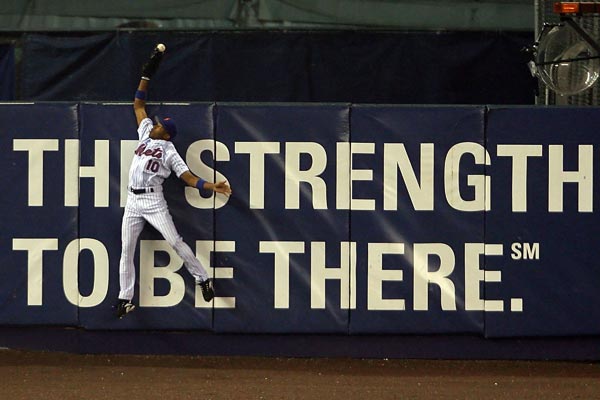
After not fooling the Cardinals in Game 4, Oliver Perez pitched very well in the biggest game of his life, allowing one run through the first five innings.  But after a one-out walk to Jim Edmonds in the sixth, Scott Rolen stepped up to the plate.  Rolen was a .450 career hitter (9-for-20) against Perez with five doubles.  However, he had never hit a home run off the Mets' lefty.  It looked as if that was about to change after only one pitch.  But Endy Chavez had something to say about that.  On Perez's first pitch to the Cardinals' third baseman, Rolen lifted a high fly ball that appeared to be headed for the Cards' bullpen.  But Chavez had the speed and the strength to be there, timing his leap perfectly to rob Rolen of a tiebreaking two-run homer.  After checking to see that the snowconed ball was in his glove, Chavez quickly threw the ball to second baseman Jose Valentin, who fired the ball to Carlos Delgado to double off Jim Edmonds for an inning-ending double play.  Shea Stadium was rocking like it had never rocked before with the Mets seemingly taking the momentum away from the Cardinals.  But they could not capitalize on Chavez's catch for the ages.

In the bottom of the sixth, the Mets loaded the bases with one out, with two participants in the previous half-inning's double play, Valentin and Chavez, coming up.  Cardinals' manager Tony La Russa could have taken starting pitcher Jeff Suppan out of the game at that moment, but chose to leave him in.  It was perhaps the most important managerial decision made in the series.  On a 1-2 pitch, Suppan struck out Jose Valentin, then got Endy Chavez to hit a routine fly ball to center to end the inning.  Neither team threatened in the seventh or eighth innings.  It was on to the ninth inning with the game still tied at one apiece.  Aaron Heilman, who had pitched the eighth inning for the Mets, was allowed to start the ninth.  Before long, his name would permanently become a part of Mets history, but not in the way he intended.

Billy Wagner had not fared very well in the ninth inning during the NLCS, giving up three runs in Game 2 and two more runs in Game 6.  Perhaps that factored into manager Willie Randolph's mind when he left Heilman in the game for the ninth inning.  The move appeared to be a good one after Heilman struck out Jim Edmonds to lead off the ninth.  But then Scott Rolen grounded a single to left to bring up Yadier Molina.  Doing his best Mike Scioscia impression, Molina lifted a long fly ball that carried out of the ballpark, far away from Endy Chavez's glove for a two-run homer.  The light-hitting Molina, who had only hit six home runs during the regular season brought back painful memories of Scioscia, another light-hitting catcher who in 1988 hit a two-run ninth-inning home run in the NLCS at Shea Stadium.  But Scioscia's home run came in Game 4 and only tied the game.  Molina's home run was in Game 7 and gave the Cardinals a two-run lead.

The Mets were now down 3-1 as they came to bat in the bottom of the ninth inning, three outs away from elimination.  Rookie closer Adam Wainwright was called upon to pitch the Cardinals into the World Series.  But he struggled early, allowing back-to-back singles to Jose Valentin and Endy Chavez to lead off the inning.  With the tying runs on base, Cliff Floyd was not called upon to bunt the runners over.  The move ended up being costly, as Floyd struck out on six pitches.  After Jose Reyes lined out to centerfielder Jim Edmonds, Paul Lo Duca, doing his best Gary Carter impersonation, refused to be the final out at Shea Stadium.  Lo Duca walked on five pitches to load the bases and bring up Carlos Beltran.  Wainwright threw two strikes to Beltran to go ahead in the count.  Then this happened...

Boo.

If you were to look at the big picture of the Mets in the last decade, 2006 was the blip on the radar, not the other way around.  Overall, 2006 was no different in how the Mets operated in years past, namely with injuries, bad contracts and reliance upon out-of-their-prime veterans and not-so-ready-for-prime-time rookies.  They were just more successful on paper than previous and post years.   

In fact, if you were to look at how the Mets started to slowly unravel at the end of the 2006 season, it was clear we all were just willing to overlook their shortcomings simply because of how good they did that year.  Most certainly Omar Minaya, Willie Randolph and Fred Wilpon did.  It is true, then, that winning makes you forget about these things.  Now that the Mets haven't won in a few years, we're able to look at 2006 more objectively, as being the one season wonder, the year that maybe shouldn't have been.  

Look at Steve Trachsel, who was an underrated and under-appreciated pitcher for the Mets in his years, winning 15 games that year but under the guise getting great run support.

Look at Jose Valentin and Chris Woodward, starting all those games at second base when they were supposed to be at best super utility players.  Who besides the Mets would give Julio Franco that much playing time, as a 48-year-old man?

Xavier Nady is seen to this day as a cult hero in Mets lore.  The fact that a middle reliever's injury caused so much of a domino effect on the dynamic of the team is a testament to not only how valuable Duaner Sanchez was to the bullpen, but conversely how that team was just one player short of imploding.  

Paul Lo Duca and Billy Wagner had great seasons in 2006, never to be replicated again in a Mets uniform.  

Carlos Beltran and Carlos Delgado fed off of each others production, and paved the way for future leaders of the team Jose Reyes and David Wright.  Now, Reyes is playing for the NL East rival Miami Marlins, and Wright has yet to take that leap to making the Mets his team. 

Lastly, trotting out 13 different starting pitchers, including Jose Lima, and they still won?  Chances are, this was not a formula for success but how lucky are you feeling, punk?   When your postseason hopes are foisted upon the likes of John Maine, Oliver Perez and Orlando "The Dookie" Hernandez, it's evident the 2006 Mets were just lucky to be there.

Prior to 2006, the Mets had made the playoffs six times.  Each of the six trips could be separated into pairs.  The 1969 and 1973 Mets were represented by many of the same players.  The 1986 and 1988 Mets could also be paired off, as the majority of the team in 1986 was still intact in 1988.  And of course, the 1999 and 2000 Mets were practically the same, save for John Olerud and Mike Hampton.  But the 2006 Mets have no postseason cousins.  They're simply a standalone team, a one season wonder on their own.


Studious Metsimus would like to thank Taryn "The Coop" Cooper for her contributions to this piece.  Not only was it her idea for the entire 2006 Mets team to receive the One Season Wonders spotlight, but she also wrote 10½ paragraphs for the piece.  You guess which ones.  For more examples of her writing on the Mets and on her other sports loves, please check out her site, A Gal For All Seasons.


Note: One Season Wonders was a thirteen-part weekly series spotlighting those Mets who had one and only one memorable season in New York. (And on occasion, it wasn't just an individual player that was a One Season Wonder.)  For previous installments, please click on the players' names below:
 
January 2, 2012: Bernard Gilkey
January 9, 2012: Terry Leach 
January 16, 2012: George Stone
January 23, 2012: Roger Cedeño
January 30, 2012: Frank Viola
February 6, 2012: Joe Christopher 
February 13, 2012: Dave Magadan 
February 20, 2012: Pedro Martinez
February 27, 2012: Bret Saberhagen 
March 5, 2012: Robin Ventura 
March 12, 2012: Willie Montañez
March 19, 2012: Lance Johnson 


Jumat, 16 Maret 2012

What Will The Mets Produce Next: A No-Hitter or A 20-Game Winner?


What do the Mets have a better chance of producing?  A no-hitter or a 20-game winner?  On the surface, the question appears to have a simple answer.

Considering that the Mets have had five different pitchers produce a total of eight 20-win seasons (Tom Seaver accomplished the feat four times, while Jerry Koosman, Dwight Gooden, David Cone and Frank Viola each did it once), yet they've never pitched a no-hitter, it would seem that the 20-game winner would be the obvious choice.

But what would appear to be the clear-cut favorite of two things sometimes isn't, as I'm sure fans of the 1988 Mets (boo, Dodgers) and 2006 Mets (boo, Cardinals) can attest.

The five pitchers who won 20 games in a single season for the Mets all experienced great success in the major leagues.  Tom Seaver won 311 games in the big leagues en route to receiving the highest percentage of votes of any Hall of Fame inductee.  Fellow 1969 World Series champion Jerry Koosman finished his career with 222 victories.  Dwight Gooden, David Cone and Frank Viola also had long and successful careers in the major leagues, with Gooden and Cone both winning 194 games and Viola finishing his career with 176 victories.

In addition, four of the five 20-game winners for the Mets also won the Cy Young Award at some point in their careers, with the lone exception being Jerry Koosman, who came tantalizingly close in 1976 when he finished second in the vote to Padres' pitcher (and future Met) Randy Jones.

Here's the kicker.  Although none of the five pitchers ever pitched a no-hitter while in a Mets uniform, three of them (Seaver, Gooden, Cone) accomplished the feat after leaving the Mets, and David Cone took it one step further, pitching a perfect game against the Montreal Expos in 1999 as a member of the New York Yankees.

Tom Seaver never did it as a Met.  Neither did Jerry Koosman, Dwight Gooden, David Cone or Frank Viola.  In fact, no Mets pitcher has ever pitched a no-hitter.  But dozens of Mets hurlers have tossed one-hitters, and not all of them were pitched by All-Stars or future Hall of Famers.  In fact, many of them were pitchers who didn't even win 100 games in the major leagues.

Of course, Tom Seaver leads the list of most one-hitters fired by Mets pitchers with five.  David Cone pitched two complete-game one-hitters as a Met and combined with Jeff Innis on a third.  Dwight Gooden pitched a one-hitter for the Mets during his rookie season, but never pitched another one in a Mets uniform.  Meanwhile, Jerry Koosman and Frank Viola never pitched a one-hitter for the Mets.
 
But Jack Hamilton did.  So did Terry Leach, Pete Schourek, Bobby Jones, Aaron Heilman, Jonathon Niese and R.A. Dickey.  What do all of those pitchers have in common?  None of them won 100 games over their major league careers.  Even Shawn Estes, who won four games as a Met, was able to pitch a one-hitter for the team.  (He could pitch a one-hitter, but he couldn't hit one pitcher.  Ah, the Roger Clemens jokes never get old, do they?)

Both Aaron Shawn Estes and George Thomas Seaver were known by their middle names and they both pitched one-hitters for the Mets.  But Seaver would've hit Roger Clemens if he had the chance.


Want some more?  Gary Gentry pitched two one-hitters as a Met, but only won 46 games in the majors.  John Maine also pitched two one-hitters in New York (with one being of the rain-shortened variety), yet he only won 41 games over his career (so far).  Even the underrated and never quite appreciated Steve Trachsel authored two one-hitters during the 2003 campaign.

A total of 35 one-hitters have been pitched in club annals.  More than half of them (18) have come after 1990.  Why is that year so important?  Because that was the last time the Mets had a 20-game winner.

Since Frank Viola's 20-win season in 1990, no Met pitcher has reached that level of pitching excellence.  In fact, the closest any pitcher has come was in 1998 when Al Leiter won 17 games for the Mets.

For a pitcher to win 20 games, he has to be consistently good over the course of an entire season.  It also helps to have a good bullpen.  Johan Santana went 16-7 for the 2008 Mets, but the bullpen blew seven games in which he left with the lead, costing him a potential 20-win season.  Meanwhile, to pitch a no-hitter, a pitcher only needs to have one game in which he harnesses all of his "stuff" against opposing hitters.

It's rare for a so-so pitcher to win 20 games.  None of the five pitchers who accomplished the feat for the Mets would be considered "so-so".  In fact, Seaver, Koosman, Gooden, Cone and Viola combined to make the All-Star team a total of 19 times as members of the Mets.

But considering how guys like Terry Leach, Pete Schourek and Aaron Heilman all came within one safety of becoming the first Met to pitch a no-hitter, it goes to show that players with nondescript careers can occasionally show flashes of brilliance.

All one needs to pitch a no-hitter is a nine-inning flash of brilliance.  For a pitcher to win 20 games in a season, he'll need a couple hundred innings of brilliance (and a good bullpen).  John Maine won only 39 games in five seasons as a Met, but came within one Paul Hoover dribbler of pitching a no-hitter.  Jonathon Niese has barely cracked 20 wins over his entire major league career, yet he came within a Chris Denorfia double of pitching a perfect game.  Even Pete Schourek and Shawn Estes, who won 20 games COMBINED over their Mets careers, have one-hitters to their credit.

It's true that the Mets have gone 50 years without a no-hitter, but perhaps we'll see one before we see another 20-game winner in a Mets uniform.  It's been 22 years since Frank Viola became to last Met to record 20 wins in a season.  Since then, there have been 18 occasions in which the Mets have come within one hit of recording the team's first no-hitter.  Common sense and superstition might suggest that the Mets will have another 20-game winner before they record their first no-hitter.  But considering how close the Mets have come to pitching a no-hitter on several occasions over the past two-plus decades, while not having a pitcher even sniff a 20-win season over the same time period might suggest otherwise.

What will Mets' pitchers accomplish next?  Will it be a no-hitter?  Or will it be a 20-win season?  It wouldn't surprise me if it was the former rather than the latter.

Jumat, 27 Januari 2012

Maine's In Massachusetts: Red Sox Sign John Maine


On May 20, 2010, John Maine took the mound against the Washington Nationals trying to rebound from his first poor start in a month.  Maine had given up six runs in five innings against the Florida Marlins in his previous start, after a four-start stretch in which his ERA was 2.49.

However, something didn't look right to manager Jerry Manuel after Maine walked leadoff batter Nyjer Morgan on five pitches.  Despite Maine's claims that he felt fine, Manuel took him out of the game.  John Maine never pitched again for the Mets, spending the rest of the season on the disabled list with shoulder fatigue.  When the Mets chose not to re-sign Maine during the offseason, he became a free agent and agreed to a minor league deal with the Colorado Rockies, going 1-3 with a 7.43 ERA in 11 starts for their Triple-A affiliate, the Colorado Springs Sky Sox, in 2011.

Now comes word that John Maine will be changing his Sox, as the former Met hurler has agreed to a minor league contract with the Boston Red Sox and has been invited to their spring training camp to compete for a spot on their roster.  Should Maine break camp with the Red Sox, he will be used as a relief pitcher, a role in which he has been rarely used.

Maine pitched for the Mets from 2006 to 2010, going 39-32 with a 4.17 ERA.  He ranks 23rd all-time in wins as a Met.  He also ranks in the top 20 in winning percentage (.549, 14th), fewest hits per nine innings (7.85, 8th) and most strikeouts per nine innings (7.76, 6th).  In addition, Maine was 1-0 with a 2.63 ERA in three postseason starts for the Mets.  And of course, Maine almost pitched the team's first no-hitter in the penultimate game of the 2007 season, helping the Mets temporarily stave off elimination with his 14-strikeout performance against the Florida Marlins.

If John Maine makes the Red Sox out of spring training, he will play for another former Met, as Bobby Valentine is the new skipper in Beantown.  As Mets' manager from 1996 to 2002, Valentine was known for going to his bullpen early and often.  None of Valentine's pitching staffs in his six-plus years as Mets' skipper recorded 10 complete games (the 1998 and 2002 squads had nine complete games apiece).  Prior to Valentine's arrival in New York, the Mets had never had a full, non-strike shortened season in which the starting staff didn't reach double digits in complete games.

Given that Maine's role on the Red Sox would be out of the bullpen, he'd probably get his fair share of opportunities to pitch for Bobby Valentine.  Of course, he has to make the team first.  Considering his lack of success (and health) since 2010, that might be easier said than done.

As a Mets fan who was also a John Maine fan, I'd like to wish him all the luck in the world as he tries to return to the major leagues as a member of the Boston Red Sox.  More than likely, he's going to need it.

Minggu, 19 Juni 2011

Mike Pelfrey: Standing Tall At Home

Look at the photo to the left. That was the linescore from last night's game, a complete game victory by Mike Pelfrey in which Big Pelf was voted co-player of the game with Carlos Beltran (who hit a monster two-run homer that was estimated at 460 feet).

It was the first complete game of the season for a Mets pitcher and the first by Pelfrey since 2008, when he pitched all nine innings in back-to-back starts on August 20 and August 25. What do those games in 2008 and last night's game have in common? All three efforts came at home. In fact, over his career, Big Pelf has stood quite tall at home, while wilting on the road.

Since coming up to the Mets in 2006, Mike Pelfrey has made 128 starts, going 47-46 with a 4.35 ERA, numbers that suggest a mediocre pitcher. However, his home/road splits suggest that Pelfrey is a Dr. Jekyll and Mr. Hyde type pitcher, as he performs surgery in his home uniform, but hides his talent in his road grays.

In 71 career home starts, Big Pelf is 29-21 (.580 winning percentage) with a 3.53 ERA. At Shea Stadium and Citi Field, he has given up fewer hits than innings pitched (446 hits in 450.2 innings) and has allowed only 24 home runs. The road is an entirely different story.

Mike Pelfrey has made 57 starts on the road. In those games, Pelfrey is 18-25 with a whopping 5.50 ERA. He has given up 392 hits in 322.1 innings and has allowed 38 home runs. Opposing batters hit .307 against him on the road, as opposed to .260 at home.

The home/road disparity has been more pronounced this year, as Pelfrey is undefeated at home (3-0) with a 2.96 ERA and 1.09 WHIP. Opponents hit .220 against him at Citi Field and he has allowed four home runs in 48.2 innings. On the road, Pelfrey becomes Little Pelf, going 1-5 with a 6.75 ERA and 1.52 WHIP, allowing a .308 batting average and nine home runs in 41.1 innings.

Pelfrey's home/road splits are reminiscent of John Maine, the former Met right-hander who finished his career in New York with a 39-32 record and a 4.17 ERA. However, Maine was 22-14 with a 3.61 ERA at Shea Stadium/Citi Field and 17-18 on the road with an ERA a shade under 5.00.

Mike Pelfrey was regarded as a top prospect when he was first called up to the Mets in 2006. But while he has shown flashes of brilliance (13-11, 3.72 ERA in 2008, 15-9, 3.66 ERA in 2010), he has never been able to sustain that brilliance for an entire season's worth of games.

Pelfrey is the dictionary definition of a streaky pitcher. When he's hot, he's unhittable (see April 2010). When he's not, he makes fans wonder why he's still on the team (see April 2011).

If Mike Pelfrey is ever going to become a true ace (not the de facto ace because the team's true ace is out until who knows when), he must be able to translate his brilliance at home into road success. He can't forget to pack his talent in his suitcase when he's about to board a plane to another city. To be fully successful, a pitcher has to be consistently good all of the time. If a pitcher like Mike Pelfrey is going to be a success half of the time, then he's going to be the first syllable of the word "success" the other half.

Mike Pelfrey is better than that. He just has to stand tall on the road to fully realize his potential.

Kamis, 29 Juli 2010

Dickey-licious!

R.A. Dickey was not supposed to contribute much to the 2010 Mets. After all, how much can a team expect from a guy who only had 22 major league wins and 5.43 career ERA over his first seven major league seasons? Surely, the Mets were only expecting to have him as a backup who would occasionally get a spot start if needed.

Then Oliver Perez and John Maine went down with injuries, proving that occasionally Mets fans' prayers are answered. Up came R.A. Dickey, who was only supposed to fill in as a starter until half of the original lineup of Johan Santana and The Four Rainouts returned from their injuries.

Fourteen starts later, Dickey is not only still in the rotation, he is a key cog in the Mets' quest to have meaningful games in September.

Today, Dickey floated his knuckleball past the Cardinals for 8.1 innings, allowing only four hits and two walks. The 4-0 victory was the major league leading 14th shutout by the Mets, and was the fifth time Dickey held his opponent scoreless while he was on the mound. For his efforts, Dickey earned his first victory since June 23.

Prior to today's outing, through no fault of his own, Dickey had failed to win a start in the month of July. The Mets had lost all five of his starts despite fantastic performances in all five outings (1.89 ERA, .230 batting average against, .271 OBP).

Today looked like a day Dickey was going to have to carry the team on his own. The Mets had just suffered an 8-7, 13-inning defeat last night in a game that took over four and a half hours to complete. The offense, which had inexcusably been missing for most of the month of July now had an excuse to be absent after playing for so long last night. In addition to the tired offense, David Wright had been given the day off after appearing to break out of his mini-slump by collecting three hits last night. Had the Mets been shut out today, would anyone have been surprised?

Then Ike Davis (who had been given the night off on Wednesday so that Mike Hessman could get his first start for the Mets at first base) gave Dickey all the runs he needed by breaking the scoreless tie with a three-run homer in the third inning of today's game. Once Dickey had the lead, he carved through the Cardinals' lineup, facing one batter above the minimum until the ninth inning, when he got into a bit of trouble and had to be relieved by Frankie Rodriguez.

Today's game marked the 12th time in 14 starts that Dickey has given up three earned runs or less. By comparison, since signing his three-year, $36 million deal prior to the 2009 season, Oliver Perez has also given up three earned runs or less in exactly 12 starts. It took R.A. Dickey a little over two months to do what Oliver Perez has done in one and a half years (and has been paid handsomely to do so).

Speaking of the impeached El Perez-idente, Ollie has not pitched more than 6.1 innings in any of his 21 starts since signing the aforementioned three-year contract. What about Robert Alan Dickey? He has pitched at least six innings in 12 of his 14 starts. However, one of the two starts where he did not make it through the sixth inning was last Sunday, when Jerry Manuel pulled the non-injured Dickey from the game because of apparent injury. The removal angered Dickey, who had only thrown 70 pitches and was pitching a two-hit shutout against the Dodgers at the time.

A well-rested Dickey put aside his differences with Dead Manuel Walking to handcuff the non-rested Cardinals today. In doing so, Dickey lowered his ERA to 2.32, which would be good enough for fourth in the National League if he had enough innings pitched.

(Special note: Dickey falls just short of qualifying for the ERA title, as he has pitched 92 innings over the Mets' first 102 games. A pitcher must pitch one inning for every game his team has played to be considered among the league leaders. I hope you're taking notes, as this will be on the quiz.)

R.A. Dickey has been better than expected since being promoted to the major leagues. The 35-year-old journeyman pitcher has gone from fill-in to dependable starter over the course of the past two months.

With John Maine's Met career almost certain to be over and Oliver Perez banned from taking the mound within two hours of the Star Spangled Banner, it appears as if R.A. Dickey and his tantalizing knuckleball might be a part of the Mets' rotation beyond this season. How Dickey-licious is that?

Jumat, 11 Juni 2010

Another No-Name Keeps The Mets From A No-Hitter

Do you recognize that mug to the left? No? Then welcome to the club. The man in the Padres hat is Chris Denorfia, and he became the latest player to keep the Mets from finally recording their first no-hitter.

Last night, Chris Denorfia lined a leadoff double in the third inning against Jonathon Niese. It turned out to be the Padres' only hit (and only baserunner) of the game.

Denorfia now has full membership in the Mets' No-Hitter Breaker-Uppers Club, which is supposedly somewhere near the Caesar's Club and the Acela Club. In joining players like Jimmy Qualls, Chin-Hui Tsao, Kit Pellow and Paul Hoover, Denorfia is entitled to full Club privileges. These privileges include being booed mercilessly by Mets fans who have great long-term memories and the right to never be known for anything else other than being the one man who prevented the Mets from finally achieving that ever-elusive first no-hitter in franchise history!

Let's talk more about the latter privilege discussed above and the other Club members we mentioned.

Jimmy Qualls

Jimmy Qualls was given Club membership when he broke up Tom Seaver's perfect game on July 9, 1969. After denying Seaver his perfecto, Qualls went on to rack up only 91 more at-bats in his short career. The ninth-inning hit against Seaver was the 12th of the 31 hits collected by Qualls over his short career that saw him start only 20 games in the major leagues. However, one of those 20 games was on July 9, 1969.


Chin-Hui Tsao

Chin-Hui Tsao had a short-lived career as a pitcher for the Rockies and the Dodgers. In his fifth major-league start on August 18, 2003, Tsao opposed Steve Trachsel for the Mets. After Trachsel retired the first 17 batters to face him, Tsao hit a double to break up the no-hitter and perfect game. The two-bagger was the first hit and only double of Tsao's career, a career that saw him start only three more games, appear in 42 others as a reliever and spawn only one more base hit, which he collected five days after joining the No-Hitter Breaker-Uppers Club.

Kit Pellow

Kit Donovan Pellow (yes, his birth certificate really does list "Kit" as his first name) played briefly for the Kansas City Royals before signing with the Colorado Rockies in 2003. His moment in the sun came in his final year in the majors, when he doubled to break up Tom Glavine's no-hit bid with two outs in the eighth inning on May 23, 2004. The double was one of only 52 hits picked up by Pellow in his career. It was also the last double of his career. After joining the Club, Pellow only started seven more games in the big leagues and picked up eight additional base hits, none of which put him on another team's No-Hitter Breaker-Uppers Club.

Paul Hoover

Paul Hoover wasn't even supposed to be in the game on September 29, 2007. However, Marlins' starting catcher Miguel Olivo had been ejected from the game in the fifth inning for charging at Jose Reyes, who was standing on third base, igniting a bench-clearing incident. Three innings later, Hoover hit a 30-foot roller in front of home plate that didn't roll foul. The squibber ended John Maine's no-hit bid with two outs in the eighth inning. It was one of only three hits picked up by Hoover in 2007. Although Hoover made his major league debut in 2001 and has played in the majors as recently as three weeks ago with the Philadelphia Phillies, he has still only amassed 25 hits in the big leagues in 96 official at-bats. The No-Hitter Breaker-Uppers Club is the only thing that has rescued Hoover from baseball anonymity.

Last night, Jonathon Niese became the latest Met to be victimized by a member of the No-Hitter Breaker-Uppers Club when Chris Denorfia recorded the only hit against him in the third inning. It's only fitting that it was a player like Denorfia who got the hit. After all, looking at his career statistics, he seemed destined to become a Club member.

Denorfia broke into the major leagues in 2005 with the Cincinnati Reds and is now playing for his third major league team. Despite the fact that he has been on a major league roster for five of the past six years, he has only collected 74 hits in the big leagues, of which 16 have been doubles. Unfortunately for Jonathon Niese and the Mets, hit #74 and double #16 prevented no-hitter #1 from happening.

The No-Hitter Breaker-Uppers Club card has its advantages, which is why card-carrying members should never leave home without it. After all, unless if you're a Mets fan, no one would ever have any idea who these Club members were.


Minggu, 23 Mei 2010

Jose Lima And The Final Destination Of The 2006 Mets Starting Pitchers

We regret to inform you that former Mets pitcher and Studious Metsimus whipping boy Jose Lima passed away earlier today at the age of 37. The cause of death was reported to be a heart attack.

Lima is now the second pitcher who started at least one game for the 2006 Mets to pass away, following the death of Geremi Gonzalez (who was then known by his hip-hop nom de plume, Jeremi Gonzalez) in 2008. Gonzalez was killed at the age of 33 after being struck by lightning in Venezuela.

Back in October, Studious Metsimus jokingly reported that after the Mets released Jose Lima in 2006, he put a hex on the franchise, lovingly referred to as "The Curse of Lima Time". The hex was supposedly the reason for the Mets' failure to reach the World Series in 2006, as well as their late-season collapses in 2007 and 2008.

But is the curse real? Has it expanded beyond a Studious Metsimus story? A look at the 13 starting pitchers who took the mound for the Mets in 2006 seems to suggest that it might have escaped the confines of this blog and gone searching for the Unlucky 13.

Tom Glavine (32 starts) - Failed to get more than one out for the Mets in the 2007 season finale. Later went back to Atlanta where he picked up two wins and was released by the team in 2009. By co-inky-dink, he ended his career the way he began it, by going 2-4 with a 5.54 ERA for the Braves in 2008. He also went 2-4 with a 5.54 ERA for the Braves in 1987.

Steve Trachsel (30 starts) - After leading the 2006 Mets with 16 wins, the Human Rain Delay II (with apologies to the original Human Rain Delay, Mike Hargrove) signed a free agent contract with the Baltimore Orioles in 2007. He was traded in August 2007 to the Chicago Cubs, then re-signed by the Orioles the following off-season, before being released by Baltimore in June 2008. His post-Mets stats for the 2007 and 2008 seasons? How about a 9-16 record and a 5.60 ERA.

Pedro Martinez (23 starts) - Started off brilliantly in 2006, winning his first five decisions. Then he was placed on the disabled list after pitching horribly in his return to Fenway Park. After coming back from the DL, he pitched poorly in the potential division clincher at PNC Park and was caught weeping in the dugout. He signed with the Phillies in 2009, but his affiliation with the Bloods (see photo, below) helped bring about his downfall. As of now, Pedro is still unemployed.

Orlando Hernandez (20 starts) - It looked as if the Curse of Lima Time was going to escape Orlando "The Dookie" Hernandez. After all, he was surprisingly effective for the Mets after being acquired in a trade from the Arizona Diamondbacks. The Dookie went 9-7 for the Mets and struck out nearly a batter per inning (112 Ks in 116.2 innings). However, The Dookie met The Curse right after he was named the starting pitcher for Game 1 of the 2006 NLDS. While running sprints in the outfield, the then-57 year old Dookie tore a calf muscle and had to be removed from the postseason roster. Despite his AARP membership and injury history, the Mets signed Mr. Dookie to a two-year, $12 million contract that off-season. They were rewarded by getting 24 starts from The Dookie in 2007 and no starts in 2008. He then signed a minor league deal with the Texas Rangers in 2009, only to be released a month later. No longer in baseball, The Dookie has apparently been offered three lucrative deals to be the spokesperson for Geritol, Metamucil and Depends undergarments.

John Maine (15 starts) - Maine was originally the throw-in when the Mets unloaded Kris and Anna Benson to the Baltimore Orioles for Jorge Julio (who was then traded to Arizona for The Dookie). Maine impressed so much as a rookie for the Mets in 2006 that he earned a spot on the postseason roster. His victory in Game 6 of the NLCS helped the Mets reach the do-or-die Game 7 against the Cardinals. Nowadays, Maine can be seen moping around the clubhouse, weak shoulder dragging along beside him. The scowl that once helped get hitters out is now solely used whenever Jerry Manuel is in the room with him.

Alay Soler (8 starts) - Pitched a complete-game shutout against the Arizona Diamondbacks in his fourth major league start. Three starts later, he gave up eight runs to the Boston Red Sox. After that game, he was told to watch tapes of his outing against the Diamondbacks to prepare for his next start against the Yankees. The Curse of Lima Time struck again, as the tapes were misplaced and instead Soler watched the tapes from his Boston Massacre. He learned well, as he gave up another eight runs to the Yankees. So long, Soler. That marked the end of his short-lived major league career.

Oliver Perez (7 starts) - When the Mets needed a reliever to replace Duaner Sanchez, they traded Xavier Nady to the Pittsburgh Pirates for Dominican food intolerant Roberto Hernandez and Oliver Perez. Perez did not pitch well for the Mets after his trade, going 1-3 with a 6.38 ERA. He did pitch in Game 7 of the NLCS and then went 25-17 over the next two seasons, fooling the Mets into giving him a 3-year, $36 million contract after the 2008 season. Since signing the mega-deal, Perez has "rewarded" the Mets with three victories. However, sales of antacids have increased exponentially in Flushing.

Brian Bannister (6 starts) - The son of former major league pitcher Floyd Bannister was a respectable 2-0 with a 2.89 ERA for the 2006 Mets before the Curse of Lima Time found him on the bases at the park formerly known as Pac Bell. While trying to score a run, Bannister left his hamstring in San Francisco and missed the next four months of the season. Bannister was not himself after his return, going 0-1 with an 8.10 ERA. He was traded that off-season to the Kansas City Royals for future felon Ambiorix Burgos, proving that the Curse of Lima Time was contagious.

Victor Zambrano (5 starts) - I won't waste your time. You already know his story. He was cursed before Lima could get to him.

Dave Williams (5 starts) - Williams was never meant to make that many starts for the Mets, but the Mets membership in the Injury of The Week Club forced him into action five times. Williams went 3-1 for the Mets in 2006, but the good record was due to excellent run support, as his ERA was a high 5.59. Williams was not as lucky in 2007, appearing in only two games for the Mets. Perhaps his 22.85 ERA had something to do with the lack of appearances. Williams has not pitched in the major leagues since.

Mike Pelfrey (4 starts) - Apparently was born with the antidote to the Curse of Lima Time in his blood. After his breakout 2008 season, Big Pelf struggled in 2009, but has been the Mets' best starting pitcher in 2010, going 6-1 with a 2.86 ERA over the first quarter of the season. He may be the key to curing all those afflicted by the Curse.

Jose Lima (4 starts) - Just like Lou Gehrig wasn't immune to the disease named after him, Jose Lima fell to the Curse that took his name. Lima never pitched again in the major league after his brief tour of duty with the Mets, a tour that included an 0-4 record and a 9.87 ERA.

Geremi Gonzalez (3 starts) - Gonzalez started against Randy Johnson in the first game of the 2006 Subway Series at Shea Stadium and gave up four runs in the first inning. The Mets eventually won that game on David Wright's walk-off hit off Mariano Rivera in the bottom of the ninth inning, making Gonzalez the answer to the trivia question, "Who sucked so badly in Game 1 of the 2006 Subway Series that the Mets needed a walk-off hit by David Wright to win the game?" Unfortunately for Gonzalez, he made a better lightning rod than starting pitcher, as he was killed during a thunderstorm in his native Venezuela.

The Unlucky 13 (other than Mike Pelfrey) have suffered professionally and personally since the 2006 season. The so-called Curse of Lima Time has claimed careers and lives, including the man for whom it was named.

Although this blog was written as a humor piece, we do not mean to poke fun at the death of Jose Lima. Lima was a fun-loving man who had a respectable major league career. He was also a positive presence in the clubhouse.

Studious Metsimus would like to offer our condolences to the family and friends of Jose Lima. He will be missed in the major league community and of course, in the blogging community. May he rest in peace.

Minggu, 16 Mei 2010

From Worst To First To Worst Again

The Mets were defeated by the Florida Marlins today by the final score of 10-8. The loss gave the Marlins their first ever four-game sweep of the Mets in Florida. Since believing in comebacks Tuesday night against the Nationals, the Mets have dropped five straight contests and find themselves occupying the cellar in the National League East. What a difference a month makes!

On April 16, after playing ten games, the Mets were 3-7 and were buried in last place, five games behind the division-leading Phillies and two games behind the fourth-place Nationals. Of course, two weeks later, the Mets surprised everyone (including themselves) by running off an eight-game winning streak. In a fortnight, the Mets had crashed the penthouse suite in the NL East and had knocked the Phillies off their perch.

One month after the Mets were in last place, they find themselves back in the cellar, proving that they can go back home again, as long as home means shoddy pitching, poor defense and bringing up the rear in the NL East.

The Mets are now 18-20. However, with the way they've been playing recently, coupled with events that took place during the third inning of today's game, the Mets might be playing games this summer hoping to get back to being only two games below .500. Let's take a look at a few things.

Had the Mets not scored six runs in the eighth inning of Tuesday night's game against the Nationals, they would be in the midst of an eight-game losing streak, having lost last Sunday's series finale against the Giants and the first game of the series against the Nationals on Monday. Jerry Manuel's head would be on the chopping block and the fans would be lining up to release the guillotine.

Oliver Perez should stop making Mets fans grimace by robble-robbing the Wilpon's millions. It's plain and simple. He has no business being on a major league roster. When he's not sponsoring the latest walk-a-thon as part of Jerry's Kids, he's giving himself whiplash (not necessarily a bad thing) as well as the outfielders (a bad thing) by making everyone on the field turn their heads to watch the latest home run sail over the wall.

Jerry Manuel has already decided that he's not down with O.P.P. (Oliver Perez's Problems) and has relegated Ollie to the bullpen. However, what seemed to be the obvious choice with Hisanori "Don't Call Me Ken" Takahashi replacing Perez in the rotation is no longer a sure thing. In fact, it's not happening. Why's that? Because of today's starter, Jonathon "Don't Call Me Solly" Niese.

Jonathon Niese had to be removed from today's game after re-injuring his right hamstring in the third inning. This is the same hamstring that required season-ending surgery last year. As a result of Niese's injury, Takahashi was brought into the game and threw 59 pitches, making him unavailable to make Oliver Perez's next scheduled start on Wednesday.

The New York Times is reporting that Raul Valdes is being considered for the start on Wednesday. Long-suffering Mets fans (and by long-suffering, I mean since April) might recall that Valdes has stepped in for Oliver Perez before. It was Valdes who gave up a grand slam to the Cardinals' Felipe Lopez on April 16 to deny Oliver Perez of what would have been his only victory of the season. Perez had entered the seventh inning of that game with a 1-0 lead, only to be removed with one out and one on for Fernando Nieve-ryday. Nieve-ryday then hit Skip Schumaker and walked Matt Holliday before giving way to Raul Valdes and his magic gopher ball.

Therefore, to summarize:

Oliver Perez - Outie
Jonathon Niese - Ouchie
Don't Call Me Ken - Still in the 'pen
Raul Valdes and his Magic Gopher Ball - Coming soon to a mound near you
Fernando Nieve-ryday - Has a cool Studious Metsimus nickname
John Maine - Not mentioned here, but is about to throw ball sixteen.

The Mets' minor league team in Brooklyn is called the Cyclones, but it's the fans who have been taken on a roller coaster ride. We've had to watch the team go down, up and down again. The ride is not over yet, but with the way the team has been playing, some fans are looking forward to getting off the ride. Can you blame them? Why get on a rickety ride if the owners aren't willing to give it the proper repairs?

It might be a long season at Citi Field this year. Let's hope the ride gets better as the summer progresses.

Rabu, 21 April 2010

The Mets Pitching Staff Is Good For Nothing


Yes, you did read the title correctly. Over the past week, Mets pitchers have indeed been good for nothing, meaning they've been good enough to hold the opposition to practically nothing on the scoreboard.

Pitching was not supposed to be the strong point of the 2010 Mets. After all, the Mets' starting rotation was supposed to be made up of Johan Santana and The Four Rainouts.

Mike Pelfrey had come off a baffling season. Although he stayed healthy (unlike his fellow starters), his ERA was over 5.00 and he never showed the consistency of his breakout 2008 season.

Oliver Perez and John Maine were injured for much of the year, but when they were on the mound, some fans were wishing that they were still on the disabled list. Maine could never keep his pitch count low and Perez lost his GPS device, preventing him from finding the plate.

As for Johan Santana, he was also injured and did not pitch in September after a subpar (for him) second half. From his first June start until his final start on August 20, Santana went 6-7 with an uncharacteristic 4.02 ERA.

The Mets tried (at least we think they did) to sign free agent starters to improve the rotation, but came home empty-handed. The same top four from 2009 would reprise their roles in the rotation in 2010 and Mets fans were not very pleased about it. A 4-8 start to the 2010 season did nothing to change their feelings about the state of the franchise.

Then something clicked in Colorado. First, Mike Pelfrey threw seven shutout innings in a victory against the Rockies. This was followed by outstanding starts by Oliver Perez, Johan Santana, Jonathon Niese and Pelfrey again. These starts were sandwiched around John Maine's Sunday night outing against the Cardinals in which he gave up three runs in five innings, but this still represented his best start of the young season.

It wasn't just the starting pitchers that were "good for nothing". The bullpen were matching the zeroes posted by the starters. The best example of this was during Saturday's 20-inning marathon in St. Louis, where the bullpen held the Cardinals scoreless from the eighth inning through the 18th inning, stranding baserunners left and right.

Coming into tonight's game, the Mets starters and relievers had held the opposition scoreless in 58 of the last 63 innings. The team's record in the six games played over those 63 innings is 4-2. That's not a coincidence.

Good pitching can always carry a team when the offense is down. For example, the 2009 Mets were near the bottom of the National League in runs scored with 671. However, the 1969 World Champion Mets had an offense that was even more anemic. The '69 team only scored 632 runs. The difference between the two teams was in the pitching.

The 2009 Mets' ERA was 4.45. The 1969 Miracle Mets finished the season with an Amazin' 2.99 ERA. The '69 Mets were never going to outslug their opponents, but they always gave you the impression that all they needed was one run and the pitchers would take it from there.

The 2010 Mets have also not been outslugging their opponents, but this current stretch of sizzling starts has them playing their best baseball of the still-young season. Eventually, the offense should heat up and when it does, it will take some of the pressure off the pitchers to throw shutouts every time they go out to the mound.

While we wait for that to happen, it's good to know that the staff is clicking on all cylinders. So you see, sometimes being good for nothing isn't really as bad as it seems.

Selasa, 16 Maret 2010

We Believe In Home Field Advantage, But What About The Road?

I noticed something interesting on the cover of my 2010 Mets tickets (see left). The slogan "We Believe In Home Field Advantage" is boldly emblazoned on it. Last year, the Mets' record at Citi Field was 41-40, not exactly what you'd call a home field advantage.

Of course, when you consider the Mets' 29-52 road record in 2009, perhaps they did have an advantage at home. The one thing I know for sure is that the Mets were at a DISADVANTAGE when they left their friendly Flushing confines.

Last year, there were eight teams who finished with winning records away from their home ballparks. Of those eight teams, six made the postseason, including both pennant winners. This was similar to what occurred the previous year (2008), when only six teams finished above .500 on the road, four of which made the playoffs.

Now let's look at home records. In 2009, 20 of the 30 teams in baseball finished with winning records. 12 of those 20 teams (60%) FAILED to make the playoffs. The year before, 21 teams finished above .500 at home. 13 of those 21 teams went home before Game 1 of the Division Series.

It's not an easy task to win on the road in any sport, but finishing with a winning road record greatly improves a team's chances to play past the 162nd game. A team is expected to win at home. That's why more than half the teams that finished with winning records at home over the past two seasons didn't play in October.

However, the majority of the teams that finished above .500 on the road continued playing when other teams were left wondering what went wrong.


The Mets finished with a winning record at Citi Field last year. However, when a team finishes 23 games below .500 on the road, that doesn't give them much of a chance to play meaningful games in July, let alone September.

For all the talk about the Mets not being able to hit home runs at Citi Field, they actually hit more long balls at home (49) than on the road (46). They scored 15 more runs at Citi Field than on the road (343 home, 328 away), but gave up a whopping 57 more runs on the road than at home (407 runs given up on the road, 350 runs given up at Citi Field).

The two most outrageous home-road splits belonged to Mike Pelfrey and John Maine. Below are the stats for Pelfrey and Maine at Citi Field and on the road:
  • Mike Pelfrey (Citi Field): 6-5, 3.72 ERA, 1.35 WHIP
  • Mike Pelfrey (Road): 4-7, 6.72 ERA, 1.73 WHIP
  • John Maine (Citi Field): 6-1, 1.98 ERA, 0.95 WHIP
  • John Maine (Road): 1-5, 6.92 ERA, 1.64 WHIP


It's very easy for guys like Omar Minaya and Jerry Manuel to say that the team can compete if they remain healthy. What they really need to say is that the Mets can compete if they can perform better on the road. Using injuries as a crutch (no pun intended) can only go so far. What will they say if the team is still losing when Jose Reyes and Carlos Beltran are back in the lineup?

The Mets don't necessarily have to finish with a winning record on the road. After all, in each of the last two seasons, there have been two teams with losing road records that made the postseason cut. But no team that loses almost twice as many road games than they win can expect to be anything but a second division team.

Forget about blaming injuries, forget about blaming the ballpark. The answer to whether the Mets will succeed or fail in 2010 rests on the road. If they can take care of business there, home cookin' will taste so much sweeter this year.

Sabtu, 13 Maret 2010

The Worst Way For The Mets To Lose A No-Hitter


Every young boy with aspirations of being a major league pitcher dreams of tossing a no-hitter. The thrill of recording out #27 before giving up hit #1 is one of the biggest joys in sports. However, this thrill has never been felt by a New York Met.

The Mets are one of four teams to have never pitched a no-hitter. Two of the other three teams are recent expansion teams (Tampa Bay Rays and Colorado Rockies). The other team is the San Diego Padres, who came into existence in 1969. The closest they came to a no-no was in 1972, when Steve Arlin's bid was broken up by the Phillies' Denny Doyle with two outs in the ninth inning. That's closer than any Mets pitcher has come.

Of the 33 one-hitters thrown by Mets pitchers (two of the 33 were of the rain-shortened variety), only two were no-hitters entering the ninth inning. Both were thrown by The Franchise, Tom Seaver, and both were broken up with one out in the ninth inning. Jimmy Qualls of the Chicago Cubs broke up Seaver's perfect game bid with a one-out single on July 9, 1969 and the Padres' Leron Lee singled to break up Seaver's no-hitter on July 4, 1972. Since then, the longest any Mets pitcher has carried a no-hitter is 7 2/3 innings.

Both Tom Glavine and John Maine had their bids for baseball immortality dashed with two outs in the eighth inning. Glavine's 2004 bid was broken up with a double into the right field corner by Rockies' catcher Kit Pellow and Maine's 2007 no-no ended when Marlins' catcher Paul Hoover hit a slow roller to third reminiscent of the excuse-me single hit by the Cubs' Keith Moreland to break up Dwight Gooden's no-hitter in 1984. (Side note: This Studious Metsimus blogger was present at the Glavine and Maine games. There is no truth to the rumor that I turned to my neighbor and said "do you think we'll finally see a no-hitter today?" in each game's eighth inning.)

As seen by the above examples, the Mets have lost no-hitters late in games by hard-hit line drives and little dribblers. But what would be the worst way for the Mets to lose a no-hitter? Studious Metsimus has the answer.

Say Johan Santana is mowing down the Phillies and becomes the first Mets pitcher not named Tom Seaver to take a no-hitter into the ninth inning. (What, did you expect it to be Maine or Perez? Neither of them is capable of pitching into the ninth inning, let alone carrying a no-hitter into the ninth.) Santana retires Jimmy Rollins and Placido Polanco to start the ninth inning, making him the first Mets pitcher to come within one out of a no-hitter.

The next batter is Chase Utley, but he draws a walk. The Phillies now have a baserunner, but the no-hitter is still intact as Ryan Howard steps up to the plate. Howard hits a routine grounder towards Luis Castillo that appears to be the third out of the inning, but the ball hits Utley as he's running to second base. The umpires immediately call Utley out for being hit by a batted ball in fair territory and the game is over.

Could it be? Has Johan Santana become the first pitcher in Mets history to toss a no-hitter? The players on the field seem to think so, as they're celebrating with Johan on the mound. But let's borrow the Major League Baseball Official Rule Book from the official scorer and take a look at two rules.

  • Rule 7.08 (f): Any runner is out when he is touched by a fair ball in fair territory before the ball has been touched or passed an infielder. The ball is dead and no runner may score, nor runners advance, except runners forced to advance.


  • Rule 10.05 (a) (5): The official scorer shall credit a batter with a base hit when a fair ball that has not been touched by a fielder touches a runner or an umpire, unless a runner is called out for having been touched by an Infield Fly, in which case the official scorer shall not score a hit.

While Johan Santana and his Merry Men were all celebrating his apparent no-hitter, the official scorer noticed that Utley had been called out because he was touched by a fair ball in fair territory before the ball was touched or passed Castillo (Rule 7.08 (f)). By Rule 10.05 (a) (5), the official scorer had to give Ryan Howard a base hit since there was no Infield Fly involved when the ball hit Utley.

Therefore, at the exact moment Johan Santana recorded the 27th out of the game, he also lost his no-hitter. Imagine the shock on his face when the scoreboard flashed the "1" in the hit column. Gary Cohen and Howie Rose would have been sick to their stomachs. If Bob Murphy were still alive, he'd be spinning in his grave while saying "and Santana loses the damn no-hitter", Ron Darling would have analyzed how losing a no-hitter this way would affect Santana's psyche and Keith Hernandez would have said that we shouldn't have female official scorers.

The Mets will pitch a no-hitter...someday. But I wouldn't be surprised if they lost one in the way detailed above before they actually completed one.