The South Siders were also attempting to trade their starting third baseman, but no team was interested in acquiring a player who had suffered a gruesome leg injury in spring training that had kept him out of the lineup for the majority of the '97 season. As a result, the White Sox kept their third baseman until his contract expired following the 1998 season, allowing him to leave the team as a free agent.
Meanwhile, the Mets, who already had a third baseman in Edgardo Alfonzo, were interested in adding a little power to the hot corner. With the White Sox showing no interest in bringing back their long-time third baseman, the Mets jumped at the opportunity to sign him, moving Fonzie back to second base to accommodate their newest infielder. It took a four-year, $32 million contract to do it, but the Mets had finally wrangled themselves a power-hitting third baseman in Robin Ventura.

In 1999, Robin Ventura's sweet swing connected with baseballs and Mets' fandom alike.
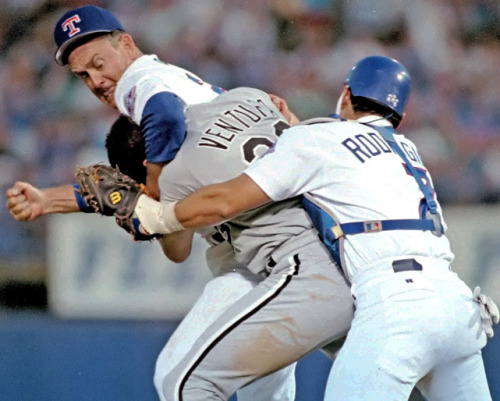
Before coming to the media capital of the world, Robin Mark Ventura had already been in the media spotlight on a number of occasions. Sometimes the attention was positive (Ventura set an NCAA record at Oklahoma State University with his 58-game hitting streak in 1987) and sometimes he was getting a noogie from future Hall of Famer Nolan Ryan.
But one thing was for certain. Robin Ventura was a complete player. In ten years with the White Sox, Ventura had six seasons of 90 or more RBIs, surpassed 20 homers five times and hit over .280 in five different campaigns. He was also an outstanding defensive player, winning five Gold Gloves as a member of the White Sox. Although Edgardo Alfonzo was a good player at the time, he had never hit as many as 20 HR or collected as many as 80 RBIs. He had also never been rewarded with a Gold Glove Award in four years with the Mets. Robin Ventura had accomplished all of those feats prior to becoming a Met. And in 1999, he was on a mission to accomplish the trifecta again.
In his first year in New York, Robin Ventura wasted no time getting acquainted with National League pitching. The Mets' new third baseman hit .375 with five extra-base hits (three doubles, two homers) and 11 RBIs over his first ten games. His torrid start put him among the league leaders in RBIs and made him one of the few players in Mets' history to reach 20 RBIs in a season before the end of April. (In 1994, Jeff Kent set the franchise record for RBIs in April with 26.)
But once April turned into May, Ventura suffered his first slump as a Met and the team soon followed. After defeating the Astros on May 3, the Mets' record stood at 17-9. The team then went on to lose 19 of their next 28 games to fall below the .500 mark at 27-28. During the month-long meltdown, Ventura batted only .240, dropping his season average to .268. Although he still managed to hit eight doubles and five home runs during the 29-game stretch, he began to strike out more often, whiffing 27 times in 100 at-bats.

After the dismissal of Apodaca, Robson and Niemann, Valentine famously stated that if the team didn't do well over the next 55 games, then he should also be relieved of his managerial duties. Wanting to save his manager and the team's season, Robin Ventura went on a hitting tear, beginning with the Mets' 7-2 victory in the Subway Series finale against Roger Clemens and the Yankees. In that game, Ventura collected two hits and scored two runs off Clemens, as the Mets handed him his first regular season loss in over a year.
The victory over the Yankees put the Mets back on track, as they went on to go 40-15 over their next 55 games, saving Valentine his job. There were very few players in the National League as hot as Robin Ventura was over the two-month stretch. From June 6 to August 6, Ventura batted .337 with 11 doubles, 16 HR and 48 RBI. He also had a .405 on-base percentage and cut down on his strikeouts dramatically, fanning only 29 times in 223 plate appearances.
The Mets were finally cooled down with a loss to the Dodgers on August 7 (a game the Mets' third baseman didn't start), but Ventura's bat continued to smoke. From August 8 to September 6, Ventura batted .366, lashed 13 extra-base hits (eight doubles, five homers) and drove in 22 runs. On September 19, the Mets defeated the Philadelphia Phillies, 8-6, with Ventura driving in the game-tying run in the fifth inning. The win upped the Mets' record to 92-58 and left them one game behind the Atlanta Braves for the NL East lead. It also gave them a four-game lead over the Cincinnati Reds for the wild card, who had lost that day to the Pittsburgh Pirates. With 12 games to go in the regular season, the Mets weren't thinking of the wild card. They wanted to dethrone the Atlanta Braves, who had won eight consecutive division titles. But things have a tendency to change quickly in baseball, and over the final two weeks of the season, the Mets found out just how true that adage was.
The Mets had a seemingly comfortable lead in the wild card race with 12 games to go. But then the Mets embarked on a seven-game losing streak. At the same time, the Reds won seven out of eight games. With three games left in the regular season, the Braves had already clinched the division title and the Mets were now chasing the Reds and the Astros in the wild card race, as both teams were tied atop the National League Central division with identical 95-64 records. At 93-66, the Mets were two games out with three games to go. Their season was in jeopardy of ending prematurely for the second straight year. But with one swing of Robin Ventura's bat, the team began to believe in themselves again.
On October 1, the Mets began a three-game series against the Pittsburgh Pirates, basically needing to sweep the Bucs and hope for outside help to have any chance of winning the wild card. The Mets took an early 1-0 lead on Robin Ventura's 32nd homer. But the Pirates came back and tied the game, sending it into extra innings. After reliever Pat Mahomes escaped a two-on, one-out jam in the 10th inning, he retired the Bucs in order in the 11th. In the bottom of the 11th, the Mets put a runner on second base with one out. After an intentional walk to Edgardo Alfonzo and a groundout by John Olerud, the Pirates decided to walk Mike Piazza to load the bases for Ventura, hoping that southpaw reliever Scott Sauerbeck would retire the lefty-swinging Ventura to end the inning. The inning did end, but not the way the Pirates wanted, as Ventura lined Sauerbeck's second pitch to right-center for a game-winning single. As an added bonus, the Astros and Reds both lost to the Dodgers and Brewers, respectively. The Mets were now one game behind Houston and Cincinnati for the wild card, and Shea Stadium was ready for an epic final weekend.
 Going into the season's penultimate game, the Mets already knew that the Astros had won and the Reds had lost. Houston was now leading the National League Central by a game over Cincinnati. The Reds' loss meant that the Mets were one win away from tying them for the wild card lead. Rick Reed was tabbed to start the game on October 2 and pitched the game of his life, striking out 12 Pirates and allowing no runs. However, Bucs' starter Francisco Cordova was matching Reed zero for zero throughout the first five innings. All that changed when the Mets came to bat in the sixth inning. The Mets needed some mojo risin' and they needed it fast. Up come Robin Ventura to provide the Mets with all the mojo they would need.
With two men on base, Ventura ripped a double down the right field line, plating the Mets' first run of the game. The Mets scored another run in the inning and added five insurance runs in the eighth inning en route to a 7-0 victory over the Pirates. The season had come down to Game No. 162, with the Mets and Reds tied for the wild card lead. Ventura went 1-for-4 in the series finale against the Pirates and was on deck when Mike Piazza watched Brad Clontz's wild pitch bounce over the backstop in the ninth inning, scoring Melvin Mora from third base with the winning run and setting off a wild celebration at home plate in front of the Shea faithful. Despite the thrilling ending, the Mets could not pop the champagne at home, as the Reds defeated the Brewers that night after a long rain delay, setting up a one-game playoff at Cinergy Field the following night.
Needing one victory to secure their first playoff berth in 11 years, the Mets got off to an early lead, compliments of Edgardo Alfonzo's two-run homer off Reds' starting pitcher Steve Parris. In the third inning, Robin Ventura collected his 120th RBI of the season, drawing a bases-loaded walk from reliever Denny Neagle to give the Mets a 3-0 lead. Ventura would reach base two more times in the game, but by then, Mets' starting pitcher Al Leiter had deflated the Reds' bubble, as the Mets went on to win the game and the National League wild card berth, advancing to the NLDS to play the NL West champion Arizona Diamondbacks.
Although Ventura hit only .214 against the Diamondbacks in the series, he found other ways to contribute. In Game 1, it was Ventura who led off the ninth inning with a single off Randy Johnson. What made the hit so incredible was the fact that Johnson had allowed a mere nine hits to left-handed batters over the entire 1999 regular season. Five batters later, Edgardo Alfonzo hit the go-ahead grand slam off reliever Bobby Chouinard to give the Mets an 8-4 lead, a lead that held up in the bottom of the ninth when Diamondbacks' shortstop Hanley Frias popped out to (you guessed it) Robin Ventura to end the game. The Mets split the next two games before winning Game 4 at home to take the series, with Ventura contributing a double and a walk in the deciding game. Despite his low batting average in the NLDS, Ventura reached base seven times (four walks, three hits) for a .389 on-base percentage.
In the NLCS, Ventura struggled at the plate, taking oh-fers in each of the first four games. Ventura didn't get off the schneid until the 11th inning of Game 5, when he singled for his first hit in 17 NLCS at-bats. Although that hit has long been forgotten, his next hit in the NLCS will always be remembered. Four innings after his 11th inning single, Ventura lashed another single, although this one carried over the right field wall. The famous Grand Slam Single gave the Mets a 4-3 victory and sent the team back to Georgia for a Game 6 showdown against the Braves.

Ain't life grand?
Unfortunately, the Mets could not force a seventh and deciding game in Atlanta, but Robin Ventura tried his best to get the Mets to Game 7. With the Mets down 5-0 in the sixth inning, Ventura was on deck when Mike Piazza hit a sacrifice fly to plate the Mets' first run. Ventura then doubled to right field off Braves' starter Kevin Millwood and scored on Darryl Hamilton's two-run single. The Mets had cut the Braves' lead to 5-3 and eventually sent the game into extra innings. But the magical run ended in the bottom of the 11th inning, when Kenny Rogers walked Andruw Jones with the bases loaded.
Despite hitting a combined .154 (6-for-39) during the Mets' ten-game postseason run in 1999, Robin Ventura provided some of the timeliest hits for the Mets against Arizona and Atlanta. Ventura was nothing but clutch for the Mets in 1999. For the season, he set career-highs in batting average (.301), slugging percentage (.529), on-base plus slugging (.908), hits (177), doubles (38) and RBIs (120). The Mets' third baseman also added 32 homers, scored 88 runs and won his sixth Gold Glove Award. (He also was prominently featured as part of Sports Illustrated "Best Infield Ever?" story.) For his efforts, Ventura finished sixth in the National League MVP vote, finishing just ahead of teammates Mike Piazza (7th) and Edgardo Alfonzo (8th).
The 2000 Mets were expected to build upon their success from 1999, with Robin Ventura being one of the key contributors. Although the team did well in 2000, winning their fourth National League pennant, Ventura did not perform as expected in his second season in New York. Ventura played in 85 of the team's first 87 games, but only batted .235 with 17 doubles, 16 HR and 53 RBIs. He was then placed on the disabled list with a bruised right rotator cuff and missed the next 14 games. Upon returning, he did even worse, batting .227 with six doubles, eight HR and 31 RBIs over his final 56 games. His final numbers in 2000 (.232, 23 doubles, 24 HR, 84 RBI, 61 runs scored in 141 games) were a far cry from what he produced in 1999. (In fact, Ventura's only positive contribution to the 2000 Mets might have been his one-man performance in Rain Delay Theatre at Yankee Stadium.) In the postseason, Ventura's batting average continued to suffer, as he hit .167 in 14 postseason games for the Mets in 2000. He also failed to reach base in any of his last nine plate appearances against the Yankees in the World Series.
Ventura's 2001 campaign was more of the same. Although his batting average went up slightly to .237 (still nowhere near the .301 average he produced in 1999), Ventura's power and run production continued to suffer. In 142 games, Ventura hit 20 doubles and 21 HR, but only collected 61 RBIs. He also struck out 101 times, which was only slightly lower than his hit total (108). The 108 hits represented a career-low for Ventura over a season in which he played at least 100 games. Unlike the 2000 season, in which the Mets made the playoffs despite Ventura's subpar campaign, the Mets barely finished above .500 in 2001. As a result, the Mets decided that they needed to shed their third baseman's high salary and move in a different direction. They did just that when they dealt Ventura to the Yankees for David Justice, who was then traded a week later to Oakland for pitchers Mark Guthrie and Tyler Yates.

Robin Ventura wasn't all about his bat. He may have been better with his glove.
Despite only having one outstanding season with the Mets, Robin Ventura is still a beloved figure in New York. He was an outstanding defensive third baseman during his three years in Flushing and provided many memorable moments for the team, although most of them came during their magical 1999 campaign. Ventura is now managing the Chicago White Sox, the team for which he played the majority of his professional career. But no matter what he does in Chicago, Ventura will always have 1999, a season that started out so innocently, but ended with a new Mets legend being born.
From his doubleheader grand salamis in May to his torrid two-month stretch in the summer of '99 to "The Best Infield Ever" to the Grand Slam Single, Robin Ventura was in the middle of many great moments during one of the most memorable seasons in Mets history. He may not have had the best Mets career, but for one season, he was in the center of it all. It's no wonder that that one season turned him into the Mets legend that he now is.
Note: One Season Wonders is a thirteen-part weekly series spotlighting those Mets who had one and only one memorable season in New York. For previous installments, please click on the players' names below:
January 2, 2012: Bernard Gilkey
January 9, 2012: Terry Leach
January 16, 2012: George Stone
January 23, 2012: Roger Cedeño
January 30, 2012: Frank Viola
February 6, 2012: Joe Christopher
February 13, 2012: Dave Magadan
February 20, 2012: Pedro Martinez
February 27, 2012: Bret Saberhagen