Sabtu, 10 Desember 2011

Ex-Mets Come Out On Top At Winter Meetings

Earlier this week in Dallas at the Late Fall Meetings, the Mets came away with three new relief pitchers and a new centerfielder.  They made a trade to acquire centerfielder Andres Torres and reliever Ramon Ramirez from the Giants, and signed free agents Jon Rauch and Frank Francisco to close out games.

The Mets weren't the only team to wheel and deal in Dallas.  In fact, it seemed as if every transaction involved a former Met.  So which former Met left Dallas with the biggest smile on his face?  You may be surprised when you hear the answer.  Let's run through the list of former Mets who were involved in transactions since the beginning of December.  (Players listed alphabetically)

  • Rod Barajas (one year, $4 million from Pittsburgh)
  • Heath Bell (three years, $27 million from Miami)
  • Chris Capuano (two years, $10 million from Los Angeles)
  • Octavio Dotel (one year, $3.5 million from Detroit)
  • Jose Reyes (six years, $106 million from Miami)

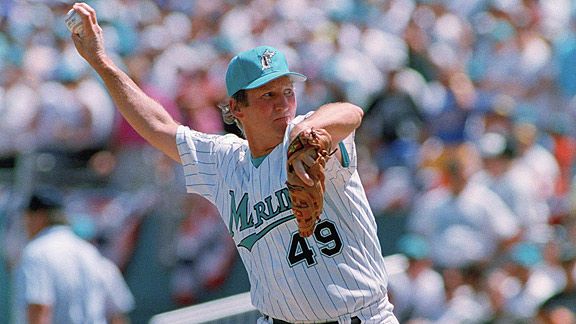
All of those former Mets will be counting their millions all the way to the bank, but none of them has as big a smile on his face as another former Met.  So tell me, my fellow Mets fans, do you remember Jerry DiPoto?

That, my friends, is ex-Met Jerry DiPoto.  Please don't all say "who dat?" at the same time.


Jerry DiPoto came to the Mets in a trade conducted during the 1994-95 players strike.  The Cleveland Indians sent DiPoto, along with fellow pitchers Paul Byrd and Dave Mlicki to the Mets in exchange for outfielder Jeromy Burnitz and pitcher Joe Roa.

DiPoto pitched two seasons for the Mets, going 11-8 with a 3.98 ERA.  His line in 1996 was one of the oddest in baseball, as DiPoto had a sky-high 1.76 WHIP (allowing 136 baserunners in 77.1 innings), yet he finished the season with a 7-2 record.  Of course, that's what happens when the runs you give up belong to somebody else, as DiPoto allowed 18 of 38 inherited baserunners to score, with none of those runs being charged to him.

So why would Jerry DiPoto, a man whose pitching career ended in 2000 at the age of 32, have the biggest smile on his face coming out of this year's Late Fall Meetings?  Perhaps that has something to do with his current job as the general manager of the Los Angeles Angels of Anaheim in Orange County near Disneyland.

After only four months as a general manager in the major leagues (two and a half months with Arizona in 2010 and six weeks with Los Angeles/Anaheim/Orange County/Disneyland), DiPoto made the biggest splash at the Late Fall Meetings, signing future Hall of Famer Albert Pujols to a ten-year, quarter billion dollar contract and top free agent starting pitcher C.J. Wilson to a five-year, $77.5 million deal.  DiPoto did all this despite being on the job for less time than it took Steve Trachsel to throw a pitch with men on base (men that DiPoto would likely have allowed to score had he been a teammate of Trachsel's on the Mets).

No wonder Jerry DiPoto is smiling.  He just heard that the 1995-96 Mets player reunion was canceled.


Within a matter of 24 hours, the Angels signed the best hitter on the planet (no offense to Val Pascucci, but Pujols has surpassed him at the plate) and took away their division rival's ace starting pitcher.

The Texas Rangers, who had to deal with Pujols for seven games in last October's Fall Classic, will now have to face Pujols a minimum of 18 times per season over the next decade.  And they also won't have C.J. Wilson, who did not allow a hit to Pujols in six World Series plate appearances against him.  Instead, the Rangers will have to face Wilson with Pujols backing up his new teammate at first base.  All this is due to the swift dealings of Jerry DiPoto.

When Jerry DiPoto was a Met in the mid-'90s, he was a vulture on the mound, swooping in to record seven victories in 1996 despite not being adept at keeping runners off the basepaths.  Although he is no longer an active player on the field, DiPoto has become quite active off the field and he clearly still hasn't given up his vulture tendencies.  Just ask the St. Louis Cardinals, Texas Rangers and especially the Miami Marlins, who thought they had the right offers on the table for Pujols and Wilson until DiPoto swooped in and grabbed them away.

Many ex-Mets have had a December to remember so far.  But Jerry DiPoto has topped them all.  He played for Dallas (Green) when he was a Met in 1995 and 1996, then he went to Dallas (Texas) and played all the other general managers there by scoring the biggest free agent hitter and pitcher on the market.  It's no wonder Jerry DiPoto is the ex-Met with the biggest smile on his face.

Kamis, 08 Desember 2011

Where In The World Is Octavio Dotel?

When Octavio Dotel broke into the major leagues in 1999 as a member of the New York Mets, no one expected him to do much.  He had already pitched four seasons in the Mets' minor league system and was halfway through his fifth when he got the call to join the big club in late June.

Dotel ended up being a pleasant surprise for the Mets, going 8-3 as a spot starter and making the postseason roster as a reliever.  He was the winning pitcher in the "Grand Slam Single" playoff game and was supposed to be a future star for the Mets.

Then Mike Hampton became available.

Considering that Al Leiter, at age 33, was the youngest starting pitcher in the Mets' regular rotation in 1999, the possibility of adding a 22-game winner who was just 27 years old made Dotel expendable.  Hampton became a Met.  Dotel became an Astro.  It would not be the first time Dotel would switch teams.  In fact, with yesterday's news that Dotel signed a one-year deal with the Detroit Tigers, he has now become the player with the most changes of address in major league history.

When Octavio Dotel takes the field for the first time as a Tiger in 2012, it will be his 13th team in the major leagues.  That will break the record set by Mike Morgan in 2000 and tied by Ron Villone in 2009 and Matt Stairs in 2010.

What makes Dotel's accomplishment more amazing is that at age 38, he'll be playing for his 13th team at an age younger than Morgan, Villone and Stairs were when they made their first appearances for their 12th team.  Morgan was 40 when he pitched for Arizona in 2000, while Villone was 39 when he first took the mound for Washington in 2009.  Stairs was the elder statesman of the trio, making his first appearance for his 12th team (San Diego) at age 42.

Dotel wasn't as peripatetic when he was in his 20s.  After his trade from the Mets to the Astros following the 1999 season, he remained in Houston until 2004, when he was dealt to the A's at the trade deadline.  At the time, Dotel was 30 years old and had only played for two major league teams.  Since then, he's suited up for (take a deep breath) the A's, Yankees, Royals, Braves, White Sox, Pirates, Dodgers, Rockies, Blue Jays and Cardinals, finally winning a World Series ring for the first time in St. Louis this past season.

Is Octavio Dotel participating in the Cardinals' victory parade or is he just sitting on his moving van?


With his move to Detroit, Dotel will now be playing for his third American League Central team, following his short stay in Kansas City in 2007 and his two-year stint in Chicago (the only team for which he's played more than one season since leaving Oakland following the 2005 campaign).  The Tigers will also be his 12th team over the past nine seasons and sixth team since the beginning of 2010.

Dotel has played for at least two teams in every division in the majors except the American League West (Oakland is the only AL West city he's called home).  However, that might be due to the fact that the AL West is the only division in baseball that has fewer than five teams.  Don't worry.  Give him time.  He'll be in Texas, Anaheim (I refuse to call it Los Angeles) or Seattle soon enough.

Most players celebrate winning their first World Series by going to Disneyworld.  Octavio Dotel is celebrating his first title by going to his 13th team in Detroit.  Something tells me he shouldn't unpack his belongings upon arriving there.

Rabu, 07 Desember 2011

The Mets' Winter Meeting Transactions: Pros And Cons

The snow hasn't begun to fall yet, but we saw a flurry of activity yesterday for the Mets in the Late Fall Meetings (winter doesn't start for another two weeks, so the Winter Meetings are a misnomer).  The Mets needed bullpen help so they stocked up with three veteran relievers.  They also made a "change-of-scenery" trade, acquiring one centerfielder coming off a down year for another.

Let's take a look at what these three separate transactions will do for the Mets and what this will do for the team in 2012 and in the future.


Jon Rauch

Sandy Alderson made it clear that the Mets were in dire need of relief help.  He admitted as much when discussing how the team suffered in the pen after the trade of Francisco Rodriguez last July.  The hodgepodge bullpen featured a combination of inexperienced career minor leaguers and washed-up veterans, and the Mets blew many late inning leads because of it.  A change was definitely needed for the 2012 season.

In his first acquisition of the night, Alderson signed Jon Rauch to be the Mets' primary set-up man.  Before Pedro Feliciano led the National League in appearances for the Mets, that distinction belonged to Jon Rauch.  Rauch made 85 appearances for Washington in 2006 and followed that up with a league-leading 88 appearances in 2007.

His career has been a series of ups and downs since leaving Washington in 2008.  In parts of two seasons in Arizona (2008-2009), Rauch was 2-8 with a 4.87 ERA and 1.42 WHIP.  Then he went to Minnesota for 1½ seasons (2009-2010) and flourished with the Twins, going 8-2 with a 2.82 ERA and 1.28 WHIP.  He also racked up 21 saves as a temporary replacement for closer Joe Nathan.  Finally, as a member of the Blue Jays in 2011, Rauch had a subpar season (5-4, 11 saves, 4.85 ERA, 1.35 WHIP).  He missed time in August due to an emergency appendectomy and ended the season on the disabled list with torn cartilage in his right knee.
 
Pros:  Rauch is nicknamed "The Wookie" for his tall frame and sometimes resemblance to Chewbacca, instantly making him R.A. Dickey's best friend in the clubhouse.  He also has excellent control, walking only 28 batters over the last two seasons (in 109.2 IP) and possessing a career ratio of 2.7 walks per nine innings.

Cons:  Sometimes Rauch can be a little "wild in the strike zone", as evidenced by the 11 home runs he gave up last season in only 52 innings pitched.  Also, as seen in his career recap above, Rauch's performance has varied drastically from team to team.  He can be very good, as he was in Minnesota, or he can be maddeningly inconsistent, as fans of the Diamondbacks and Blue Jays can surely attest.  Will another change of scenery bring out the good Jon Rauch?


Frank Francisco

A teammate of Jon Rauch in Toronto last season, Frank Francisco has been a very consistent pitcher since 2008.  Over the past four seasons, his ERA has never been higher than 3.83 or lower than 3.13.  He has also given no fewer than 40 hits and no more than 49 safeties in each of the last four years, while allowing between 20 and 22 earned runs per season.  He has achieved this level of consistency despite having different roles from year to year. 


Francisco served as the set-up man in Texas in 2008, before saving 25 games as the Rangers' closer in 2009.  He went back to the set-up role for Texas in 2010, before becoming a closer for the Blue Jays in 2011, saving 17 games in Toronto.  Francisco will not be continuing his set-up man/closer roller coaster ride for the Mets in 2012, as Terry Collins has already anointed him as the team's new closer.

Pros:  Francisco is a fireballer who will rack up a ton of strikeouts, something that has not been a strength of the Mets' bullpen in recent years.  His 10.5 K/9 IP rate over the past four seasons is among the best in baseball.  Francisco has also proven that he can handle any relief role in the bullpen and finished the 2011 season strongly (1.37 ERA, 0.84 WHIP and held opponents to a .188 batting average after the All-Star Break).

Cons:  Although he is a strikeout pitcher, his strikeout rate has gone down slightly from year to year (11.8 K/9 IP in 2008, 10.4 K/9 IP in 2009, 10.3 K/9 IP in 2010, 9.5 K/9 IP in 2011).  His WHIP has also increased annually since 2009 (1.12 in 2009, 1.27 in 2010, 1.32 in 2011).

 
Angel Pagan traded for Andres Torres and Ramon Ramirez

After an outstanding second half in 2009 and a breakout season in 2010, Angel Pagan took a step back in 2011.  After managing to keep his batting average around .300 for most of '09 and '10, Pagan could only muster a .262 average last season.  He also had his lowest on-base percentage in four years as a Met (.322) and made too many questionable baserunning decisions.

Andres Torres had a similar situation to Angel Pagan in 2011.  Torres shocked everyone with his breakout 2010 season for the World Champion San Francisco Giants (.268 batting average, 43 doubles, 8 triples, 16 HR, 63 RBI and 26 SB in 139 games).  But he had a miserable follow-up campaign in 2011 (.221 batting average, 24 doubles, one triple, 4 HR, 19 RBI and 19 SB in 112 games), causing him to lose playing time once the Giants acquired Carlos Beltran from the Mets.

Ramon Ramirez had a shaky start to his major league career in Colorado, but has flourished since he left the Mile High city after the 2007 season.  In the four years since his departure from the Rockies, Ramirez has compiled a 2.77 ERA and a 1.22 WHIP, while holding the opposition to a .220 batting average.  But since becoming a Giant at the trade deadline in 2010, Ramirez has been one of the most unhittable relievers in the majors, compiling a 2.07 ERA, 1.09 WHIP and a .194 batting average against him.  He also didn't give up many long hits as a Giant, holding opponents to a .267 slugging percentage and allowing only two home runs to the 388 batters he faced.

Pros:  Angel Pagan for Andres Torres straight up would have been a bad deal, as Pagan is younger than Torres and even with a down season in 2011, still performed better than Torres did for the Giants.  The addition of Ramirez, a quality arm in the bullpen with an extended period of success, makes the deal more attractive.  Plus, Andres Torres can serve as a stopgap in center field until Kirk Nieuwenhuis is ready for the majors (hopefully by late 2012), similar to the way Rey Sanchez held shortstop warm for Jose Reyes until his call-up in 2003.

Cons:  The Mets acquired a centerfielder with 27 HR and 118 RBI.  That's not his total for one season.  That's what Torres has amassed in 1,423 major league plate appearances over parts of seven seasons.  Torres also has 4,444 plate appearances over 1,035 minor league games.  That means Torres has over three times as many plate appearances in the minor leagues as he has in the majors.  When a player who will be 34 by Opening Day can say that about his professional career, that's not something to be proud of.  It also doesn't say much about his ability to stay in the major leagues.  Pagan has a better chance of replicating his 2010 season than Torres has of doing the same.


We owe (the fans), we owe (the fans), so it's off to work we go!

The 2012 Mets improved themselves at the Late Fall Meetings by adding three quality arms in the bullpen.  Jon Rauch will be the primary set-up man and can be counted on to pitch as many days as he is needed.  Frank Francisco may not have dominant numbers, but he has been a model of consistency over the past four seasons and is a legitimate strikeout pitcher.  Ramon Ramirez has the potential to be the best reliever in the Mets' bullpen.  He doesn't depend on the strikeout to retire batters.  Rather, he makes opposing hitters swing at his pitch, and allows mostly singles when he does give up hits, which over the past few seasons has become a rare sight.

I can deal without Andres Torres in the outfield, but at least he does possess some speed, which the Mets will need now that Jose Reyes is no longer on the team.  Plus, there's always a chance that he might be able to find some of that 2010 magic in his tank, although is .221 average and 19 RBI in 398 at-bats last year reminded me a little too much of Luis Castillo.

For now, it appears that Sandy Alderson is trying his best to mold this team in his image.  He is getting quality players without spending top dollar or too many years of commitments.  It's still too early to know what this will mean for the 2012 Mets.  But at least it shows that it won't just be 20 Buffalo Bisons and a handful of veterans sitting in the dugout at Citi Field next season.  For the amount of money Sandy has to play with, I'd say he's doing a pretty good job.

Selasa, 06 Desember 2011

Joey's Soapbox: My Connection To Jose Reyes

Greetings, Mets fans.  This is Joey Beartran reporting, although I have to say that I am too distraught to get up on my soapbox today.  As you already know, Jose Reyes has traded in his orange and blue duds for a Miami Marlins' Skittles-colored jersey.  It's a day I never expected to see, and one that I'm having a tough time accepting.

It's not because I'm upset that Reyes remained in the NL East, where the Mets will see him for 18 games per season.  It's also not because the Mets lost their leadoff hitter and shortstop, replacing him at those positions with Angel Pagan and Ruben Tejada, respectively.

My tough time accepting the loss of Jose Reyes goes back to the day I was born.  Please allow me to explain.

I'll always be connected to Jose, and not just through an internet connection.


On June 20, 2004, my future colleague at Studious Metsimus saw me sitting up on a display in the Mets Team Store located behind home plate at Shea Stadium.  I was dressed in the gray Mets hoodie you're used to seeing me in, surrounded by... nothing ... I was the last Mets bear of my kind in the Team Store.  From my vantage point, I could see outside the windows of the store, but I couldn't see the field, even with my proximity to home plate.  Therefore, I had yet to see Jose Reyes play.

It was Father's Day and my future colleague decided I should come out from behind the window and see my first Mets game in person.  So he paid $25 for the right to take me off the display (I don't come cheap) and we went up to our seats in the mezzanine.

That weekend was special for other reasons in addition to it being my first Mets game after my "birth".  On Friday, June 18, the Mets held a ceremony to honor Mike Piazza for becoming the all-time leader in home runs by a catcher.  The following night, June 19, was Jose Reyes' first appearance for the Mets after spending the first two-plus months of the season on the disabled list.  I wanted to see Reyes so badly, being that I was not "alive" for his rookie season in 2003.

Do you know how much of a fan of Reyes I was?  I told my colleague once we left the Team Store on June 20 that my name was Jose (even though we all know it's Joey).  Reyes did not lead off for the Mets that day.  That honor went to Kaz Matsui, who was also playing shortstop for the Mets at the time, with Reyes manning second base.

The game between the Mets and the Tigers was scoreless through three and a half innings.  Jeremy Bonderman was pitching beautifully for the Tigers, taking a no-hitter into the bottom of the fourth.  Then Jose Reyes came to bat to lead off the inning and everything changed, both for me and the Mets.

Reyes worked a seven-pitch walk to start the inning.  After Bonderman struck out Mike Piazza and Cliff Floyd, he faced the dangerous Richard Hidalgo.  Hidalgo had just been acquired by the Mets from the Astros prior to the weekend series against Detroit and was familiarizing himself with Shea Stadium.  Prior to his fourth inning at-bat, Hidalgo had gotten off to an 0-for-8 start as a Met.  But in none of those eight at-bats did Hidalgo come up with Reyes on base.  That was not the case in this at-bat.

With Reyes bouncing back and forth off first base, Bonderman started to become frazzled.  He threw several times to first baseman Carlos Peña with Reyes getting back safely each time.  Finally, after throwing a strike to Hidalgo, Bonderman grooved a pitch that Hidalgo hit over the fence for his first home run as a Met.  Without question, it was Reyes' nerve-jangling dance off first base that caused Bonderman to change his approach on the mound.  I had just seen firsthand what a dynamic player Reyes was, how he could change a game by getting into the mind of the opposing pitcher.

 I idolized Jose Reyes so much that I'd slide into second base head-first like he would.


It was the beginning of a love affair with Jose Reyes that took me to the highest highs (the 2006 playoffs) and the lowest lows (any of his ten million trips to the disabled list).  Ever since Father's Day 2004, I followed everything Reyes did.  I cheered when he moved back to shortstop after Art Howe's ill-advised decision to move him to second base in 2004 failed miserably.  I cringed when Jerry Manuel tried to bat him third in the lineup in April and May 2010.  I was confused when Jose took himself out of the lineup after collecting a bunt base hit in the team's final game of the 2011 season, then elated when he won the batting title later that night.

But alas, that bunt hit was the last time I'd see him in a Mets uniform.  It would be the last time anyone would see him wearing the only major league uniform he had ever worn.

Jose Reyes is now a Miami Marlin.  It doesn't seem right, does it?  I didn't know who the Mets' shortstop was before Reyes played his first game in 2003 or who wore No. 7 last before it became synonymous with Reyes.  It didn't matter to me that Rey Sanchez manned the position prior to Jose's debut or that Jason Phillips wore No. 7 for 11 games in 2002.  It was all about Jose Reyes for me.

Now he's gone.

I named myself Jose after my "birth" because I wanted to be like No. 7 on the Mets.  He was the future of the team but he was right there in front of me in the present.  He was flashy, energetic and he played with such a love of the game, it was hard not to love him.

I will still be a fan of Jose Reyes.  After all, it's hard to give up on something once you've had a connection with it for your entire lifetime.  But that connection will never be the same for me.  It won't be the same when I see Ruben Tejada start a double play.  Whenever Angel Pagan wipes dirt off his pants after stealing a base or legging out a triple, no one will start singing "Jose, Jose, Jose, Jose".

It'll be quite difficult for me at Citi Field in 2012.  As always, I'll root for the name on the front of the jersey instead of the one on the back.  But when the Marlins come to town and I see the name "REYES" on the back of their leadoff hitter's jersey, a mountain of memories will flood my mind.

Jose Reyes and I will always have a special bond, going back to the day we first met on June 20, 2004.  The Mets won that game against the Tigers, but I feel like I won by getting to see him play for as long as I did.  Guess that's a connection that'll never break.

Senin, 05 Desember 2011

Song Parody: It's So Hard To Say Goodbye To Reyes Today

Everyone is talking about Jose Reyes' departure from the Mets today.  From this piece at Kiner's Korner to this one at A Gal For All Seasons to this other one at Mets Merized Online, bloggers from all over Mets-ropolis are waxing nostalgic about the Mets' former shortstop.

Former shortstop.  Those are words reserved for Rey Ordoñez, Mike Bordick and Kaz Matsui.  They're not words we ever thought we'd use for Jose Reyes.  But now it's a reality.  Jose Reyes is no longer a Met.

Usually, the purpose of a song parody is to poke fun at something Mets-related, hence why I've written more parodies on Oliver Perez than anyone else.  But today, I'd like to bring it down a notch.  Two decades ago, when Jose Reyes was still in grade school in the Dominican Republic, Boyz II Men had a hit with their poignant ballad, "It's So Hard To Say Goodbye To Yesterday".  That song couldn't be more appropriate for the way many Mets fans feel about this sad day.

So let's pause for a moment to reflect on our former shortstop (sigh...former...) as we sing "It's So Hard To Say Goodbye To Reyes Today":


How do I say goodbye to who we had?
The shortstop who smiled and laughed
Will not be back.

I thought he'd be here forever
But Jose has gone away.
It's so hard to say goodbye to Reyes today.

I don't know who will show at once-filled Citi Field.
All I know is that we've been
Always behind you.

If we're competitive tomorrow
I hope it's worth losing Jose.
It's so hard to say goodbye to Reyes today.

And I'll take the speedy memories
His beaming smile and his energy.
It's so hard to say goodbye to Reyes today.

And I'll take the speedy memories
(Take with me those memories)
His beaming smile and energy.
It's so hard to say goodbye to Reyes today...


Broken News: The Two Hours Before Midnight Massacre

Welcome to the latest edition of Broken News, where someone else breaks the news and then we break it some more.  Broken News might be the perfect title for what I'm about to say because fans of Jose Reyes feel like their hearts have been broken this morning.

A little over two hours before midnight, it was revealed that Jose Reyes decided to accept the Marlins' latest contract offer of six years and $106 million to leave the only team he'd ever known.  I'll let that sink in before I continue...

 Sigh...

...I know.  It'll never sink in.  Soon he will take his physical, pass it and appear before the Miami media (which probably outnumber the true Marlins fans in South Florida - the ones who still proudly wear their Charlie Hough Marlins jerseys to games).

Gone will be the legs that produced 1,300 hits, 99 triples, 370 stolen bases and the only batting title in franchise history.  Replacing him at shortstop will be Ruben Tejada, who shows promise defensively and is very good at working the count.  That being said, this is the equivalent of replacing Tom Seaver in the rotation with Pat Zachry, who was also a promising young player in 1977 coming off a Rookie of the Year campaign with the Reds.  Pat Zachry was no Tom Seaver.  He was barely better than Nino Espinosa, but Nino rocked his afro better.  Ruben Tejada might not be able to rock anything, other than an occasional double or two that might hit the moved-in walls at Citi Field on three hops.

None of this is Ruben Tejada's fault and fans should not expect him to replace Jose Reyes' production on the field.  Similarly, no one should boo Angel Pagan if he's not the leadoff hitter Reyes was.  However, those two players will probably be heckled when they go through a slump, prompting the 7 Line to create "Bring Back Reyes" T-shirts and placards for display at an empty Citi Field.  (Note to the 7 Line:  If you do create "Bring Back Reyes" shirts, can I have one for free for giving you the idea?)

The Marlins are giving Jose Reyes $106 million for the next six years.  That's more than the Mets are willing to commit to every player on their roster in 2012.  The average annual value of nearly $18 million is more than the $15 million the Marlins spent on their entire 25-man roster in 2006, which coincidentally was the last (and only) time Jose Reyes played in the postseason.

 Double sigh...

You might say that $106 million is too much to pay for a player who'd been on the disabled list in each of the last three seasons.  You might also say that six years is too much for a player whose game depends on his legs, especially one who will still be earning $18 million annually when he's in his mid-thirties.

But one thing is for sure.  Jose Reyes was a dynamic player, one who could change a game like no other player on the Mets could.  The Marlins noticed that and were willing to take a risk, one that might bite then in the end, but for now makes them a far better team than the one that finished in last place in the NL East in 2011.

The Mets never had a chance.  And the way things look now, they're not going to have a chance in the NL East for years to come.  Last night, the current generation of Mets fans lived through their version of the Midnight Massacre.  If the Marlins ripped the fans' hearts out in 2007 and 2008, then they took their souls last night when they acquired Jose Reyes.

It's always been hard to be a Mets fan in this town.  It just became harder.

Sabtu, 03 Desember 2011

Where Are The 2006 Mets Now?

Don't let the title mislead you.  This post is not meant to inform you on what members of the Mets' last playoff team are up to.  On the contrary, it's meant to show you why that team might not have been as good as we thought they were at the time.

A total of 49 players suited up for the Mets in 2006.  As of this writing, only four of those players played for the Mets in 2011.  Those players were Jose Reyes, David Wright, Carlos Beltran and Mike Pelfrey.  However, Carlos Beltran was traded to the San Francisco Giants in July and Jose Reyes might have played his last game as a Met, leaving Wright and Pelfrey as the only two members of the '06 NL East champions who stand to be Mets in 2012.

Let's put it this way.  If Wright and Pelfrey are the only players left come Opening Day 2012, that'd mean the 2006 Mets would have the same number of players on the 2012 team as they have on the DL.  That doesn't stand for disabled list.  That stands for deceased list, as Jose Lima (four starts in '06) and Geremi Gonzalez (three starts in '06) are no longer with us.

The potential for having only two players left out of 49 a mere five years after that team steamrolled their way through the 2006 regular season is unusual in baseball, even in this day and age when free agents leave their teams frequently.  The 1996 Yankees, a team that won a World Series ten years before the Mets failed to get to one, had more players left on their 2011 roster (Derek Jeter, Jorge Posada, Mariano Rivera) than the Mets might have next April on Opening Day from their 2006 team.

But contrary to what it appears to be, this post is not about the few players left on the team from the 2006 roster.  It's not just that most of the players from 2006 are no longer members of the Mets.  It's that these players are no longer in major league baseball, period.

Of the 49 players who played for the 2006 squad, only 14 played in the major leagues in 2011.  Of those 14 players, two of them finished the season in the minor leagues (Aaron F. Heilman, Lastings Milledge) and another (Chris Woodward) collected only ten at-bats in the majors after spending the majority of the season playing at the Triple-A level.

It would take longer for you to read the list of 35 players from the 2006 Mets who did not make an appearance at the major league level in 2011 than it did for Steve Trachsel to deliver a pitch to home plate when there were runners on base, but we're going to do it anyway.  Here they are, in alphabetical order, with their current whereabouts and/or statuses.

  • Brian Bannister (retired)
  • Chad Bradford (retired)
  • Carlos Delgado (retired)
  • Victor Diaz (out of majors since 2007; played in Mexico in 2011)
  • Mike Difelice (out of majors since 2008; managed Kingsport Mets in 2009 and 2010)
  • Pedro Feliciano (signed two-year deal w/Yankees in 2011; might never pitch for them due to injuries)
  • Cliff Floyd (out of majors since 2009; broadcaster for FOX Sports Florida)
  • Bartolome Fortunato (out of majors since 2006; played in Canada in 2011)
  • Julio Franco (waiting for Omar Minaya's call from San Diego)
  • Tom Glavine (retired in non-devastating fashion)
  • Geremi Gonzalez (R.I.P.)
  • Shawn Green (retired; on book signing tours for his new book)
  • Anderson Hernandez (played w/Astros' AAA team in 2011)
  • Orlando Hernandez (played w/Nationals' AA team in 2010, left the team to walk the Earth)
  • Roberto Hernandez (retired)
  • Jorge Julio (out of majors since 2009; bouncing around in Pittsburgh's minor league organization)
  • Ricky Ledee (retired)
  • Jose Lima (R.I.P.)
  • Paul Lo Duca (out of majors since 2008; serves as a horse racing analyst)
  • John Maine (left Rockies' AAA team in 2011; might be walking the Earth with Orlando Hernandez)
  • Eli Marrero (out of majors since 2006; serves as batting coach for Reds' rookie affiliate)
  • Pedro Martinez (retired 10 minutes ago)
  • Kaz Matsui (out of majors since 2010; played in Nippon Professional Baseball league in 2011)
  • Henry Owens (out of majors since 2007; suspended for HGH in 2009 and hasn't played since)
  • Oliver Perez (played w/Nationals' AA team in 2011; not good enough to make AAA team)
  • Royce Ring (played w/Mariners and Red Sox AAA teams in 2011)
  • Duaner Sanchez (out of majors since 2009; played in Mexico and Independent League in 2010)
  • Alay Soler (retired)
  • Kelly Stinnett (retired)
  • Steve Trachsel (retired)
  • Michael Tucker (out of majors since 2006; played for various independent teams since 2009)
  • Jose Valentin (out of majors since 2007; player-owner for Santurce Crabbers in Puerto Rican league)
  • Billy Wagner (retired)
  • Dave Williams (out of majors since 2007; last played professionally w/Nationals' AAA team in 2009)
  • Victor Zambrano (don't ask)

Aaron F. Heilman and Lastings Milledge both ended their seasons at the minor league level in 2011.  Chris Woodward was lucky to get a late September call-up.  That leaves only 11 players from the 2006 Mets who played exclusively in the major leagues in 2011.  One of those 11 players (Ramon Castro) only played in 23 games with the White Sox in 2011, missing the majority of the season due to a right hand fracture.

That leaves only Heath Bell, Carlos Beltran, Endy Chavez, Philip Humber, Guillermo Mota, Xavier Nady, Darren Oliver, Mike Pelfrey, Jose Reyes and David Wright as the only players from the 2006 NL East champions to play exclusively in the majors only five years after they were teammates on the Mets.

Most of the players from 2006 are either retired, dead or Victor Zambrano.  It's also stunning to note that a large number of players who were good enough to be part of a division winner in 2006 were no longer worthy of playing in the major leagues just five years later.

If you recall, both Pedro Martinez and Orlando "The Dookie" Hernandez were scratched from the postseason roster in 2006 because of injuries.  Neither pitched well after 2006 (we don't recognize Pedro's renaissance with the Phillies in 2009 because that would be saying something positive about a member of the Phillies, which is taboo here).

Also, for those who blame Beltran for the Mets' failure to advance to the World Series in 2006, let me remind you that he wasn't the only Met to strike out with the bat on his shoulders in the ninth inning of Game 7.  Before Beltran, Cliff Floyd took strike three as a pinch-hitter with the tying runs on base and nobody out.  That's the same Cliff Floyd who was too hurt to start any of the games in the NLCS after Game 1.

The 2006 Mets steamrolled their way through the 162-game regular season.  But that team was full of players who were either one injury away from ending their careers or no-names who had no business being in the majors.  What do you know?  Only five years later, a great number of those players have suffered career-altering injuries or haven't sniffed the major leagues since Shea Stadium was still around.

A winning team needs a mix of veterans to guide the kids along.  But the 2006 Mets depended too much on veterans.  Now, those veterans are no longer around, succumbing to injuries and Father Time.  That has forced players who are still kids themselves (see Reyes, Jose and Wright, David) to be the team leaders.  Given those facts, is anyone surprised that the Mets have now trudged their way through three consecutive losing seasons?